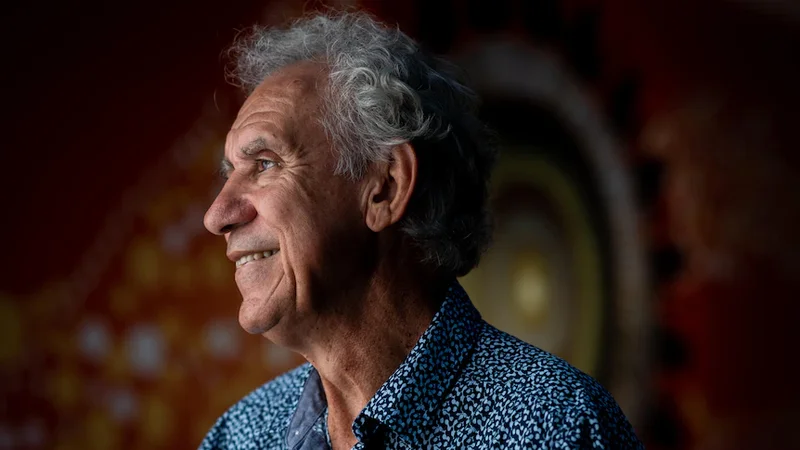
When British heavyweight boxer Anthony Joshua won gold at the Olympic Games in London, Charlie King sat in the Australian commentary box and pinched himself.
Aboriginal and Torres Strait Islander readers are advised that this article includes the name and image of an Indigenous person who has died, used with the permission of their family.
It was 2012, and the ABC broadcaster was making history himself as the first Indigenous broadcaster to commentate his second Olympics in a row.
"I was happy to announce that he won a gold medal — it was a big moment for me," Charlie says.
As he announced the athlete's win, Charlie had a "flashback" to his childhood, when he'd sit on father's feet and listen to the boxing on the wireless radio.
It's where his passion for sports commentating began.
"He would talk to the radio and say things like, 'What happened to him? Is he going to be okay?' and then he'd try telling me what he was talking about; I loved it," Charlie says.
"Watching Anthony Joshua walk out and stand in the middle of the ring as the gold medallist, I went back to that happening with dad and thought, 'Wow this is such a good moment, pinch yourself,' and I did."
The well-known ABC Sport and Grandstand broadcaster retired in May after more than 32 years with the public broadcaster in the Northern Territory.
During his time working across radio and television, the 75-year-old has commentated more than 600 matches for the NT Football League (NTFL), as well as broadcast two Olympic Games and two Commonwealth Games.
A premiership player with NTFL team Wanderers, Charlie also played a key role in coaching the NT's pioneering female footballers to their first national competition in 1990.
"They desperately wanted to play, and they weren't getting the support they needed back then — they couldn't even get an oval," he says.
'Tough area' of family violence advocacy
Everywhere Charlie goes in the Northern Territory, he is recognised and stopped for a chat.
He has used his large profile in the media to speak up on challenging issues, including the NT's scourge of family violence with the No More campaign.
"It was a tough area to work in because it's hard to measure success … you're also working with people who are violent, and they're angry and threatening," he says.
He credits his weekend work with the ABC for giving him the time to focus on his advocacy work during the week — a movement that would grow to see footballers link arms against violence.
For instance, he says he would suggest an outside broadcast at Nhulunbuy, and while he was there, he could engage with locals.
"I got to know people in those communities and the work I was doing in the No More campaign gave me an opportunity to talk to those people about things like family violence," he says.
The Gurindji man has received many accolades for his public-facing work, including an Order of Australia medal (OAM) and being named the NT's Senior Australian of the Year in 2019.
But it's been his advocacy behind the scenes with the ABC's Bonner Committee, which works with senior leaders at the public broadcaster to shape culture and recruitment of Indigenous staff, where he has felt his greatest responsibility.
"I wanted to say to Aboriginal people, 'I can do this, you can too'," he says.
"There are so many Aboriginal stories to be told.
"There's been important work to increase employment of Aboriginal staff, but the ABC still has more work to do — that's an observation, not a criticism."
'Be better, not bitter'
Charlie credits his mother's experience of being removed from her family at Limbunya Station near Kalkarindji during the era of the Stolen Generations for giving him a strong sense of social justice.
Born in Alice Springs in 1951, as the third of 11 children, Charlie has described feeling the sting of racism growing up, and says it was his mother who helped him push back on it.
"People don't know the damage of racism; it's a horrible thing," he says.
"She would say 'don't get bitter, get better', and I'd go and deal with it front-on and make a difference."
His one regret during his long broadcasting career was never getting the chance to hear his mother's full story about her childhood or to interview her before she died in 1984.
"I'm so sad to say that we got so close to having a sit-down conversation, which we didn't have," Charlie recalls.
"I called in to see her one day, on a Saturday … she walked with me to the car and she said, 'When are we going to have the talk?' and I said, 'I'll be back out on Sunday," and she passed away on the Saturday — I missed it."
Parkinson's disease Charlie's new challenge
As Charlie embarks on retirement, he faces his greatest challenge yet as he manages life with Parkinson's disease.
Diagnosed in 2025, Charlie says the condition has slowed down his movement somewhat, but not his drive to make a difference.
"I love people, I simply love people, I get on well with people, I need people," he says.
He credits his partner Jayne Lloyd and daughter Emma King for being his greatest supporters, and says patience is the number one gift a person can give to someone living with the disease.
"I'll be sitting in a conversation with three people, say, and they are talking and I want to make a comment," he explains.
"By the time I figure out in my mind what my comment is going to be, they have already moved on to two or three other topics, so you've got to be patient."
Charlie remains focused on the silver linings that retirement offers: weekends at home with family, saying yes to watching his grandchildren play footy and more hours in the day for his advocacy work.
"It's a slow disease, you know; it doesn't end your life quickly, it's very slow, so I still have a lot of time left and things to do," he says.
He signs off the ABC airwaves with a simple message to his huge following: live your best life.
"Every day counts — if you want to do something good, do it, don't wait until it's too late," he says.
"Don't wait until you pick up some disease that's going to strike you down quickly.
"Be a good person and stand strong and say no more to family violence."