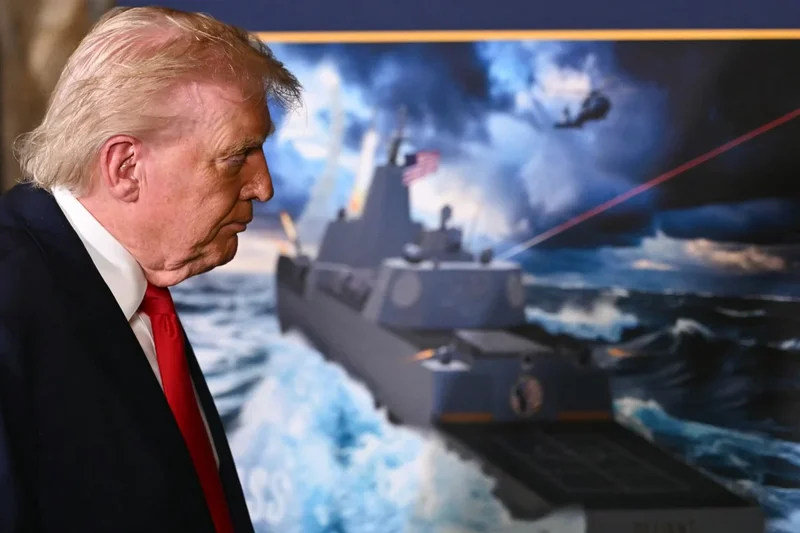
It could cost more than $455 billion to build President Trump’s planned “Golden Fleet” of Trump-class battleships, according to a new government estimate, dwarfing original cost estimates.
Building the first 15 ships in the program could total about $275 billion, according to data released Wednesday by the nonpartisan Congressional Budget Office.
However, the Navy hopes to eventually sail about 25 of the Trump ships, which could bring costs for the program north of $455 billion, angering Democrats such as Senator Jeff Merkley of Oregon.
“At a time when families are struggling to afford groceries, gas, health care, and child care, Congress cannot throw hundreds of billions of dollars at Trump’s ‘Golden Fleet,’ including plastering his name across a new battleship,” Merkley wrote in a statement on Wednesday.
Democrats are pushing to strip funding for the ships out of ongoing budget negotiations. They have pointed to blooming costs on the president’s other signature projects, such as the renovation of the Lincoln Memorial Reflecting Pool and the new White House ballroom.
“Trump couldn’t handle renovating a reflecting pool or building a ballroom,” Senate Minority Leader Chuck Schumer said on the floor on Thursday, calling the ships an unprecedented “vanity project.”
The first of the roughly 840-foot-long Trump ships would cost about $23 billion to build, with successive ships notching about $18 billion each. Initial military and outside estimates suggested the ships would cost between $9 billion and about $15 billion to build.
The president’s insistence that the ships be nuclear-powered has further driven up initial cost projections, the CBO found, though eventually nuclear-powered battleships could cost less because they don’t require conventional fuels.
The CBO also noted that building ships — which would boast numerous missile-launchers, a laser system and an electromagnetic railgun — would require delay-prone U.S. shipyards to more than double their output of large ships by 2035.
A Trump administration official told The Independent the CBO’s figures are only early-stage estimates that could fall once more information is available on the ship’s design, savings from their nuclear-powered propulsion and improvements to shipyard efficiency become clear.
The president, a naval history buff, unveiled the ships in December, promising they would be “100 times the force” of past vessels. At a launch presentation, Trump said he began considering a new class of battleships in his first term, wondering, “Why aren’t we doing battleships like we used to?”
Militaries are increasingly moving away from the ultra-large-scale battleships of early and mid-1900s wars, in favor of smaller, more nimble vessels, as well as drones and other high-tech weapons.
The Trump-class ships would be the largest combat ships in the world and larger than any surface ships built for the Navy since World War II, according to the CBO.
The Trump administration ousted Navy Secretary John Phelan in April, reportedly due to the president and Defense Secretary Pete Hegseth’s belief that he was not doing enough to build the “Golden Fleet.”
Trump has said the first two ships in the program could be built in about two-and-a-half years. The CBO pegs the figure at about eight years.
Outside experts are skeptical of the Trump plan.
“It will take years to design, cost $9 billion each to build and contravene the Navy’s new concept of operations, which envisions distributed firepower,” Mark Cancian, a senior adviser with the Center for Strategic and International Studies, wrote in December. “A future administration will cancel the program before the first ship hits the water.”
President Trump has a history of over-promising on costs and missing deadlines on his signature projects.
The Republican initially said his White House ballroom project would be privately funded and cost about $200 million. It is now projected to cost about $600 million, with substantial taxpayer funding.
Similarly, he initially claimed his Reflecting Pool project would cost about $1.5 million and be done in one week.
Work on the pool has now cost the government about $16 million and has stretched on for months.
The state of the U.S. fleet has been closely watched as the Navy has carried out an on-again, off-again blockade around the Strait of Hormuz as part of the Iran war.
In May, the USS Gerald R. Ford aircraft carrier returned to Norfolk, Virginia, from a nearly year-long deployment, the longest of any U.S. warship since the Vietnam War.
As it operated in hotspots such as the U.S. anti-drug campaign in the Caribbean and the war against Iran, the ship suffered a major fire, food shortage complaints and issues with the systems it uses to launch and catch aircraft.