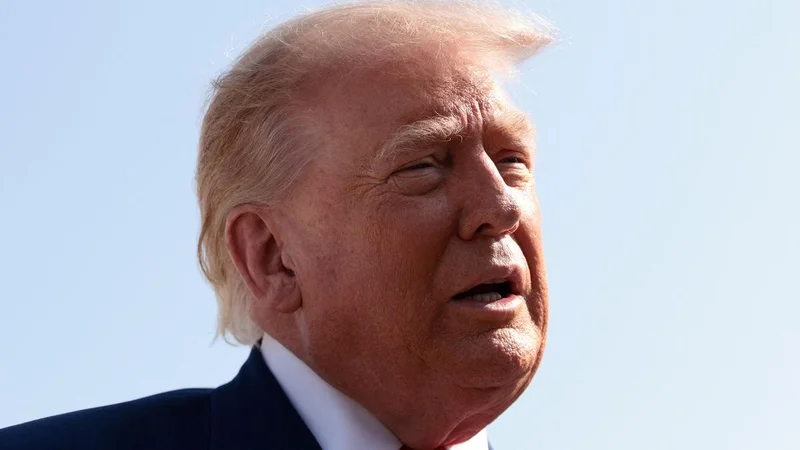
U.S. President Donald Trump. File
\| Photo Credit: Reuters
U.S. President Donald Trump has given generic pharmaceutical companies a two-year window to establish manufacturing facilities in the United States, warning that products imported after August 2028 could face tariffs of up to 200%.
The announcement, made on Wednesday (July 22, 2026) through a social media post, has significant implications for India, which sends more than a third of its pharmaceutical exports to the U.S. While Indian drugmakers sought to strike a cautious note, they warned that higher tariffs would ultimately increase medicine costs for American consumers.
Mr. Trump said the measure is intended to encourage generic drug production in the U.S. and reduce dependence on overseas supply chains.
“Effective August 1, 2026, all generic drugs being brought into the United States will continue to have a tariff of zero per cent for a two-year period of time, after which the tariff will be raised to 100% for a one-year period of time, and 200% thereafter,” he said. The policy, he added, is aimed at reshoring pharmaceutical manufacturing while preserving existing arrangements for patented and innovative medicines.
The announcement rattled pharmaceutical stocks. The Nifty Pharma index fell 1.31%, with 18 of its 20 constituent companies closing lower. Industry executives largely adopted a wait-and-watch approach, while reiterating that any additional costs would likely be passed on to consumers.
“It’s not practical to move operations like that to the U.S. overnight. If tariffs are imposed, we will have to raise prices,” said Dr. Reddy’s Laboratories Chief Executive Officer Erez Israeli. He added that the company was not planning any immediate changes and noted that policy positions could evolve over time.
According to the Global Trade Research Initiative (GTRI), India is among the countries most exposed to the proposed measure. India exported pharmaceutical products worth $25.8 billion in 2025, of which $9.7 billion, or 37.7%, went to the United States, its largest overseas market.
Indian firms account for nearly 47% of all generic prescriptions dispensed in the U.S., making India the largest supplier of affordable generic medicines. Despite this dominance, generics’ low pricing means India’s share of the value of U.S. generic imports is estimated at about 30%.
The U.S. imported pharmaceutical products worth $213 billion in 2025, including $94.1 billion worth of finished medicines sold in retail packs. GTRI founder Ajay Srivastava said many Indian generics could remain competitive despite the tariffs because they are significantly cheaper than branded alternatives. However, large-scale relocation of generic drug manufacturing to the U.S. would be challenging, given the industry’s reliance on global supply chains and imported active pharmaceutical ingredients.
Granules India Executive Director Priyanka Chigurupati said the company’s three U.S. facilities position it well to support increased local manufacturing. However, she cautioned that higher generic drug prices could ripple across the healthcare system and affect patient affordability.
Indian Pharmaceutical Alliance Secretary General Sudarshan Jain said Indian companies already have a substantial U.S. presence, with more than 40 facilities supporting jobs, manufacturing and research. India, he said, remains a trusted partner in supplying affordable, quality medicines to American patients.
GTRI added that building a fully domestic pharmaceutical supply chain in the U.S. would require significant investment and would almost certainly lead to higher medicine prices.
Pharmexcil Chairman Namit Joshi said the announcement provides welcome clarity. “The zero-tariff window through 2028 gives the industry a meaningful runway, and we see this as time we can use productively — to keep strengthening our position across multiple markets rather than relying on any single one.”
Published - July 22, 2026 10:13 pm IST