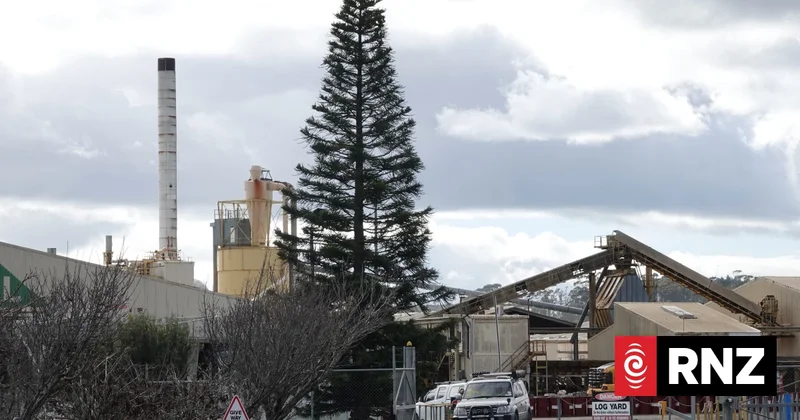
It's a shock and a disappointment that Kaitāia's Northland Mill will close down today - two weeks ahead of schedule, a union organiser says.
Marcus Coverdale, of Workers First Union, said he only found out about the decision late on Wednesday.
About 60 people had been employed at the mill, which produced wood veneer and was owned by Juken NZ.
The company still owned the neighbouring Triboard Mill, with 140 jobs, but the future of that plant was also uncertain.
Earlier this year, the company said it wanted to exit Kaitāia and put both mills on the market.
Coverdale said a skeleton crew had committed to keeping the Northland Mill operating until 21 August.
"So obviously it's a shock, but the workers themselves are a bit relieved that they don't have to carry on sweeping the floor and opening and closing the gates for the last times," he said.
"The mood was quite sombre. People are just ready to move on and start the new chapters in their life, moving next door or moving on to other opportunities."
There was some good news, with 10 older workers at the Triboard Mill opting for voluntary redundancy, opening up jobs for younger workers laid off at the Northland Mill.
Some still had 20 years of working life ahead of them, so they were "really grateful" for the opportunity.
Juken NZ had committed to paying staff out in lieu of notice, Coverdale said.
Workers would also receive a wage increase and backpay in their final pay calculations.
He was still hopeful a buyer could be found for the Northland Mill site.
"There's been rumblings there is an interested party looking to buy the site. It comes with the council consents, some of the materials and the machinery. But not attached to the workers or the employment."
Meanwhile, Coverdale said another interested party was due to tour the neighbouring Triboard Mill site on Friday - but it was not known if it was a serious buyer.
The Triboard Mill produced a manufactured wood product used in the construction industry and was one of the biggest employers in Kaitāia.
The flow-on effects of the Northland Mill closure would be felt in Northland long after the gates closed for the last time, he said.
"It's not just the 40-odd workers that are out on the street. It's the flow-on effect of those wages not being spent in the local community anymore. And also the smaller businesses that provided support, a lot of transport and maintenance companies are going to feel the pinch as well."
Juken NZ director Yasufumi Tsuchiya said redundancy payments for the Northland Mill workers were being made this week, with final pay, including entitlements through to 21 August, to be paid out next week.
He said 28 employees had secured ongoing employment with Juken NZ through redeployment and retention opportunities.
This included 19 staff who had accepted roles at the Triboard Mill.
A further six had agreed to remain temporarily to help with site maintenance and closure, with three of those likely to be redeployed into ongoing positions.
That left a total of 44 employees retiring or seeking new jobs.
Tsuchiya said employees continued to have access to help from the Ministry of Social Development, the Employee Assistance Programme, employment services and wellbeing support.
The company would host a job fair in coming weeks to help connect affected workers with potential employers.
While manufacturing had ended at the Northland Mill, Juken NZ was still exploring opportunities for the future of the site, including selling the land and associated assets.
The company was also continuing to explore selling the Triboard Mill as a going concern.
"Discussions remain ongoing, however no buyer has been identified to date," he said.
Tsuchiya acknowledged the "constructive engagement" of employees and union representatives throughout the closure process.