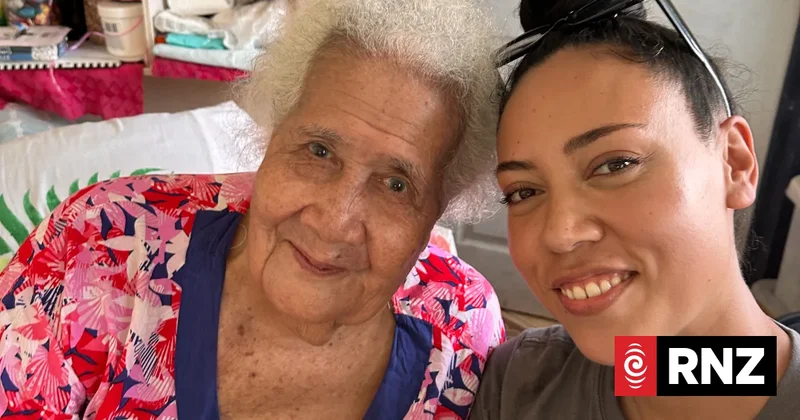
Pacific artist Olivia Foa’i's emotional journey back to her ancestral home in Tokelau
By Elena Pasilio, RNZ Pacific Tokelau affairs correspondent
Feature: In June of 2025, Olivia Foa'i boarded the MV Mataliki in Samoa bound for Fakaofo in Tokelau - a 24-hour voyage across a vast stretch of rolling Pacific ocean.
She was returning to her grandfather's homeland for the first time since childhood.
Although she had spent much of her life away, Fakaofo and Tokelau remained present through her family and the music of Te Vaka, the internationally recognised Pacific band founded by her father, Opetaia.
By the time of her return to Fakaofo, Foa'i was already an established Pacific artist in her own right.
She had travelled around the world with Te Vaka from a young age, before performing as a member of the band. Her vocals featured on the soundtrack of Disney's Moana, and she had released award-winning solo music, including songs recorded in the Tokelau language.
As the vessel departed Samoa, she smiled for a photograph beside the uncle travelling with her. The image captured the excitement she felt, but not the nervousness she carried about returning to a homeland that was very much a part of her identity, yet geographically distant from the life she knew.
"I was so nervous, anxious and excited," she recalled during a Zoom interview from her home in Australia in July.
When the MV Mataliki reached Fakaofo on 5 June last year, the Fakaofo passengers transferred onto the smaller barge that would carry them through the channel between the reefs towards Fakaofo's wharf.
And as the barge began moving towards Fakaofo, Foa'i pulled out her Super 8 camera and started filming. This would be one of her first acts on returning to the island, observing and recording the place that had lived in her imagination for years.
Through the camera, she captured the shoreline, the movement of the ocean and the birds flying above the atoll.
She later said the arch of their wings immediately felt familiar. It was a shape she had seen throughout her childhood in Te Vaka's artwork and designs, including the band's logo.
"I was like, 'Oh wow,'" she recalled. "The birds here in Australia don't have that arch in their wings. The shape is not the same."
One frame from those footages would later become the image behind her manu shirt - a visual connection between Tokelau, her family's creative legacy and her own experience of returning to Fakaofo.
But Foa'i was not returning with the confidence of someone who felt completely at home in the remote atoll. Her understanding of Tokelau had been shaped through several layers of distance and places.
Her father was born and raised in Alamagoto, a Tokelau community in Samoa where families from Fakaofo, Nukunonu and Atafu lived together. He later carried that identity with him to New Zealand and Australia, while Foa'i grew up between Auckland and Sydney.
She arrived in Tokelau, conscious that her Gagana Tokelau was limited and unsure of how she would fit into a culture she felt deeply connected to but had largely experienced from afar.
"There was a real humility in coming back and being like, 'Okay, I'm here. What happens now?" she said.
The uncertainty eased when she stepped onto Fakaofo and found that what awaited was not a test of how much language or cultural knowledge she held, but family willing to receive and welcome her.
"We can easily build it up (negatively) in our minds," she said. "But, then it's really beautiful and humbling to just arrive and be like, "Oh, it's fine. You're accepted. Just come as you are, try your best."
Returning as an adult also changed the way Foa'i saw the island she remembered from childhood.
"When I was younger, Fakaofo was so much bigger," she said. "And then going back as an adult, I was like, 'Wow, this place is much smaller than I remember.'"
But what stayed with her was not the size of the island. It was the time she spent with the elders in her family.
"To sit with them there, that will stay with me," she said. "That's irreplaceable."
She said their patience to listen as she searched for her words in the Gagana Tokelau and corrected her when she needed guidance was precious.
Another memory that remained vivid was a picnic trip to the outer islet of Fenualoa with her close relatives.
Leaving the main village of Fale behind, Olivia felt as though they had briefly stepped away from modern life. On Fenualoa, she watched as baskets and plates were woven from coconut leaves, coconut crabs were gathered and a fire was lit to cook the food.
"It almost felt like we left modernity back in Fale," she said. "It was maybe a little taste of what it could have been like before we had all these modern things."
The meal became one of her most memorable experiences of the visit. Through ordinary acts of gathering, preparing and sharing food, she was able to experience another side of Tokelau with her family.
She returned to the fast-paced life beyond the reefs of Fakaofo, but she took with her the experience many Tokelauans and Pacific Islanders living abroad long for - the chance to return to their ancestral homeland and reconnect with family, culture and place.
The trip to Tokelau has somehow brought some parts of her life into a full circle moment, because for the past almost 9 years, Olivia has also been working on a documentary about Te Vaka, tracing the journey of the band and the vision that drove her father, Opetaia, to take Pacific music to audiences around the world.
The idea came after the release of Disney's Moana in 2016.
Opetaia's work as a songwriter on the film brought him a new level of international recognition, but as Foa'i watched the attention surrounding him, she felt that many people were seeing only the success of that moment and not the decades of work that had come before it.
"People didn't understand," she said. "People didn't know the story."
She wanted audiences to know more about the man behind the music - his beginnings, his commitment to Pacific languages and storytelling, and the years he and the members of Te Vaka spent pursuing their vision long before Hollywood came calling.
"I felt like no one really understood the 20 years prior that brought him to this point," Foa'i said, "and why this moment was so important to the Pacific and why it was so important to him and his life's work."
With no previous experience making a documentary, she bought a camera and began filming her father, the band and the people around them - anyone who had anything to do with Te Vaka's journey.
"I was like 'I don't have any experience, but I wonder if I could tell it,'" she recalled.
What began as an attempt to document a defining moment in Opetaia's career soon became something more personal. Foa'i had grown up inside the Te Vaka story, travelling with her parents from a young age as they worked to build a dream and bring Pacific music to the world - she wanted to capture all that would tell this story.
"I did this so I could have something for the documentary, but also so I could understand my own family," she said.
The project eventually led Foa'i deep into her family's archives and in 2020, she spent countless hours digitising hundreds of MiniDV tapes recorded by her mother, Julie, from the band's early days as far back as the 90s.
And now, after almost nine years of filming, interviewing and digitising MiniDV tapes, Foa'i said the Te Vaka documentary is close to completion.
"I finally feel like I can express to people what my parents were trying to achieve with Te Vaka," she said, "and what it meant to get to where they got to."
In the Tokelau language, Te Vaka means the boat or canoe - a fitting name for a band built on carrying Pacific languages, rhythms and stories across oceans and onto stages around the world.