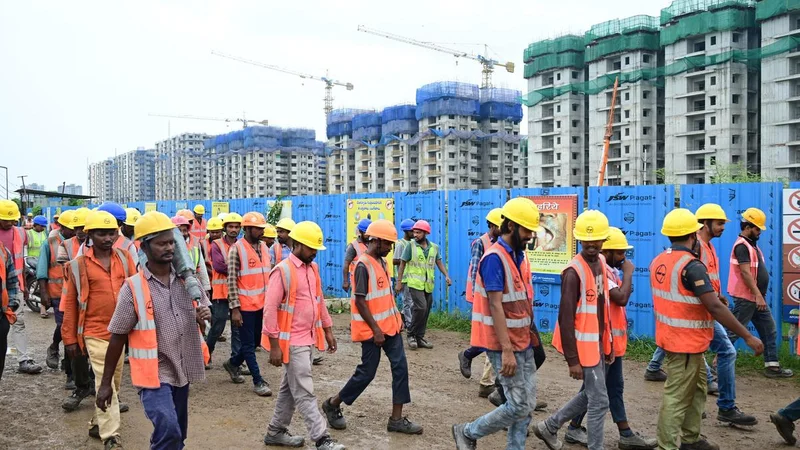
Cranes and earthmovers dominate Amaravati’s skyline as Andhra Pradesh’s greenfield capital, where towering government complexes and landmark infrastructure, takes shape. But behind the rapid construction is a quieter story of migrant workers, local communities, women exploring entrepreneurship and skill development opportunities, and the people whose lives are being transformed alongside the city.
Among the thousands of workers contributing to Amaravati’s transformation is 46-year-old Deepak Maiti from Purba Medinipur district of West Bengal, who has spent the past year amid cranes, concrete, and steel helping build the capital city.
Maiti is among 1,900 migrant labourers, mostly from West Bengal, Uttar Pradesh, and Odisha, engaged in constructing the sprawling multi-storied NGO housing project at Nelapadu village under Thullur mandal in Guntur district. His workday begins early and stretches for nine hours. Despite demanding schedule, thoughts of home are not far away. “My old mother awaits me back home. I visit her whenever possible,” he says softly.
As dusk settles over the workers’ camp, the atmosphere begins to shift. After a long day at the construction site, labourers gather around carrom boards and ludo games, sharing laughter and enjoying moments of camaraderie. Yet, conversations often drift back to families waiting thousands of kilometres away.
Maiti’s story is echoed by many others at the site, each carrying a similar tale of migration, sacrifice and hope. One of them is 35-year-old Indrabhan, a farmer from Bharatpur in Uttar Pradesh, who arrived in Amaravati four months ago in search of additional income, while the crop on his farm awaits harvesting.
“Like many seasonal migrant workers, I plan to return once the farming season demands my attention,” he says. On a lighter note, he adds that five fellow workers from his home State are also at the site. “I don’t feel out of place, and adapting to life in the camp has been easier,” he says.
Inclusivity
To make life away from home easier for these migrant workers, the contractor has put in place facilities to cater to their diverse cultural and daily needs. Separate kitchens and dining areas allow them to prepare meals according to their culinary preferences, while a grocery store within the camp stocks daily essentials, lending a sense of familiarity and routine to life far from home.
The camp site is equipped with bunk beds, sanitation facilities, safe drinking water, kitchens, dining halls, first-aid centres, CCTV surveillance, emergency response systems and recreational spaces for sports and weekend movie screenings.
Even with these facilities, the emotional burden of migration remains difficult to overcome. For 32-year-old Ramswamy from Odisha’s Rayagada district, separation from family remains the hardest part of life away from home. Having arrived in Amaravati six months ago in search of work, he left behind his wife and two young children, an eight-year-old son and a two-year-old daughter. After a long day at the construction site, one ritual remains non-negotiable. “I make video calls every day after returning to my room. Seeing my children refreshes my body and heart,” he says, a gentle smile lighting up his face. “The facilities here do not lessen the pain of separation from the family,” he adds.
Life at the site is not entirely defined by work and separation. Community celebrations, including birthday events, provide workers with relief from the rigours of construction.
Welfare at the camp extends beyond accommodation and recreation. ”Welfare measures complement a safety programme that begins even before a worker enters the site,” says Nilanchala Hotta, Occupational Health and Safety Manager at Larsen and Toubro, the multinational conglomerate company implementing the NGO housing project.
Highlighting the mandatory medical examinations, safety induction, and continuous training, Hotta says the project has recorded four million safe work hours while maintaining full compliance with environmental and social safeguard standards.
Beyond work
The scale of these measures becomes evident when viewed against the backdrop of Amaravati’s massive construction activity, stretching over expansive tracts of land. The rich alluvial plains, once known for their fertile agricultural fields nourished by the River Krishna, now bear the unmistakable marks of large-scale excavation and earthwork.
Every few kilometres, fleets of earthmovers, excavators, bulldozers, graders, dump trucks, and compactors dot the landscape, their steady movement underscoring the scale of activity under way. The roads tell the story of a city being built from the ground up. Traffic slows as signboards caution motorists with messages of “go slow”, “deep excavations in progress,” “heavy machinery at work,” and “construction zone ahead.”
Beyond the heavy machinery and construction sites, efforts have been made to support the families who have migrated with the workforce. Snaking around excavation sites will lead to a crèche set up at a labour camp in Thullur, where P. Swathi, the caretaker, is surrounded by nearly 30 children in the 3- to 10-year age group.
Bridging the language gap with the children is a challenge, shares Swathi, who is a native speaker. “I try to communicate with them in my broken Hindi,” she says with a sheepish smile and a shrug.
Caring for children is only one part of the broader social support system. Persuading mothers to send their children to the crèche is a difficult task, says Ch. Nithisha, a gender specialist deployed by the Social Welfare wing of the Andhra Pradesh Capital Region Development Authority (APCRDA). “Attendance remains an uphill task,” she adds.
Beyond childcare, efforts are also being made to address gender concerns, enhance safety, and create opportunities for women through dedicated welfare and empowerment initiatives. Describing her role, Nithisha says it entails preparing and implementing a Gender Action Plan, conducting awareness programmes, and providing training on gender issues and gender-based violence prevention.
She is also responsible for establishing grievance redressal mechanisms, supporting women’s livelihoods and entrepreneurship, and ensuring that the project’s benefits are inclusive, equitable, and responsive to the needs of women and vulnerable groups. “We have established Internal Complaints Committees at all levels of the projects,” she says, adding that she visits camps where women migrant workers live to see if they feel comfortable.
“Women take time to open up, and it is important to ensure their welfare while they work far away from their homes,” she says.
Bridging the gender gap
While migrant workers play a key role in Amaravati’s construction, the city’s development is also reshaping the lives of local communities that once heavily depended on agriculture. For generations, farming was the primary source of livelihood for families across the villages that now make up the Amaravati Capital Region.
Even as many landowners voluntarily pooled their land for the construction of the new capital, the need for alternative sources of income became increasingly important. Employment opportunities remained limited, particularly for women, owing to low literacy levels, early marriages, and socio-cultural norms that largely confined them to their homes.
Recognising this gender gap, the APCRDA has been working to make local women active participants in Amaravati’s growth story. “The CRDA’s Entrepreneurship Development Programme equips women with vocational skills, business training, and market linkages, enabling them to establish micro-enterprises and generate sustainable livelihoods,” says Col. V. Ramulu, Group Director of CRDA Social Development Wing.
“Through this programme, we are helping women become economically independent,” says Ramulu. The initiative aims not only to improve household incomes but also to empower women to become stakeholders in the development of the State’s future capital.
One such outcome of these efforts is the promotion of women-led entrepreneurship through “Amaravati Amma Vanta” initiative—a community-based food brand developed by the CRDA to promote local livelihoods and the culinary heritage of Andhra Pradesh. “This initiative supports women Self Help Groups (SHGs), local producer groups, and micro-entrepreneurs by providing training, quality standardisation, branding, packaging, and market access for traditional food products such as millet-based foods, pickles, sweets, snacks and other value-added local specialties,” Ramulu says.
The impact of the initiative is reflected in the journey of Adineni Mahalakshmi, a 21-year-old from Mandadam village, who had no understanding of the concept of financial independence. A Class VII dropout, she is now considered one of the successful micro-entrepreneurs. Mahalakshmi says, “I never thought I could contribute meaningfully to my family income.” As a homemaker, Mahalakshmi sells millet malt, which is in great demand among CRDA employees and people visiting the office for grievance redressal.
Mahalakshmi’s success story is one among many that highlight the programme’s wider impact on women’s livelihoods in the capital region. The initiative began with millet-based food processing training for 161 community members, leading to the establishment of 26 women-led micro-enterprises, with each entrepreneur now earning an average monthly income of ₹12,000. Encouraged by this success, APCRDA plans to expand into dairy products, culinary powders, pickles and other traditional foods under the “Amaravati Amma Vanta” brand.
“We are also exploring partnerships with corporate market facilitators such as HESA Global to connect these enterprises with organised retail outlets and wider markets, ensuring long-term commercial sustainability and improved livelihoods,” says Mr. Ramulu.
“Amaravati Amma Vanta” is only one among several livelihood initiatives being promoted in the capital region. The focus is also on equipping women with marketable skills that can pave the way for self-employment and entrepreneurship.
This is evident in the beautician training classes being conducted at an auditorium on the SRM University-AP campus. The classroom buzzed with enthusiasm as participants eagerly learnt professional beauty and grooming techniques, many nurturing dreams of setting up home-based salons or small enterprises that could provide them with a steady source of income.
Nearly 100 women from villages across the Amaravati Capital Region sat engrossed as trainer G. Vasavi demonstrated beauty and skincare techniques. The beautician course, offered by APCRDA in collaboration with SRM University-AP, is one of several skill development programmes designed to equip local residents with employable skills and encourage entrepreneurship.
“I would love to start my own beauty business from home after completing this course,” says Kaithepalli Sravani, a homemaker from Thulluru. Then, breaking into laughter, she adds, “Even if I don’t get any customers, I can at least use what I’ve learned to enhance my own beauty.”
For Borra Sri Durga Shanti, a young mother of two from Malkapuram, the training represents an opportunity to contribute to her family’s income. “I can’t wait to start my own beauty parlour and support my husband financially,” she says.
“These women are quick learners and constantly ask questions that go beyond the course curriculum,” says Vasavi, a cosmetologist and makeup artist. As part of the tie-up, SRM University is also conducting training programmes in Fitness and Nutrition Science, GST and Tally, cybersecurity, digital marketing, embedded systems, and Very Large Scale Integration technology for various sections of the local community. Additionally, a free weekly Ayurvedic medical camp, organised at the APCRDA Project Office with the support of the Department of AYUSH, provides consultations and medicines to employees and farmers visiting the capital region.
Social and environment
The focus on inclusive development transcends livelihoods and extends to the environment as well. The officials’ effort to ensure that urban development goes hand in hand with environmental conservation is exemplified by the centralised tree translocation facility, which has been developed on 15 acres of land in Anantavaram.
This facility preserves mature trees that would otherwise be lost to infrastructure development. Nearly 10,000 trees representing 54 species are being scientifically relocated, rehabilitated, and nurtured before being replanted across Amaravati’s future parks and avenues. Instead of waiting decades for new saplings to mature, the initiative safeguards existing canopy cover, biodiversity, and carbon sequestration, ensuring that the city’s green heritage grows alongside its urban infrastructure.
From protecting decades-old trees to creating spaces for remembrance and farewell, Amaravati’s development story is rooted in a broader vision of care, sustainability, and human dignity. A multi-faith funeral campus in Amaravati is a first-of-its-kind integrated facility designed to provide dignified, affordable, and environmentally sustainable funeral services for people of all faiths.
The campus addresses the lack of adequate funeral infrastructure in the capital region by offering religion-specific spaces and common amenities such as prayer halls, cremation and burial facilities, a mortuary, waiting halls, a dining area, parking, and landscaped grieving spaces. “The project was planned after extensive consultations with religious leaders and community representatives and aims to cater to the city’s needs for the next 15 years while serving as a model that can be replicated elsewhere,” says Mr. Ramulu, noting that the ₹13-crore project, built on 6.89 acres in Thulluru, has been completed and is ready for inauguration.
While construction machinery continues to dominate the skyline of Amaravati, officials are ensuring that development remains socially and environmentally accountable. In many ways, the foundations for the new capital are being laid not just with concrete and steel but also with the aspirations of the people building it.
Published - August 07, 2026 07:51 am IST