Researchers at Sungkyunkwan University have developed a highly efficient catalyst for converting carbon dioxide (CO2) into valuable chemicals in a collaborative study.
The university said Wednesday that its research team, led by professors Kim Jung-kyu and Lee Sang-uck of the School of Chemical Engineering, developed the catalyst in collaboration with a research team led by Dr. Koh Jai-hyun of the Korea Institute of Science and Technology.
Kim Jun-young, a professor in the Department of Biomedical-Chemical Engineering at the Catholic University of Korea, also participated in the study.
Experiments demonstrated that the catalyst successfully converted CO2 into 2-propanol, a high-value industrial chemical and complex alcohol widely used as a semiconductor cleaning agent and disinfectant.
The findings were published online in Applied Catalysis B: Environment and Energy, one of the world’s leading journals in catalysis and environmental science.
Ph.D. candidate Hong Won-tae and postdoctoral researcher Cho Seong-chan, both from Sungkyunkwan University, were listed as first author and co-first author, respectively.
The university noted that converting CO2 into useful chemicals using electrical energy is a promising green technology that can both reduce greenhouse gas emissions and recycle carbon dioxide as a valuable resource.
However, previous approaches have generally been limited to producing relatively simple compounds such as carbon monoxide and methane, while directly converting carbon dioxide into the more complex alcohol 2-propanol, which is widely used as a semiconductor cleaning agent and disinfectant, has remained a major technological challenge.
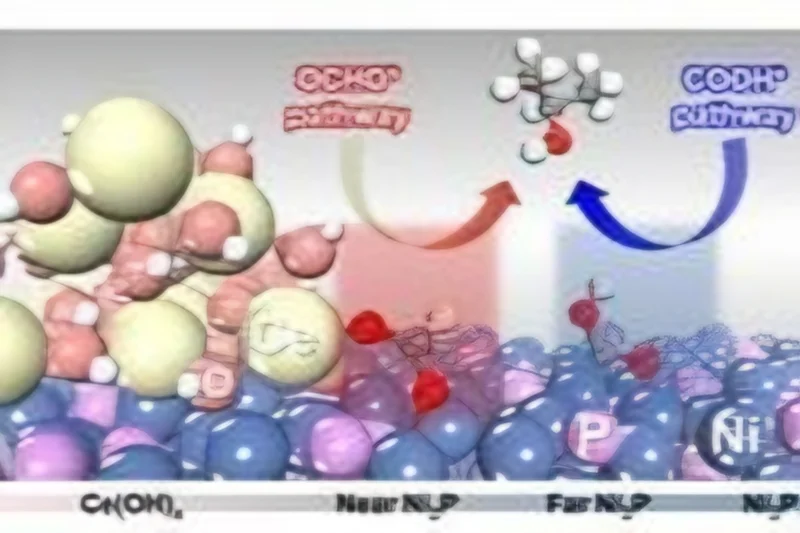
To overcome this challenge, the research team precisely controlled the flow of electrons across the catalyst surface, opening up two distinct reaction pathways.
By enabling these pathways to operate simultaneously, the team guided the carbon atoms from carbon dioxide to link together in a controlled manner, successfully producing 2-propanol with high selectivity.
Notably, the newly developed catalyst produced 2-propanol with world-leading efficiency under ambient temperature and pressure, without the need for specialized high-pressure equipment.
It also maintained stable performance without any noticeable degradation over 48 hours of continuous operation, demonstrating excellent durability.
“This is a new approach to catalyst design that enables two reaction pathways to work together,” said professor Kim Jung-kyu, who led the research.
He added, “We expect it to significantly accelerate the commercialization of environmentally friendly technology that converts waste carbon dioxide into valuable industrial feedstock.”
The research was conducted with support from the National Research Lab Program, the CO2 Reactive Capture and Conversion Convergence Technology Development Program, and the Engineering Research Center Program of the Ministry of Science and ICT.