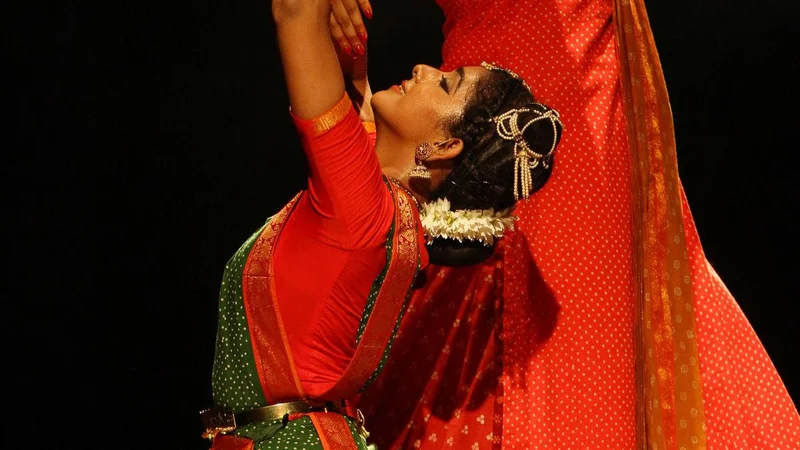
Sandhya Raman (Costume Designer): Silk and cotton were never mere fabrics; they reflected our way of life. Whether it was a sari with a broad border or a narrow one, the occasion often dictated the pattern and colour. The psychology of colour remains deeply embedded in our traditions even today. Time-tested hues such as turmeric yellow, kumkum red and auspicious greens continue to resonate, even as we experiment with pastels and contemporary palettes.
A sari, to me, is perhaps the most beautiful garment in the world. Though it essentially is two borders and a pallu, but within that simple structure lies immense beauty and meaning. One end belongs to you, while the other tells a story that extends beyond you.
I have worked closely with weavers, embroiderers and printers across India, and I have found an enduring connection between textiles and dance. Who better than a dancer to understand a garment? What a dancer wears is not only inspirational but aspirational. Both dance and weaving are driven by rhythm; there is music in the loom, just as there is rhythm in movement.
Increasingly, dancers are giving a thought to fabric and styling, understanding that what they wear is not merely decorative but an extension of the artistic narrative. The costume has become as thoughtfully designed as the choreography itself.
Anita Ratnam (Dancer): August 7 was once associated with the Swadeshi Movement. My mother and maternal grandmother were deeply conscious of textiles. From them, I inherited not only a love for sustainable fabrics but also a flair for experimenting with colours, patterns and styling. This sensibility informs all my works, created in close collaboration with my dear friend, costume designer Sandhya Raman.
Conversations with Sandhya often unfold alongside the choreographic process. In ‘Naachiyar Next’, for instance, her use of Madurai’s iconic Sungudi saris was particularly striking. The costumes anchored the work both socially, reflecting Andal’s origins in a poor Brahmin family, and culturally, evoking the milieu of Srivilliputhur.
Our dances are rooted in emotion, and the use of Indian colour palettes and textiles does not make them any less contemporary. What matters is that these choices arise from aesthetic and artistic necessity, not tokenism. Dance, after all, is also a means of sustaining our craft traditions.
Daksha Sheth (Dancer): I come from Ahmedabad, a city that has textiles woven into its very identity, so my love for fabrics is almost inherent. When I began researching my production Sari, which celebrates the craftspeople behind our beautiful weaves, it started as an exciting journey of discovery. But it was also deeply moving, and at times heartbreaking, to see how many weavers struggle to sustain traditions that have been passed down through generations. That realisation was one of the reasons I felt compelled to create the production. Since then, I have made it a point to work primarily with natural fibres in my creations. My work places great emphasis on the body and movement, and natural fabrics complement that beautifully, allowing the body to move, breathe and express itself with ease.
Vaibhav Arekar (Dancer): In my latest production, ‘Viyoga’, which explores humanity’s growing disconnect from Nature, we sourced handloom fabric directly from weavers for the costumes. It was important that the material itself reflected the philosophy of the work. Similarly, in ‘Nama Mhane’, which is about the sants and the abhang tradition, we wanted the costumes to be rooted in authenticity and tradition. Costume designer Sushant Jadhav helped bring that vision to life. What a performer wears is important. A costume is never incidental; it shapes the visual language of a production and deepens its storytelling. While cotton and other natural fabrics can be demanding to maintain, they carry a timeless charm that synthetic materials simply cannot replicate.
Geeta Chandran (Dancer): I grew up and married into households where a love for handlooms ran deep. When I trained in dance and became a performer, my love for saris, particularly handwoven ones, began to dominate not only my wardrobe but also some of my choreographic productions. The unusual colours, textures and designs created by weavers across the country excited me, a passion further fuelled by my collaboration with Sandhya Raman.
Rukmini Devi: Warp, weft and the visionary
V.R. Devika, the author of the book Rukmini Devi Arundale - Arts Revivalist and Institution Builder, believes the increasing use of sustainable fabrics in dance productions today is the result of the untiring efforts of numerous craft revivalists and pioneering artistes. A staunch handloom sari lover, she says, “the seeds of this textile journey in dance were sown by Rukmini Devi. She never viewed any aspect of dance in isolation, least of all costume. Recognising its integral role in storytelling and characterisation in dance dramas, she went so far as to establish an in-house weaving unit at Kalakshetra, both to source the right weaves for her productions and to inculcate in her students an understanding of the many threads that connect our artistic and craft traditions. Her legacy continues to inspire dancers, designers and textile enthusiasts alike.”
Published - August 07, 2026 07:30 am IST