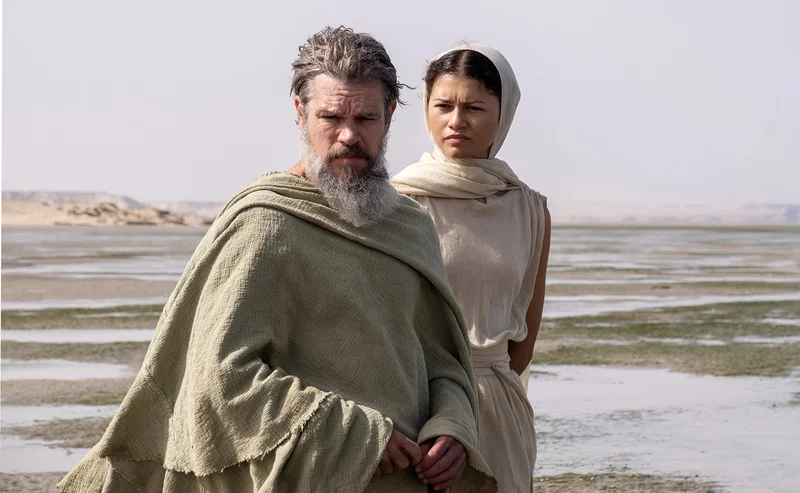
âDefy the gods.â Thatâs the main tagline on the promo material for director Christopher Nolanâs blockbuster sword and sandal mythological epic The Odyssey.
A better slogan though would have been âDefy the bardsâ as this staggering adaptation of Homerâs eighth-century Greek poem, written by Nolan himself, has already ruffled the feathers of teachers and students of Homeric literature.
Rather than maintaining scholarly fidelity with its titular source, the script weaves together various story beats from The Odyssey (including Emily Wilsonâs translation) and its predecessor The Iliad, as well as other epic poems such as Virgilâs The Aeneid, and even taking inspiration from the work of 18th-century Spanish painter Francisco Goya.
In doing so, Nolan has crafted a film that is his story rather than history. Not that any of this is actually history (no, the Trojan Horse wasnât real!). These ancient stories are just that: stories. They are fanciful myths of heroes, monsters, and gods designed to both entertain and elucidate, and as such, they grant some leeway in their retelling.
This is made inherently clear as The Odyssey opens with real-life rapper Travis Scott, as the bard Phemius, banging his staff on a table and spitting bars, as the kids say. It may not be full-blown rapping, but the cadence, informality, and Scottâs very prominent natural accent, may not be what some viewers are expecting.
Studying various modern translations of Homerâs work, Nolan concluded that when these tales were regaled to listeners in the centuries since first being penned, they would have been told in ways that connected with the respective people at the time.
As a result, the filmmakerâs infamously slavish devotion to tactile filmmaking realism is juxtaposed with character casting and dialogue choices that many will probably find at odds with period accuracy.
This is a Greek epic where the Colombian-American John Leguizamo and British Robert Pattinson speak to each other in their native Brooklyn and South London accents, respectively, all while standing in massive sets in real-world locations, meticulously crafted to match the architecture and decor of the time.
Production designers studied Bronze Age texts to get the crafting of weapons just right, but the armour of certain armies boasts over-the-top stylistic choices. This intentional anachronistic flair will be the biggest stumbling block for many â you either buy into Nolanâs mythological vision, or you donât.
For the uninitiated, The Odyssey is the tale of Odysseus (Matt Damon), the crafty king of Ithaca, who left behind his wife, Penelope (Anne Hathaway), and toddler son Telemachus, to engage in a decade-long war campaign against the city-state of Troy at the behest of fellow king Agamemnon (Benny Safdie) and his brother Menelaus (Jon Bernthal), in order to return the latterâs kidnapped wife, Helen (Lupita Nyongâo).
Fear not! This is not yet another cinematic version of the Trojan War (which, coincidentally, is one of the borrowed bits not originally in The Odyssey).
While Odysseusâ famous plan to infiltrate the impregnable Troy in the belly of a giant wooden horse disguised as a peace offering does feature prominently, The Odyssey mainly busies itself with the 10 years after that conflict ended â where Odysseus and his men find themselves unable to complete their voyage home.
As the gods seemingly seek to punish Odysseus for an impulsive action, his path is blocked at every turn by tumultuous seas, monsters, witches and more. Finding himself now in the company of the nymph Calypso (Charlize Theron), Odysseus recounts all that has befallen him.
Meanwhile, Penelope and a now-grown Telemachus (Tom Holland), have spent the lengthy span of the Trojan war with nothing more than ballads of Odysseusâ feats, and the decade after that pining for his return despite no word of him from anywhere.
As the throne sits empty, the palace is filled every night with suitors hoping to convince Penelope that her husband is dead and that she should remarry by choosing one of them. Chief among them is Antinous (Pattinson), a scheming aristocrat who swindled his way out of joining Odysseus in war and now sees an even quicker path to becoming the king of Ithaca by removing Telemachus from the board entirely.
Protected only by his teacher Mentor (Ryan Hurst) and his fatherâs blind but loyal swineherd, Eumaeus (Leguizamo), Telemachus sets out on his own quest to find out what happened to Odysseus.
All of this is told to us in a non-linear fashion, which has been the calling card of Nolanâs filmmaking career. In fact, Homer employs the same approach in his original text; Nolan just shuffles things around even further. And again, as heâs done so many times before, the filmmaker proves himself a deft hand at keeping it all coherent.
This restructuring is not just for flash, as it allows certain key moments in Odysseusâ saga to be viewed in a new thematic light. Extra motivation is added to the heroâs meandering trek home and certain narrative changes â such as Nolanâs choice to only feature the goddess Athena (Zendaya) instead of the involvement of the broader Greek pantheon â make more sense in context.
The writer/director is helped mightily here by editor Jennifer Lame (who most recently won an Oscar for her work on Nolanâs Best Picture winner Oppenheimer) to also keep things kinetic.
Despite a runtime edging close to three hours, The Odyssey never stops moving, pitching you from dramatic peak to trough frequently. And while this does mean that the colossal runtime zips by, unfortunately some of Odysseusâ more famous encounters get whittled down to just fleeting vignettes as a result.
The most expansive and subsequently best of these is undoubtedly a run-in with Circe (Samantha Morton), a fantastic sequence that boasts some of the filmâs best character work and some jaw-dropping practical visual effects.
With The Odyssey being the first feature film shot entirely with IMAX film cameras, Nolan and cinematographer Hoyte van Hoytema had to invent new methods of shooting to accommodate the supersized IMAX camera rigs. The results are staggering.
And thatâs coming from only watching this on a âregularâ IMAX screen rather than the âtrueâ 70mm IMAX screens boasting a 1.43:1 aspect ratio, which gives The Odyssey unprecedented screen real estate to work with. However with only 41 such IMAX screens worldwide, chances are that most of you reading this will be unable to experience the film 100% as Nolan intended.
It still looks incredible, though. And sounds it too. If you have ears of a delicate persuasion, let this stand as your official warning. Just as he did in Oppenheimer, Nolan essentially weaponises the filmâs audio here, with battle sequences crashing into you with visceral force. Expect another Oscar nomination for sound to be on the cards next year.
All of these technical achievements would mean nothing without the characters to justify their use. In this, the ensemble cast are almost uniformly great, led from the front by a stellar Damon and Hathaway.
Both Odysseus and Penelope are dramatically complex characters â in particular Nolanâs version of the Queen of Ithaca â and the films takes a âwarts and allâ approach to them, with Damon and Hathaway both nailing it. Pattinson continues to prove himself the consummate chameleon on screen, as his Antinous is a slimy villain you love to hate.
On the opposite end of the moral spectrum is another standout in Leguizamo, as Eumaeus, who is often the beating heart of the film. Itâs arguably the finest dramatic work of his career and will surprise some people. Meanwhile, Elliot Page as Sinon, one of Odysseusâ most trusted soldiers, also works magic with a very small role, knocking it out of the park in one key scene.
Admittedly, however, not everybody is as successful. As Telemachus, Holland steps up in the filmâs dramatic conclusion but lacks believable earnestness in some scenes prior to that. The usually magnetic Theron is also let down by simply not having enough to do outside of wistful looks.
And despite all the actors being allowed to retain their natural accents, Bernthal actually feels like the only one who is just playing himself instead of a character. Meanwhile, Safdieâs Agamemnon is barely a character at all and more just an âaura farmingâ set of very cool-looking but wildly impractical armour. Nolanâs thinly veiled commentary on masculine posturing?
Itâs these shortcomings, as well as a few production oddities â CGI is sparingly used but one scene makes it painfully obvious, and some of the more outlandish armour designs are distractingly cartoonish â that stop The Odyssey from truly being Nolanâs best work, as some reviews have proclaimed.
Hype aside, itâs still a monumental piece of filmmaking that is the very definition of epic. DM
The Odyssey is in cinemas now, having released on 17 July. This review was first published on Pfangirl.