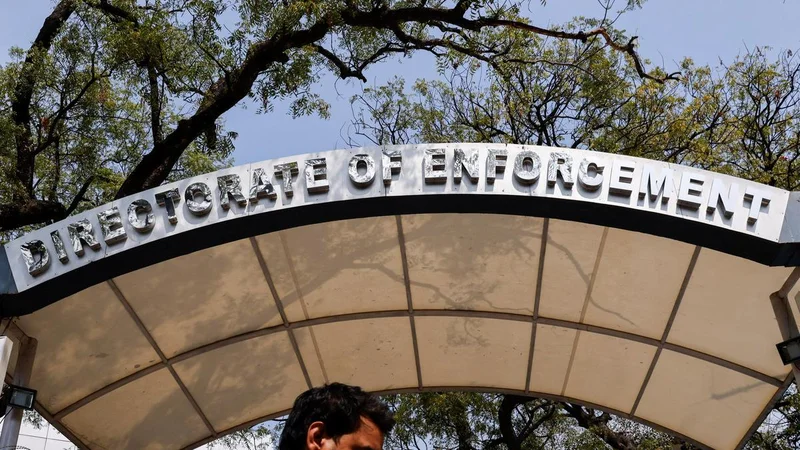
The Enforcement Directorate raided 10 residential and business premises linked with eight people allegedly involved in the smuggling of areca nuts from Myanmar. The money trail of the alleged smugglers in Mizoram and Assam was traced to traders in New Delhi, the agency said on Thursday (August 6, 2026).
The ED, in its statement, said sleuths of its unit in Mizoram’s Aizawl conducted search operations under a relevant Section of the Prevention of Money Laundering Act (PMLA) at the identified locations across southern Assam’s Cachar, Hailakandi, and Sribhumi districts on Wednesday (August 5, 2026).
The seven people accused of involvement in the illegal trade of Burmese areca nuts are Jakir Hussain, Kabir Hussain, Anjan Kumar Paul, Pinku Paul, Romi Jain, Anowar Hussain, Khalil Uddin, and Dipankar Deb.
“The operation was in connection with an investigation into an organised network engaged in cross-border smuggling of areca nuts from Myanmar into Mizoram, and their onward sale and distribution to purchasers or financiers based in Assam and Delhi,” the ED said.
The ED initiated an investigation based on a first information report registered by the Anti-Corruption Branch of the Central Bureau of Investigation in Imphal against public servants and private persons, following a Gauhati High Court order on July 16, 2024, in a PIL (public interest litigation) in 2022.
“The FIR/PIL alleged large-scale smuggling of areca nuts from Myanmar into Champhai, Mizoram, using fraudulent e-way bills and forged documents, despite owners not being GST registered. E-way bills amounting to approximately ₹86.25 crore under CGST and ₹251.19 Crore under SGST were found to have been issued from financial year 2021-22 to 2023-24, with Zokhawthar emerging as a major transit point,” the ED said.
Zokhawthar is a border trade point in Mizoram’s Champhai district, about 180 km southeast of Aizawl.
Three-tier structure
The ED investigation revealed a layered, three-tier structure used for smuggling and sale of Myanmar-origin areca nuts. At the first tier, Burmese suppliers handed over consignments of areca nuts, without customs clearance, to Mizoram-based facilitators at warehouses in Champhai, near the Indo-Myanmar border.
The agency said that the three main facilitators are women — Lalhnemi, Zosangpuii, and Zonunsang. Along with others, they arranged onward supply of the smuggled areca nuts to a group of purchasers or financiers based in Cachar, Karimganj, and Hailakandi districts of southern Assam. “Bank analysis has revealed that transactions in crores of rupees were conducted between the parties,” it said.
At the third tier, the Assam-based financiers further sold areca nuts, or routed sale proceeds, to purchasers or financiers based outside the northeast. “Romi Jain, proprietor of Delhi-based Ganpati Traders, was found to have conducted huge transactions with Silchar and Mizoram-based entities involved in the illegal smuggling of areca nuts,” the ED said.
Investigation revealed that Myanmar-origin areca nuts procured through this chain were ultimately supplied to buyers situated in Delhi, West Bengal (including Kolkata and Falakata), Nagpur, and Uttar Pradesh.
On Tuesday (August 4, 2026), raids were conducted at nine premises in Champhai, covering persons or entities engaged in procurement of smuggled areca nuts from Burmese suppliers. Analysis of their bank accounts established a money trail leading to people in Silchar and Delhi, the ED said.
Burmese areca or betel nut is illegal primarily because it is smuggled into India to evade customs duties and taxes. This illicit trade involves forged documents, money laundering, causing massive revenue losses while undercutting domestic farmers.
Published - August 07, 2026 10:42 am IST