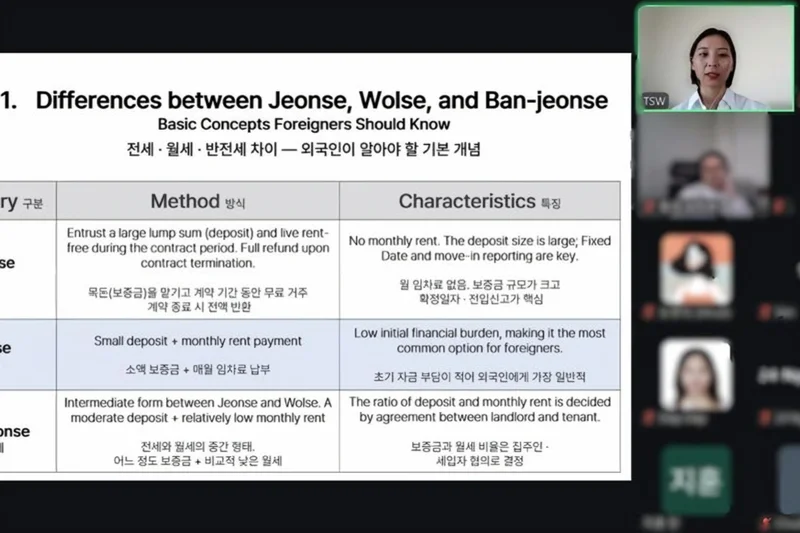
The Korea Times hosted an online seminar Thursday offering international students in Korea a step-by-step guide to navigating housing contracts, aimed at reducing the language barriers, deposit risks and visa complications many face when renting a home.
The online session, titled "3-Step K-Housing Survival Guide," was led by Park Song-I, team leader at Foreedom, a company that supports foreign residents with housing issues. Park laid out a three-step process — secure contract, deposit protection and visa safety — to help students avoid common pitfalls.
Park opened by explaining the differences between Korea's main rental types, including "jeonse," a lump-sum deposit system in place of monthly rent, and "wolse," or monthly rent. She noted that foreign nationals can sign such leases, but that legal protections under Korea's Housing Lease Protection Act generally require an Alien Registration Card, which allows tenants to report a change of residence and obtain a fixed date stamp on their lease.
Renters without a registration card may have limited legal recourse, she said, advising students to wait until they receive their card before signing a deposit-based lease.
On deposit protection, Park stressed the importance of checking a property's certified register, an official document showing a landlord's ownership and any liens or seizures against the property, before signing a contract.
She recommended obtaining an up-to-date copy on the day of signing and treating any contract cautiously if the deposit plus existing loans on the property exceeds 70 to 80 percent of its market value.
For visa safety, Park walked participants through the full process from house hunting to moving in, emphasizing that registering a change of residence and obtaining a fixed date stamp are essential not only for protecting a deposit but for maintaining valid immigration status.
She also offered move-in day precautions against fraud, including photographing and filming the unit's condition, reviewing maintenance fee terms in the contract, avoiding transfers to third-party accountsand working only with licensed real estate agents.
This article was published with the assistance of generative AI and edited by The Korea Times.