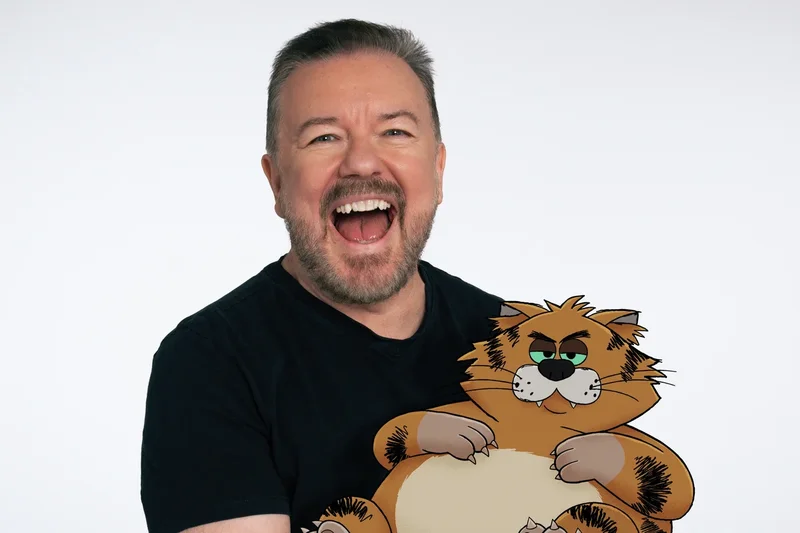
If it were possible to speak to Ricky Gervais with honesty – the sort of obscure, marrow-deep honesty you can usually only find with a polygraph machine and zoo-grade barbiturates – I would be genuinely fascinated to ask him one question: what does he really think of Alley Cats? Watching the abrasive, smug, and completely mirthless new Netflix cartoon from the British comedy titan, I found it genuinely impossible to tell. Is this the work of a man who has lost all creative mooring, awash in his own self-belief? Or is it the work of a canny grifter-cynic, a man who has watched audiences lap up all his crudest, hokiest impulses in projects like Derek and After Life, and thought, “let’s just give the people what they want”?
Gervais writes, directs, and stars in all six short, depressing episodes of Alley Cats, which follows a group of foul-mouthed felines as they eke out a living in the city. There’s Gus (Gervais), a jaded everycat and de-facto leader of the group; burly bruiser Fang (Andrew Brooke); depraved, physically rebarbative Puke (David Earl); Ponce (Tom Basden), a snooty housecat slumming it with the strays; and Olive (Diane Morgan), too cool for the rest of the gang in a sort of oddball Phoebe Buffayish way. All the cats look fine enough – cartoonish and colourful – but they move with the same antiseptic smooth-stiffness that has marred most TV animation since hand-drawn techniques were priced out of fashion years ago.
Every episode of Alley Cats tends to go something like this. We open on the cats watching television, where they spend a few minutes riffing on whatever’s on screen, Gogglebox-style, and making idle, sweary chit-chat about the world and their philosophies. Then they go out in the world, and do something vaguely cat-like – hunt mice; scavenge for food; look for a mate – while making more sweary chit-chat, perhaps throwing in a fat joke, an Aids joke, or a sexual assault joke, for good measure. (In one scene, Earl’s character uses a racist slur in describing a part of his anatomy; the phrase is completely unremarked upon.) Then, a few minutes from the end of the episode, maybe around the 12-minute mark or so, something sad happens, and everything becomes po-faced and treacly. Rinse, and repeat.
Before each episode cannonballs into the bathetic deep end, Alley Cats most brings to mind The Ricky Gervais Show, the radio series (and primordial podcast sensation) fronted by Gervais, Stephen Merchant, and producer-turned-punching-bag Karl Pilkington. It is perhaps relevant that Gervais’s previous foray into animation was the Channel 4 and HBO-commissioned TV adaptation of this podcast, where pre-existent audio was matched to bright and cheap cartoon images. At times, this seems to be the sort of tenor that Alley Cats is going for – naturalistic banter between friends. But the dynamic never works: absent a Pilkington figure, Gervais is often forced to play both roles himself, idiot and scolder wrapped into one. It is an entirely confected spectacle, and barely even that.
As TV premises go, “Dark Garfield” is something that might have been transgressive 30 years ago – not today. (Really, the concept of a profane, offensive cartoon cat nearly predates Gervais himself: Ralph Bakshi’s grotty and groundbreaking Fritz the Cat came out over half a century ago.) The idea of imposing human psychologies onto talking animals has been done to death at this point; Netflix’s BoJack Horseman would be an example of something that managed to do this with infinitely more depth, and incomparably sharper humour, than Alley Cats can muster.
For the past two decades, the increasingly futile question hanging over Gervais’s career has been whether he will ever make something as brilliant as The Office again. Alley Cats makes me wonder if he even has it in him to make another Life’s Too Short.
‘Alley Cats’ is available to stream on Netflix now