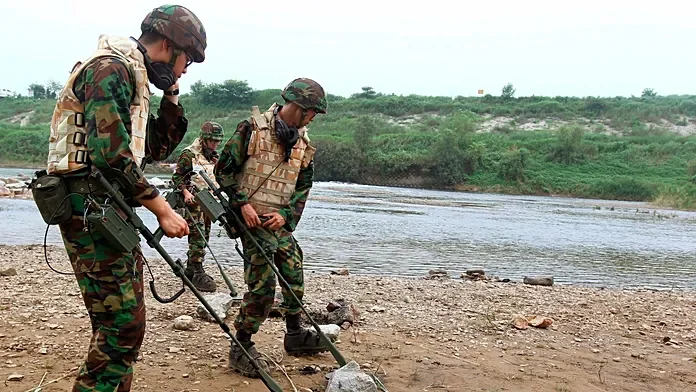
The Demilitarised Zone (DMZ), splitting the Koreas since their 1950-53 war ended with an armistice, is one of the most heavily mined places on Earth.
South Korean authorities have collected 15 landmines believed to have washed over into their coastal territory from the inter-Korean border on monsoon deluges, officials said on Friday.
The Demilitarised Zone (DMZ), splitting the Koreas since their 1950-53 war ended with an armistice, is one of the most heavily mined places on Earth.
Some 800,000 are estimated to be buried around the area, according to military data cited by the Yonhap news agency, many from the war but mine-laying has continued in recent years.
Choi Young-ran, head of civil defence for South Korea's northwestern border country of Gwangwha, said 15 "suspected North Korean landmines" were "discovered along coastal areas."
She told the AFP news agency the mines "believed to have been washed away during the monsoon season and recent torrential rains" had been found between 23 July-3 August.
"We have recovered all 15," she said.
Gwangwha, an archipelago county, sits at the mouth of the Han River estuary which is bisected by the border between North and South Korea.
Seoul's military warned last month about the risk of heavy rainfall washing explosives into rivers crossing the border and causing "serious damage" if they explode downstream.
In 2015, two South Korean soldiers patrolling the western DMZ lost limbs when they were severely wounded by a North Korean mine, the military said.
In late July, Gwangwha county sent out alerts to residents warning them of the danger of North Korean mines along coastal areas.
County officials said Wednesday they had "not ruled out the possibility that more could arrive."
Park Heung-yeol, a Gwanghwa resident, said tourist numbers fell for a time after the 2015 landmine incident and locals fear that could happen again.
Despite the heat, "there are still around 300 people who dig for clams by hand," he told AFP.
"It seems like a dangerous activity for them" given the risk from mines, he said.
Natural disasters tend to have an outsized impact on North Korea due to its weak infrastructure. Deforestation has left it vulnerable to flooding.
Specialist outlet NK Pro said on Thursday hundreds of homes at a large North Korean border military base were washed away by heavy rains in late July after an apparent dam collapse.
Citing satellite imagery, it said "at least 380 single-story row houses were completely swept away, while the site is reportedly a key artillery command."
South Koreans living along the high-security border face frequent disruptions and danger.
Pyongyang has sent trash-filled balloons and also broadcast bizarre, unsettling noises over the border.
The broadcasts became a major nuisance under President Lee Jae Myung's hawkish predecessor, Yoon Suk Yeol.