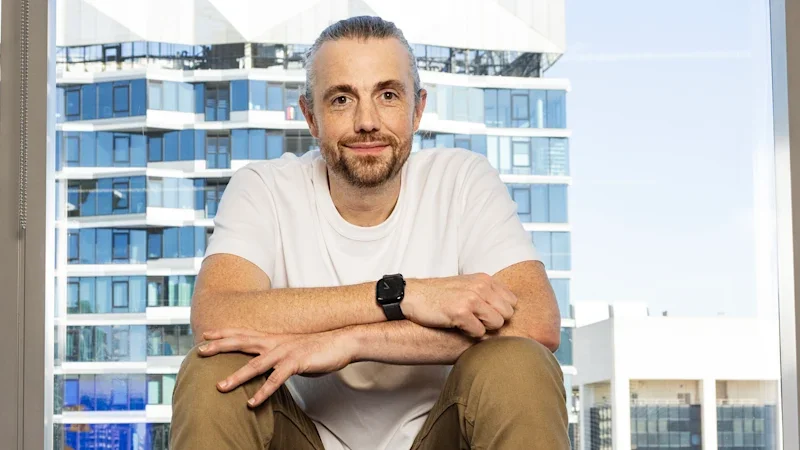
Technology billionaire Mike Cannon-Brookes’ net worth soared on Friday morning, after Atlassian posted its first quarterly operating profit in more than two years and its shares jumped as much as 38 per cent in after-hours trading on the Nasdaq.
Atlassian, the Sydney-founded maker of Jira and Trello, is listed in New York. Co-founder and chief executive Cannon-Brookes holds 47.3 million shares in a family trust. At Thursday’s close, that stake was worth $US5.2 billion ($7.4 billion). Hours later it had jumped to roughly $US7 billion ($10 billion).
Scott Farquhar, who stepped back from the co-chief executive role in August 2024 but kept a comparable holding, gained a similar amount.
“Mike and I built Atlassian with the long term in mind, which remains as true today as it ever was,” Farquhar said in a statement. “These results are testament to both Atlassian’s durability and the huge runway ahead with AI.”
Cannon-Brookes was unimpressed by the focus on his own fortune, opening an interview with this masthead by dismissing the premise.
“If you focus on money, it’s totally irrelevant to the 10,000-plus people who’ve done an incredibly hard job to work on it,” he said. “Whatever happens to my own personal situation, or Scott’s personal situation, should be largely irrelevant.”
Atlassian’s fourth-quarter revenue rose 28 per cent to $US1.77 billion, ahead of the $US1.66 billion that analysts had forecast, while operating income was $US211 million, against a $US28 million loss in the same quarter a year earlier. Earnings of $US1.87 a share beat a consensus of about $US1.50.
Cannon-Brookes said Atlassian’s latest AI-powered developer tools had passed 1 million monthly active users, more than doubling in a single quarter. He also told investors that he would enter a trading plan to buy up to $US250 million of Atlassian class A stock on the open market, a signal that helped drive the rally.
Atlassian traded above $US189 a year ago, then plummeted through the software sell-off known as the “SaaSpocalypse”, in which investors panicked and sold off software companies that charge “per user”, fearing that AI agents would soon replace the human workers requiring those software licences. The stock was ejected from the Nasdaq 100 in April and bottomed at $US56.01 on April 10. In March, Atlassian cut 1600 jobs, about 10 per cent of its workforce.
“AI is the best thing that’s ever happened to Atlassian,” Cannon-Brookes said in a video message to shareholders on Friday, arguing that models themselves are becoming a commodity, while a company’s accumulated internal context cannot be bought. Rovo, the company’s AI agent, is now used by more than 80 per cent of the Fortune 500, he said.
Cannon-Brookes said that Team Anywhere, the policy that lets Atlassian staff work from wherever they choose, had grown into a significant competitive advantage in a market where every large technology company is chasing the same engineers. Atlassian employs people in about 17 countries, in 49 of the 50 US states and in every Australian state and territory, including a handful in the Northern Territory.
“What other equivalent jobs do they have if, for whatever reason, they can’t leave or they don’t want to leave?” he said.
The company’s 40-storey Sydney headquarters, beside Central Station, is due to open in 2028. “It’ll be pretty full by the time we move in,” he said. “I guarantee it.”
Asked whether Atlassian’s “Open company, no bullshit” value survived a recent ruling ordering the reinstatement of a worker dismissed over comments about him, Cannon-Brookes declined to discuss the case, which remains before the courts. The value still stood, he said, though it came with community guidelines and responsibilities.
Despite the strong quarter, the company still posted a $US54 million accounting loss for the full year, and executives warned that profit margins will remain tight next year. Chief financial officer James Chuong said Atlassian had built extra prudence into the second half of its forecast.
The rally also came weeks after Atlassian shut what had been the most reliable wealth machine in Australian technology. From the pay cycle beginning July 1, staff rated as meeting expectations now receive their annual bonuses entirely in cash rather than company shares. Those employees have no exposure to Friday’s move.
Atlassian has said that the change protects existing investors from having the value of their shares watered down. Stock-based compensation cost the company $US1.36 billion in the 2025 financial year, about a quarter of revenue, and the board has authorised billions of dollars in buybacks to mop up the shares issued to staff.
On the broader AI boom, Cannon-Brookes said Australian companies were selling themselves short. Some of Atlassian’s most forward-leaning customers are large Australian banks and logistics operators, he said.
Asked whether the country should build its own foundational AI models, he said it had no chance and did not need one.
‘AI is the best thing that’s ever happened to Atlassian.’Mike Cannon-Brookes, Atlassian co-founder
“We’re very good at adapting and deploying technology towards solving customer problems,” he said. “We don’t need to be building foundational models, just as we don’t need to be building search engines or cloud computing providers.”
Where Australia should move, he said, is data centres, an opportunity he described as time-limited as Japan, Chile, Iceland and Argentina compete for the same investment. Community opposition here has been mild, which he put down to the buildings themselves being unremarkable.
“A data centre is just like a Bunnings,” he said. “It’s a big grey box from the outside.”
The Business Briefing newsletter delivers major stories, exclusive coverage and expert opinion. Sign up to get it every weekday morning.