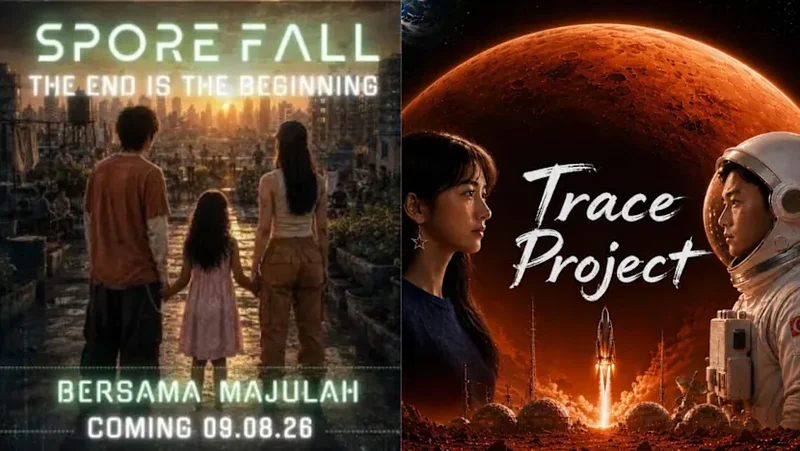
'AI slop' or not? 2 Singapore films set for National Day release spark debate
Created using AI, Trace Project and Bersama Majulah tell fictional stories inspired by Singapore and will be released on Sunday (Aug 9).
Two Singapore-made films created using generative AI and premiering on National Day have sparked debate online, with critics dismissing them as "AI slop" and questioning generative AI's growing role in filmmaking.
The projects – Bersama Majulah and Trace Project – are both stories set in fictionalised versions of Singapore.
Bersama Majulah (a direct translation of "Together Onwards" from Malay) is a short film produced by Singapore-based AI studio Edenstone. It depicts a National Day Parade disrupted by a deadly spore outbreak that turns people into zombies. It's set in the country of Lionara, it features familiar landmarks such as Marina Bay and the Merlion.
The film was created by local showrunner Joel Boh, with Golden Horse-winning producer Chan Gin Kai serving as executive producer and a theme song by local musician Dharma Sadasivan. A spin-off of Edenstone's AI animation series Spore Fall, the short film will be released on the series website on Aug 9.
In a press release, the studio said it expected the film to generate "widespread public discourse", adding that it viewed public debate on the film as "a sign of cultural impact".
Meanwhile, Trace Project is produced by another Singapore-based AI studio, FizzDragon and will have a single screening on Sunday at Golden Village VivoCity.
The hour-long film follows Lin Jia Jun, Singapore's first astronaut to set foot on Mars after humanity launches the fictional Mars Footprints Programme to establish a new civilisation following Earth's collapse.
CRITICISM FOR "AI SLOP"
Both films have since drawn criticism online for their AI-generated visuals.
Across platforms such as TikTok, YouTube and Instagram, some viewers described Trace Project as "AI slop" or "backward", while others described the characters as "lifeless", "empty", with "horrible dialogue and accents". One user wrote that they "can't tell if this (film) is satire", while another remarked that the AI film was a sign that "there is no hope for film in Singapore".
On Bersama Majulah's social media pages, some commenters responded with encouraging messages such as "Majulah!", while others reacted with GIFs expressing shock.
A few commenters also made their feelings clear on YouTube, with one noting: "I cannot believe AI slop like this made it to the local news. Bad directing, cringy dialogue, actors spoke with an American accent, messy timeline. This is a good example of when AI should not be used."
Responding to the criticism, Pax Chen, founder and chief executive officer of FizzDragon, defended Trace Project in a LinkedIn post published on Tuesday (Aug 4).
"Trace Project is an experiment. It is not a claim that AI filmmaking is perfect, nor that this is the only way to make films," she wrote. "It is simply one story, created from one person's experience and imagination, and an invitation for people to decide what they think of it."
Meanwhile, in response to CNA Lifestyle's queries, Bersama Majulah's creator Boh acknowledged "the fatigue around 'AI slop'". However, he denies his film as "slop" and asserts that "the soul of the work is entirely human".
"The story arcs, character motivations, and emotional truth were written by us long before AI entered the picture," Boh told CNA Lifestyle. "AI only handles the execution layer – environments, visual effects, and production scaling."
He added: "The process demands rigorous human oversight at every stage: Prompt engineering, shot selection, editing, and the final cut are all controlled by our team. We call it human-written, AI-realised."
DEBATE SURROUNDING AI-GENERATED FILM
The debate comes as AI-generated filmmaking appears to be gaining traction internationally.
US-based generative video company Runway held its fourth annual AI Festival in July, while several AI film festivals are scheduled later this year.
At the same time, major film institutions continue to emphasise the role of human creativity.
According to Reuters, organisers of the Cannes Film Festival have not outrightly banned AI, but films primarily driven by generative AI are not eligible to compete for the Palme d'Or. Reuters also reported that Academy Awards rules issued in May state that AI actors and AI writers are ineligible for Oscars.
Opposition to AI-generated creative work has also come from parts of the film industry, such as when The New York Times reported how the Writers Guild of America East ended its 12-year partnership with the Urbanworld Film Festival in July after the festival introduced a new programme showcasing AI films.
Closer to home, across social media, a few Singaporeans see generative AI as a way to lower production costs and overcome creative limitations, while others argue that relying on AI takes away the human creativity and emotional authenticity that audiences value.