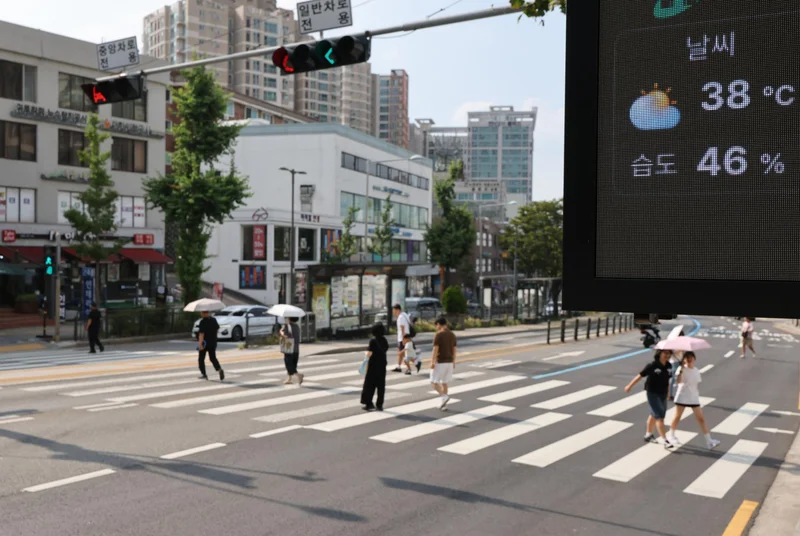
Despite Ipchu, the traditional start of autumn, the heat wave reached a new peak on Friday, with Seoul topping 40 degrees Celsius for the first time on record.
According to the Korea Meteorological Administration (KMA), Friday was the hottest Ipchu on record nationwide, with temperatures reaching 40.2 C in Seoul's Nowon District at around 3:28 p.m.
It was the first reading above 40 C at a monitoring station in the capital since Aug. 1, 2018.
Temperatures soared to near 40 degrees Celsius in many parts of the country, reaching 40.7 in Hanam, Gyeonggi Province, and 40.2 in Gwangyang, South Jeolla Province. Seoul's Gangseo District hit 39.2 degrees Celsius, while Yeongwol, Gangwon Province, and Yeoju, Gyeonggi Province, recorded 39.8 and 39.6, respectively.
From June 1 through Thursday, Korea averaged 14.8 heat wave days, the fourth-highest figure for the period since nationwide records began in 1973. The country also averaged a record 13 tropical nights, when overnight temperatures remain at or above 25 degrees Celsius.
As such extreme heat becomes increasingly common, climate insurance is gaining attention as a new safety net for those whose livelihoods are vulnerable to extreme weather.
Once largely limited to crop damage, climate insurance is expanding to protect the incomes of climate-vulnerable groups, including construction day laborers, delivery workers and small-business owners.
Local governments are expanding such initiatives to protect people from the mounting economic and health risks of extreme weather.
Jeju Province this month launched the country's first heat-related work stoppage insurance for construction day laborers, compensating workers for up to four hours of lost income when work is halted under a heat wave warning issued before 1 p.m.
Gyeonggi Province launched its climate insurance program in April last year, automatically covering all residents. The program pays 150,000 won ($105.8) for heat-related illnesses without requiring proof of actual losses, while also covering risks from cold waves and infectious diseases.
The expansion comes as increasingly frequent climate disasters expose gaps in existing safety nets, particularly for climate-vulnerable groups.
Construction and delivery workers risk losing income when extreme heat halts outdoor work, while small-business owners face falling sales and older people heightened health risks.
Meanwhile, the heat wave is expected to ease somewhat over the weekend as a high-pressure system around the Korean Peninsula shifts northeastward. Scattered showers are forecast across inland areas, excluding the west coast, which could bring temporary relief from the intense heat.
Hot conditions are expected to persist into next week, however, with daytime highs forecast to range from 33 to 35 degrees Celsius nationwide.