WASHINGTON — Sens. Catherine Cortez Masto (D-Nev.) and Katie Britt (R-Ala.) have introduced bipartisan legislation that would direct the Pentagon to strengthen the U.S. Space Force’s preparation for a potential conflict with China by expanding training, wargaming and simulation while requiring a new public assessment of Beijing’s commercial space sector.
The Space Superiority Readiness Act would require the Defense Department to expand the Space Force’s capacity to conduct wargaming, modeling and simulation of peer conflicts in space and develop training programs focused on the tactics, techniques and procedures needed for space control operations. The legislation also calls for an unclassified report to Congress on China’s commercial space capabilities and their potential military applications within 180 days of enactment.
A spokesperson for Cortez Masto said the Nevada Democrat filed the proposal as an amendment to the fiscal 2027 National Defense Authorization Act.
The Senate Armed Services Committee has already approved its version of the NDAA, but the full Senate has yet to begin floor debate.
Neither sponsor serves on the Senate Armed Services Committee. Cortez Masto serves on the Finance; Banking, Housing and Urban Affairs; Energy and Natural Resources; and Indian Affairs committees. Britt serves on Appropriations; Judiciary; Banking, Housing and Urban Affairs; and Rules and Administration.
“She will continue to pursue every avenue to get it passed into law, and introducing the legislation as a standalone bill is part of that process,” Cortez Masto’s spokesperson told SpaceNews Aug. 6.
The measure comes as the Space Force increasingly emphasizes preparing guardians for combat operations in orbit rather than solely operating satellites that support military forces on Earth.
“By providing guardians with the tools, training, and resources they need, they will continue to be ready to confront any threat,” Cortez Masto said.
Britt framed the legislation as a response to China’s growing military space capabilities.
The bill “underscores how critical space is as a warfighting domain,” she said in a statement, adding that China is determined to dominate space and the United States “must be able to maintain space control in a potential conflict with the People’s Republic of China.”
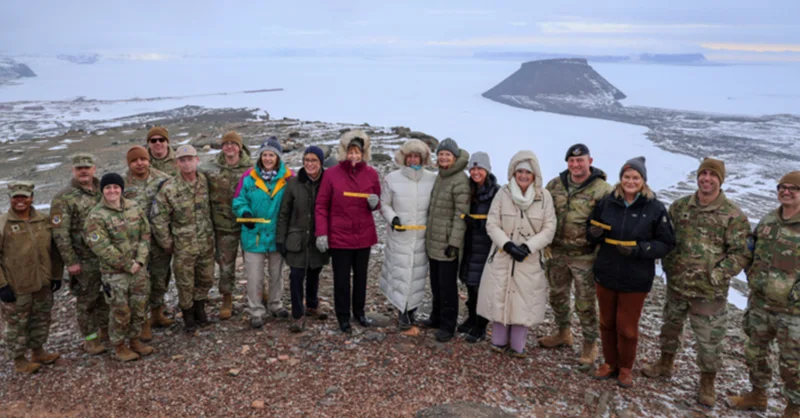
The legislation appears to build on concerns the senators were exposed to during a bipartisan congressional delegation to the Arctic in May. Cortez Masto and Britt visited Pituffik Space Base in Greenland, where they received briefings on missile warning, military space operations and strategic competition with Russia and China. The delegation also toured the SvalSat satellite ground station in Norway, which supports both commercial and government satellite operations in the Arctic.
The proposal largely reinforces initiatives the Space Force says are already underway.
The service has been developing its Operational Test and Training Infrastructure, or OTTI, a network of simulators, live training ranges, adversary representations and distributed environments intended to allow Guardians to train against realistic threats without relying on operational satellites.
Rather than creating a new training organization, the legislation directs the Pentagon to expand the capacity of those existing efforts while placing greater emphasis on scenarios involving conflict with China.
The China reporting requirement represents the bill’s other significant policy objective.
The Defense Department already publishes extensive assessments of China’s military space programs, including its satellite constellations, anti-satellite weapons and counterspace capabilities. The legislation would require a separate unclassified assessment focused on China’s commercial space industry and how those capabilities could support military operations.
Previous assessments have warned that China continues to expand anti-satellite weapons, electronic warfare systems, directed-energy capabilities, cyber tools and co-orbital spacecraft while increasingly drawing on commercial technologies.
Because the report would be unclassified, it would provide industry and outside analysts with additional insight on the implications of China’s rapidly expanding commercial space sector.