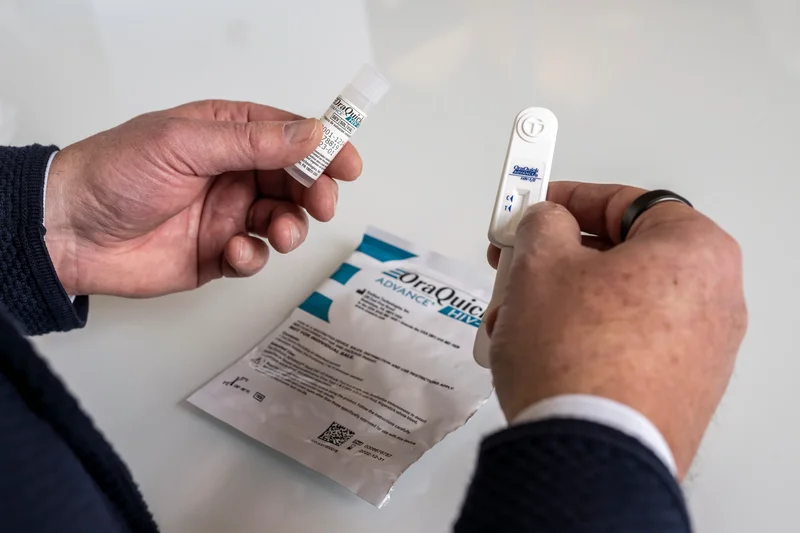

OraQuick is Canada’s first oral self-test and provides results in about 20 minutes after swabbing the upper and lower gums.Eduardo Lima/The Canadian Press
A national program that distributes free HIV self-testing kits across Canada is expanding on Thursday, increasing access to an oral swab test recently approved for sale by Health Canada.
For many years, the only HIV at-home testing option available in Canada was the INSTI finger-prick test, which requires a small blood sample. But, in February, Health Canada approved OraQuick, the country’s first oral self-test that provides results in about 20 minutes after swabbing the upper and lower gums.
Starting Thursday, people across Canadawill now be able to order either test free of charge through the confidential I’m Ready program, led by St. Michael’s Hospital in Toronto. Users of I’m Ready will also now be able to connect directly to licensed clinicians at Freddie and Felix, virtual sexual health services focused on HIV prevention and care.
Sean Rourke, a scientist at St. Michael’s Hospital and director of REACH Nexus who developed I’m Ready, said the expansion will further reduce barriers to testing, particularly for people in rural, remote and underserved communities.
“If we just expect people to walk in the door and get tested, there’s a certain percentage of people in Canada that will never do that, so this is an option that will actually reach them,” said Dr. Rourke.
“The sooner people get tested and get on treatment, the better for how long they’re going to live and how many complications they’re going to have.”
Manitoba declares public health emergency over rising HIV cases
Left untreated, HIV is fatal with median survival span of eight to 10 years from the time of infection. It makes the body vulnerable to infection, leading to possible complications such as pneumonia, shingles, and neurological and cardiovascular complications. However, if treated early, people with HIV can expect a near-normal lifespan.
There are significant barriers to HIV testing in Canada, including stigma, confidentiality concerns, geographic isolation and limited access to health services, which allow undiagnosed infections to spread.
New HIV diagnoses have grown considerably in Canada in recent years but declined slightly in 2024, the most recent year of national data. There were 2,288 new diagnoses that year, representing a 3.3-per-cent decline from 2023. In 2020, an estimated 1,520 new HIV diagnoses occurred in Canada.
However, the diagnosis rates vary between provinces and territories. While the national rate was 5.5 casesper 100,000 people in 2024, Manitoba and Saskatchewan greatly exceeded it, climbing to rates of 19.5 and 18.6 per 100,000, respectively.
The Manitoba government, in May, declared a public health emergency to combat rising HIV rates, which the province linked to a range of factors, including injection drug use and homelessness.

Dr. Sean Rourke, a Toronto-based clinical neuropsychologist and scientist at St. Michael’s Hospital, in Toronto in February. The I’m Ready program has distributed more than 38,000 free tests and reached more than 16,000 people since launching in 2021.Eduardo Lima/The Canadian Press
Dr. Rourke said providing more testing options, especially an alternative for those who “get a little icky with blood,” will make it easier for people to learn their status. He added that much of their focus has been on improving access in more vulnerable communities, including for Black, Indigenous and transgender individuals.
The I’m Ready program has distributed more than 38,000 free tests and reached more than 16,000 people – many of whom were first-time testers – since launching in 2021. When purchased privately, the kits often go for between $35 and $60.
The updated app and website also connect users with HIV prevention, treatment and care resources, including information on pre-exposure prophylaxis, or PrEP, and postexposure prophylaxis, or PEP, options.
KC Barron, a member of the I’m Ready youth steering committee and project co-ordinator with the youth-led charity LetsStopAIDS, said many young people are unaware that free tests are available or unsure how to access them.
Canada’s first oral HIV self-test has been approved for sale
He said a resourcesuch as I’m Ready can be life-changing for people who have a limited or no support system.
Mr. Barron recalled meeting a 17-year-old in Saskatchewan who was closeted and not accepted by their family for being gay. The teenager tried to get help from their doctor but was denied access to PrEP, a prescription medication that greatly reduces the risk of contracting the virus, and is now living with HIV after a partner failed to disclose their positive status before sexual activity.
He said being able to provide a safe space for people such as the teenager to share their story makes a world of difference and opens the door to connecting people with the right resources.
Mr. Barron, who is transgender, added that negative experiences within the health care system are not uncommon. He said he has faced “setback on setback” from doctors because of his identity, highlighting the need for more accessible services.
“Even making an appointment, I feel so much dread,” he said. “But, to not have to go through that, and being able to get the self-test kit and just have it easily accessible and free is just so much easier, to be able to do it myself.”