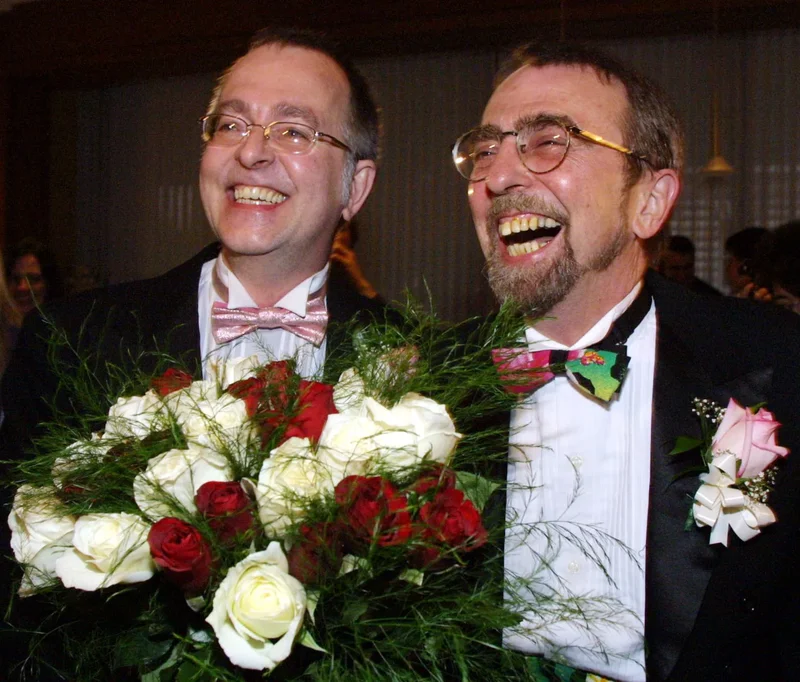
When Michael Hendricks applied for a marriage licence in 1998 to wed his long-time partner, René LeBoeuf, the clerk at the Montreal courthouse was flummoxed. No, no, she said, this won’t do – there has to be a husband and a wife.
Well, Mr. Hendricks replied, I do the cooking, so I guess that makes me the wife, and René does the dishes, so he must be the husband.
That streak of irreverent defiance would eventually see Mr. Hendricks and Mr. LeBoeuf become the first gay couple married in Quebec.
But the joyful occasion in April, 2004, came after a gruelling six-year legal battle and a decades-long struggle for gay rights that included the darkest days of the AIDS crisis and the systemic homophobia that enabled it. Having seen friends evicted from apartments and left with nothing after the deaths of their partners in the 1980s and 1990s, Mr. Hendricks was determined to secure full legal status for gay couples.
When Mr. Hendricks died on July 18 at the age of 84, Mr. LeBoeuf had the same protections as any other widower.
But Mr. Hendricks’s activism extended far beyond the gay community, and a range of Montrealers are better off because of him. A native of New Jersey, Mr. Hendricks became an exemplary citizen of his adoptive Quebec. He took up the cause of female sex workers, Black victims of police brutality and fellow American war resisters.
“He was a great man,” said Roger LeClerc, a fellow member of the era’s “queer brain trust” in Montreal. “He was a noble man who defended the rights of everyone.”
Born on Nov. 7, 1941, and raised in Trenton, N.J., Mr. Hendricks began a new life when he moved to Quebec to escape the Vietnam War. As he later told it, he was visiting Montreal in 1968 when his mother called to say she had received his draft notice in the mail. He decided to simply stay put.
His first activist role saw him assisting other conscientious objectors who had fled across the border. He helped run a hostel for war resisters, including Vietnamese officers who had come to North America for training and then absconded by bus to Montreal.
The city in those years was effervescent with the afterglow of Expo 67, the smash hit of a world’s fair that had brought more than 50 million visitors. Prime minister Pierre Trudeau was on the cusp of decriminalizing homosexuality across Canada. Quebec’s nationalist Quiet Revolution was in full swing.
Mr. Hendricks threw himself into the deep end of Québécois culture by taking a computer programming job in largely francophone Grand-Mère, near Shawinigan, where he quickly learned French. In 1973, living again in Montreal, he met Mr. LeBoeuf at a New Year’s Eve party. His new course was set.
Gay life in late-1970s Montreal was liberated and joyful relative to the repression of earlier times. A nascent Gay Village in the east end of downtown bustled with packed bars and bathhouses. In 1977, the backlash to one brutal police raid led the Parti Québécois to ban discrimination based on sexual orientation, making Quebec the first jurisdiction in North America to enshrine such protections.
Rumours of a “lifestyle” disease among gay men in New York and San Francisco had started to trickle up to Montreal, Mr. Hendricks recalled in an oral history of the era, but it was not until the early 1980s that the couple began to see AIDS touch their own community.
The stigma and ignorance around the disease could be crushing. When a friend Bernard lay dying in the Royal Victoria Hospital, medical staff refused to clean him and placed food trays at the door to avoid contact.
Awareness of the dangers of HIV came relatively late to the Quebec gay community partly because of the cultural and linguistic distance from the American epicentre of the crisis, said Mark Andrew Hamilton, author of a Concordia University master’s thesis on the AIDS crisis in Montreal. ** **
“There was such a belief that it was an anglophone problem, a New York problem,” he said.
“There was this weird idea that if you didn’t go to the Mineshaft, or these gay cruising clubs in San Francisco, you wouldn’t get AIDS. Or if you didn’t sleep with an anglo.”
By the end of the decade, however, the epidemic was unavoidable. At one gathering of almost 30 friends in 1989, it became clear that Mr. Hendricks and Mr. LeBoeuf were the only HIV-negative people there.
That same year, a member of the influential New York-based AIDS activist group ACT UP started a Montreal chapter. Mr. Hendricks and Mr. LeBoeuf were at the founding meeting.
The skies had darkened in other ways for gay Montrealers. The murder of 23-year-old queer activist Joe Rose on a city bus was just one in a series of homophobic killings the community tracked in those years, when the police were often reluctant to investigate hatred as a possible motivation. A violent 1990 raid on a Sex Garage warehouse party, in which cops removed their badges before bludgeoning partiers, was another catalyst to action.
In a climate of fear and mourning, Mr. Hendricks threw himself into activism with a kind of “frenzy,” he later recalled.
“Much of it was a kind of active grieving,” he said. “It was better than sitting alone in your room and crying.”
The American immigrant with the charmingly off-kilter accent became a driving force in gay activism, organizing with a fierce and sometimes bruising style. Mr. LeClerc was struck by his savvy and knowledge – Mr. Hendricks read three or four newspapers a day – but also by his occasional harshness.
“I heard him dress down people; he was unforgiving. Once he made up his mind, it was over, there was no discussion possible.”
ACT UP campaigned for better access to life-saving medications for AIDS patients, among other causes, with spectacular demonstrations such as a mass die-in at a downtown mall on the first anniversary of Mr. Rose’s murder. Later, the group pivoted to “nursing members through their final days – many of whom had been abandoned or disowned by their families,” Mr. Hamilton wrote.
Among Mr. Hendricks’s projects in the 1990s was establishing a park in the Village to commemorate those who had died of AIDS. The beautifully landscaped space is now known as Parc de l’Espoir – a sentimental name Mr. Hendricks deplored. He didn’t see much “hope” in what had happened.
“Our best friends were dying,” Mr. Hendricks said, “and they were all dead by December 1, 1995.”
By then ACT UP Montreal had disbanded amid a wave of deaths and disabilities among its members. But like a soldier who can’t help but fondly remember the war, Mr. Hendricks would eventually call the sorrowful, chaotic intensity of the early 1990s the best years of his life.
Partly that was because Mr. LeBoeuf was by his side. Fellow activists found them inseparable. In the late 1990s, with the worst of the AIDS crisis in North America abating, the couple went looking for their next cause and found it in each other.
“We said, ‘What can we do to continue our activism and piss people off,” said Mr. LeBoeuf in an interview with The Globe. “We said, ‘Why don’t we get married?’”
No country in the world had legalized gay marriage when Mr. Hendricks and Mr. LeBoeuf applied for their licence in 1998. Even finding a lawyer who was willing to take their case was a “waking nightmare,” Mr. LeBoeuf said. Again and again, the couple was told that “people aren’t ready.”
They wouldn’t be discouraged. Too many times they had seen men die of AIDS only for the surviving live-in partners to be evicted and shunned by the surviving family, “left only with the mattress because no one wanted to touch it,” Mr. LeBoeuf said.
To their chagrin, opposition to the campaign came not only from straight society but also from within their own community, where many saw marriage as a conservative institution that had no place in gay life. At times the men “felt like Don Quixote, tilting at windmills,” Mr. LeBoeuf said.
In 2001, they sued the Quebec government over its refusal to marry them, arguing that the denial violated the Canadian Charter of Rights and Freedoms. While the case made its way through the courts, same-sex marriage was implemented in Ontario and B.C. Finally, in 2004, the Quebec Court of Appeal granted them the right to marry without delay. The federal government legalized same-sex marriage across the country the following year.
Their friends crowded into the courthouse on April 1 to watch them tie the knot in tuxedos with pink bowties – as did the news media. Cameramen were fighting for position as the couple said “I do”, Mr. LeBoeuf recalled with a laugh.
After his moment in the sun, Mr. Hendricks went back to where he was most comfortable: the activist trenches. He left a good job at the National Film Board to work at Stella, a sex-worker non-profit where he was a rare man among women, just as he had been a rare anglophone volunteer in the ranks of the Parti Québécois, and a white face in the crowd of anti-police brutality demonstrations after Montreal cops shot and killed a Black man in 1987.
He didn’t go out of his way to garner recognition, but later in life he began to receive it anyway. Historians of queer Montreal sought him out for interviews, and a hit 2025 play about the AIDS crisis in Montreal featured a character named Michael Hendricks. He and Mr. LeBoeuf were delighted.
“They loved going to the play, and were very touched and happy that this stuff was getting reacknowledged,” Mr. Hamilton said.
Even as degenerative diseases wore his body down, Mr. Hendricks stayed alert to contemporary issues in queer life, worrying about attacks on trans people and the possibility of a legal challenge to gay marriage in Canada. He had hoped to stay alive for a museum exhibit on the history of ACT UP Montreal being curated by Mr. Hamilton and Mr. LeBoeuf, along with archivist Simone Beaudry-Pilotte, but could not. He received medical assistance in dying on July 18.
Irreverent to the end, Mr. Hendricks requested no memorial be held.
“He said, ‘Incinerate my remains, put them in a box and throw them in the garbage,’” Mr. LeClerc recalled. “For him, the work he had to do was here on earth.”
He is survived by his husband, Mr. LeBoeuf.
You can find more obituaries from The Globe and Mail here.
To submit a memory about someone we have recently profiled on the Obituaries page, e-mail us at obit@globeandmail.com.