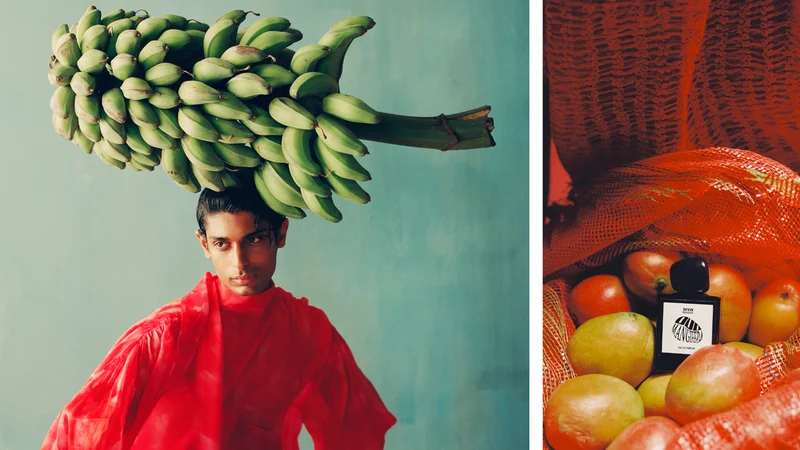
As Indians, we have this wonderful quality where fragrance fills our homes, our lives. It is in the hair of someone walking past us, a temple around the corner with its incense burning bright, a pot of chai boiling, a crowded fish market, or a bustling flower market filled to the brim with strings of tuberose, jasmine, lilies, and carnations.
Scent is our superpower. It is also perfectly interlinked with memory. So, I wanted to turn my attention to the rising number of niche Indian-origin fragrance brands cropping up around me.
‘A romanticised lens’
What is it about scent that makes it a cultural shorthand for home — one that a new generation of perfumers and entrepreneurs is now trying to bottle? I posed this question to Sai Pogaru of Rahasya Fragrance, a new niche Indian fragrance brand that caught my eye at Selfridges in London. “Scent was always linked to travel and exploration. When you smell something, it immediately transports you somewhere,” he explains, of the brand’s scents that have names like ‘Hill Station’ (for that very particular Indian experience of retreating to the mountains or hills in the summer).
Pogaru started the brand with his two friends in Singapore last year, after leaving their corporate jobs in social media, product design and management consulting, respectively. The brand has since expanded to the U.S. and the U.K. with Australia and India planned soon. “There is this dynamic energy in terms of how India is progressing and moving, the ideas that come out of it, and how culture is both preserved but also evolving,” he says. “That is something that is fascinating to us.”
With the founders being born in India but raised in varied parts of the world such as Indonesia, Singapore, the U.S. and Australia, I’m curious to understand their lens of India, bottled into vials of perfumes. Take, for example, Rickshaw Rhythms (a scent that Rahasya conjured with a member of their community who described rickshaw rides in Chennai along the coastal road and all the scents he smelled along the way: “coconut, sea breeze”, and more), or Oud Mangifera (inspired by the sticky, heat-y experience of eating mangoes in the summer).
“I think the diasporic lens is one where memories are very much rooted in the small cultural moments. It is a very unique lens because it is looking at home fondly from the outside in,” says Pogaru. “It’s an almost romanticised lens of India, and that’s not necessarily a bad thing.”
An ode to Delhi
Next up, my nose led me to Sept Fragrances, a small-batch fine fragrance brand that is conceived and championed between Paris and Delhi, founded by ex-fashion creative, Tanya Khurana. Named after her address in Paris (Saint Germain in the 7th arrondissement) where she lived for the large part of her adult life, after spending her foundational years in Bangkok, and with a small stint in the US, Tanya started the brand from Delhi, where she’s now lived for over four years, since moving back during the COVID-19 pandemic.
I came across her fragrance brand at a yoga event at the Serpentine Pavilion in London, hosted by a new Eastern Wisdom platform and app based in the city called Jnana. The scent in the give-away bag that I received was ‘Lores’, an ode to the layered history of Khurana’s home, Delhi. “Lores plays on sandalwood in a sparkling, non-conventional interpretation, mixed with papyrus, saffron, caramel and cinnamon,” she says. “It was personal for me because I wanted to create an ode to home — Delhi — and its layered history. Delhi has gone through so many rebirths and regenerations, and I wanted to bottle that up.”
Khurana, along with her independent Parisian fragrance studio partners, dream up classical Indian fragrances, but with the lightness of the Mediterranean. For instance, the ‘Rose Caravan’, a charming and eclectic take on the quintessential South Asian ingredient that is also genderless.
What personally draws me to her brand is its visual world. There are layers of references that feel distinctly modern. For ‘Rose Caravan’, it was Wes Anderson’s Darjeeling Limited that informed the fragrance’s world. Think pink and cactus tones as Owen Wilson and Adrian Brody navigate the chromatic lens of the filmmaker through India. “What I saw was an interesting space for a contemporary niche brand with a distinct cultural voice that, in quality and craftsmanship, stands alongside global niche brands,” she explains.
The forerunners
ragasin the Bandra heat.
‘Not only for those who want to shop Indian perfumes’
What both these brands, and many of their ilk, are doing is a kind of reclamation. Rahasya, which means mystery and secrets in Sanskrit, for the brand translates as reclaiming the Indian ingredients that have long been used by international fragrance houses. A kind of, “these actually come from India, and see, this is what we can do with it in our unique way”.
Similarly, Sept, wants to share the modern Indian story with the world. “The fragrances are not made only for people who want to shop Indian perfumes. People from Italy or America tell me they are reminded of childhood, a grandmother’s garden, or food they love. That is the beauty of fragrance: it doesn’t have to be culturally tied,” says Khurana.
The more niche perfumes I encounter, the less abstract this idea becomes. One of my current favourites, Tsu Lange Yor’s TLY 5755, with notes of Australian native sandalwood, Tasmanian mountain pepper, and buddawood — a scent so rooted in a place and culture far removed from my own, yet its memories still reach me. Perhaps that is what these new Indian brands understand: by celebrating the everyday and the niche, without reaching for familiar tropes like palaces and rose gardens, they choose to make their stories more specific — and, somehow, more far-reaching.
The column is dedicated to dissecting India’s growing presence around the world, against some of the most talked about cultural backdrops.
The writer is an independent journalist based in London, writing on fashion, luxury and lifestyle.
Published - August 07, 2026 04:38 pm IST