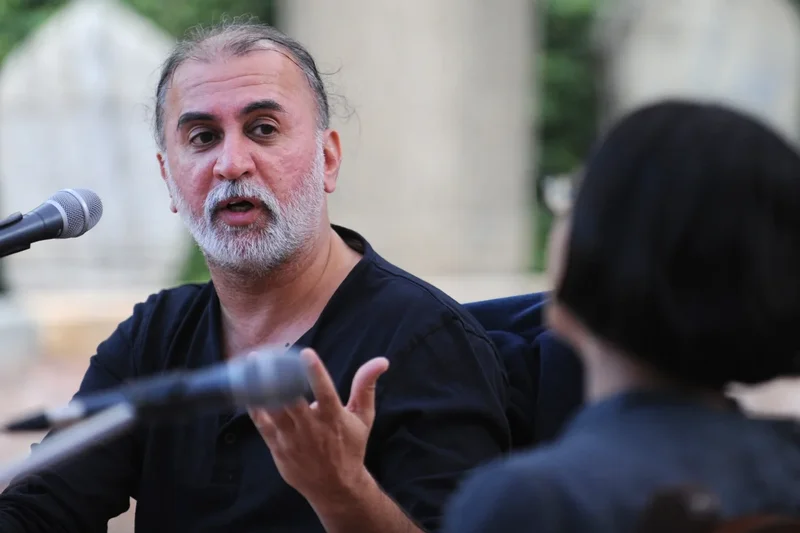
Indian journalist Tarun Tejpal, once among the country’s best-known investigative editors, has been sentenced to 10 years in prison after a court convicted him of raping a junior colleague during a work event in 2013.
The Bombay High Court’s Goa bench on Thursday found the 63-year-old founder and former editor-in-chief of investigative news magazine Tehelka guilty of rape and sexual harassment, setting aside a 2021 trial court ruling that had cleared him of all charges.
The judges sentenced him to 10 years’ imprisonment, ordered him to pay fines of around Rs1m (£7,815), with the amount to be paid to the survivor.
Tejpal said he would challenge the ruling in the Supreme Court, and judges granted him four weeks to surrender after his lawyer sought more time to lodge the appeal.
Tejpal, who founded Tehelka in 2000, built a reputation as one of India’s leading investigative journalists through a series of undercover investigations, most notably the “Operation West End” sting into alleged defence corruption.
In November 2013, a junior colleague accused Tejpal of sexually assaulting her twice inside a hotel lift during Tehelka’s annual ThinkFest conference in Goa. The event, attended by politicians, business leaders, and international guests including Robert De Niro, was one of India’s best-known ideas festivals.
The journalist said Tejpal assaulted her on two consecutive days while exploiting his position as her editor. She later resigned from Tehelka, accusing the publication’s leadership of attempting to minimise the allegations and engaging in “tactics of intimidation, character assassination and slander” rather than supporting her, according to her resignation letter to then managing editor Shoma Chaudhury, published in full by India Today.
Tejpal was later arrested and spent about seven months in custody before being granted bail by India’s Supreme Court in 2014.
In May 2021, a sessions court in Goa acquitted him of rape, sexual harassment, and other charges, ruling that prosecutors had failed to prove the case beyond reasonable doubt. The judgment was widely criticised by lawyers, women’s rights campaigners, and legal experts after it questioned the complainant’s conduct after the alleged assaults, saying that she “did not demonstrate any kind of normative behaviour” that a survivor of sexual assault “might plausibly show”.
The judgement also said certain facts created “doubt on the truthfulness of the victim”, and brought up photographs taken shortly after the alleged assaults, saying she was “smiling and looked happy, normal, in good mood”.
The Goa government appealed the acquittal, arguing that the trial court had effectively put the survivor on trial instead of the accused.
In an 81-page judgment delivered on Thursday, the Bombay High Court agreed.
Calling the earlier acquittal “perverse”, Justices Neela Gokhale and Amit Jamsandekar said the trial judge had fallen into the trap of expecting an “ideal” or “perfect” victim and had relied on “stereotypical assumptions” about how a survivor should physically resist or emotionally react after an assault.
The bench also criticised the lower court for allowing the defence to “harass and humiliate” the complainant during cross-examination. The judges described the survivor as a witness of “sterling quality”, held that her testimony did not require independent corroboration to sustain a conviction, and found that CCTV footage and Tejpal’s apology emails supported the prosecution’s case.
The judges found that the prosecution had proved its case beyond reasonable doubt and convicted Tejpal under provisions of the Indian Penal Code covering rape by a person in a position of trust or authority, sexual harassment, and assault with intent to disrobe.
During sentencing, Solicitor General Tushar Mehta, representing the Goa government, urged the court to impose the maximum punishment, arguing that Tejpal had abused his position over a woman “of his daughter's age”.
“This court must give out a clear message to society that when a girl says no, it means no,” Mehta told the bench, according to Live Law. “A no means a no.”
Tejpal pleaded for leniency, telling the court: “I am 62 and I believe I am a victim. I have a wife... All that I can say is we can go and appeal. Please be lenient for me.”
Outside court, he said he would challenge the conviction in the Supreme Court and maintained that the prosecution was politically motivated. “For the past 13 years they are after me because of my work with Tehelka,” he told reporters. “There is so much evidence that I should have been acquitted 10 times over.”
The survivor’s mother welcomed the verdict, telling NDTV it had lifted “a heavy weight” after years of legal proceedings. “It was painful long years and took a lot of strength to keep going,” she said.