Have you ever looked at a keyboard and wondered why there is a key called ‘shift’ staring at you? That too, not just on one side, but one on each side, with an upward arrow next to it. Sometimes the key becomes just the upward arrow as well, like how it is shown on phone keyboards.
What is this key? Why is it called the ‘shift’ key? Read on to know more about its origin story!
The origin which shifted things
Fun fact: the shift key was never an invention made for computers. It began way back in the late 1800s when typewriters were the star of the show.
A journey which lasted years and years, typewriters have evolved over time. From not having a keyboard structure to forming the QWERTY layout we see today to the shift and caps lock keys we see today — typewriters and keyboards have come a long way.
It was around 1878 that the idea of the shift key was executed on a typewriter — the Remington No. 2 typewriter — created by the E. Remington and Sons company. Typewriters till then either only had one set of capital letters to type anything out or were bulky with two sets of ‘keyboards’ (one lowercase and the other uppercase), which had to be used alternatively whenever needed. The initial Remington typewriter also did not have the shift key.
In 1878, the Remington No. 2 Typewriter adopted the first shift key instead of adding a second keyboard — basically one keyboard and a mechanical shift to access uppercase letters and extra symbols. This enabled the typers to easily shift between lowercase, uppercase and even symbols.
A key had two parts — a lowercase alphabet and uppercase characters or special characters. Both were on the same side but away from each other that it had to be mechanically shifted to change.
Pressing down the shift key while typing physically moved or ‘shifted’ the type mechanism so that, instead of hitting the paper with the lowercase character, the machine would hit it with the uppercase or special character. Releasing the shift key made it go back to lowercase characters. This mechanical technique changed the way typing itself used to happen and, funnily enough, stuck around to date as the shift key on your laptop!
This was a major improvement in typing efficiency, reducing the number of keys and making it easier and faster to switch between cases.
Ever evolving
Over time, typewriters commonly added two shift keys, one on each side, so that they could be used through whichever hand was free, much like modern keyboards.
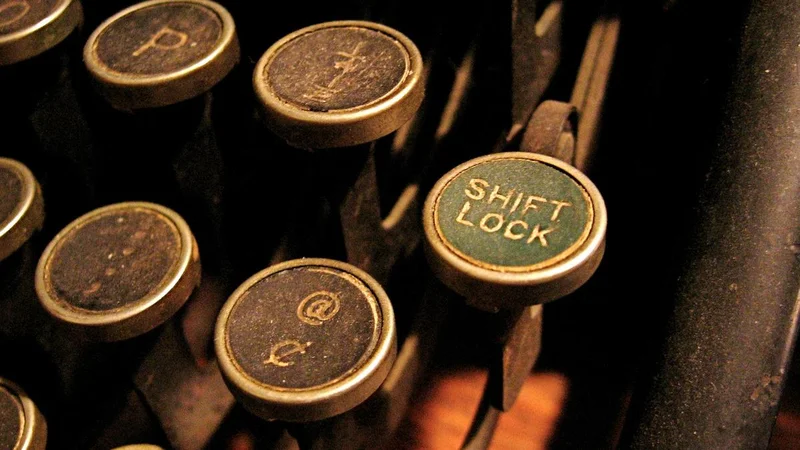
Some typewriters also had Shift Lock mechanisms, an ancestor of the Caps Lock key we have today, used to shift fully to uppercase characters. It held the machine in the shifted position so everything would type in uppercase without needing to keep holding the key like before.
Today, the design and names of the inventions remain the same, and the function for the most part. The technique used, however, has shifted from mechanical to purely software-based. Now, the keyboard’s controller detects that the shift key is being held and alters the scan code it sends to the computer. The operating system and applications then interpret that combination as a different character or command. While techniques change, the ideas and innovation behind them stay the same!
Published - August 07, 2026 04:52 pm IST