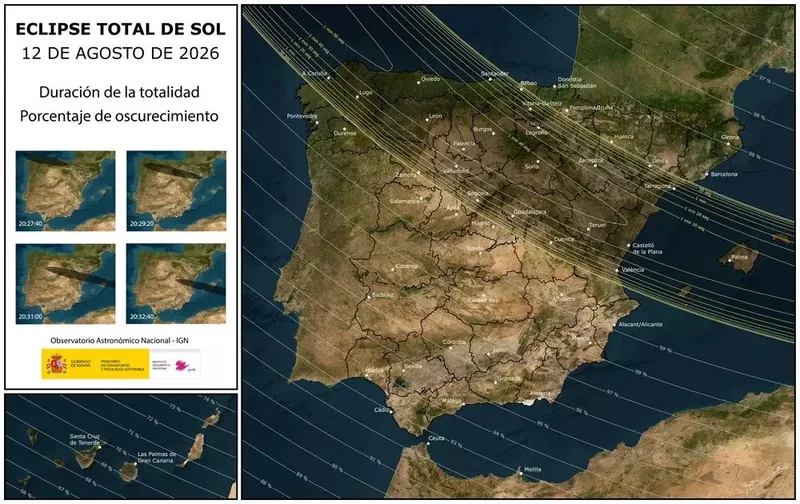
The total solar eclipse is a big deal here in Spain because this is the first time that this event will be able to be seen from Spain in over 100 years.
If you're planning on travelling to see it or want to witness it in your area, there are certain things you need to be aware of in order to get the best out of the experience.
Q: What exactly will happen on August 12th?
There will be a total solar eclipse, which will be possible to see from many parts of northern Spain.
This happens when the moon comes directly between the Earth and sun, blocking the sun out completely and only leaving the corona – the outer layer of its atmosphere, which will look like a halo of light around it.
You will only be able to see this phenomenon in the path of totality. Once either side of this path, you will only be able to see a partial eclipse, meaning the moon will only partially cover the sun.
**Q: How will I know where to see it from? **
The total eclipse will be able to be seen from hundreds of locations all the way from Galicia through Castilla y León and central Spain, over to Aragón and then finally, southern Catalonia, northern Valencia and the Balearic Islands. For the exact locations, you’ll need to look at an eclipse map.
Regional, provincial, and municipal authorities have begun publicising observation points across the country which will not only have good viewing, but will also be able to accommodate visitors.
RTVE has complied a good map here showing all the official viewing locations.
For example, here are the places that the Navarran government has highlighted as the best places to watch it from in the region. You can see the places in your area by searching eclipse plus your region.
Q: Is it necessary to go to a particular viewpoint?
While you don’t have to go to one of these particular official viewpoints to be able to see the eclipse, you will need somewhere that meets specific requirements.
It will need to be somewhere you can clearly see the western horizon without any obstructions in the way such as mountains, buildings, or trees, according to the National Astronomical Observatory.
READ ALSO: Where to travel in Spain to see the solar eclipse this summer
Q: How do I know exactly when the eclipse will happen?
The total eclipse will happen just before sunset, but the exact time you will be able to see it and for how long, will depend on where you are in the country. The further west you are, the earlier you will be able to see it.
In A Coruña, in Galicia for example, the eclipse will begin at 19.30 and will reach totality at 20.27, while on the other side in Tarragona in Catalonia, it will begin at 19.35 and reach totality at 20.29.
It’s only a few minutes difference, but if you want to see it, you’ll need to know the exact time, that’s because it will only last around just under two minutes to just around 30 seconds, depending on your location. The nearer to the central line you are, the longer you’ll be able to see it for.
There are several apps that will find the best spot to position yourself and the exact time the eclipse will start. The Spanish National Geographic Institute (IGN) has released this app (for Android) (for iPhone) where users can find all the relevant information about the three eclipses visible in Spain between 2026 and 2028.
Q: Do I need special glasses to view the eclipse?
According to NASA, you can view the eclipse directly without proper eye protection only when the moon completely covers the sun.
If you want to be able to see the eclipse as it moves towards totality, then yes, you will need special certified eclipse glasses with ISO 12312-2 approval. Many cities in the path of the eclipse are handing these out for free over the next week or so.
Find out where to get them here. You can also buy them online if you can’t get a free pair, and many .
READ ALSO: How to get free glasses to see Spain's total solar eclipse
Q: Why is it so dangerous to view an eclipse with the naked eye?
If you watch the eclipse happening without protection you could severely damage your eyes.
Elena Salobrar, a professor at the Faculty of Optics and Optometry at the Complutense University of Madrid explains that the ultraviolet light from the sun generates free radicals which destroys the neurons in our retina, “and infrared light essentially cooks them”.
Q: What happens if I can’t get a pair, is there another way to see it safely?
If you can’t get a pair of certified glasses, you will only be able to view the eclipse indirectly without damaging your eyes.
This means using a pinhole projector card, box projector or similar.
According to the Royal Museums in Greenwich in the UK, to make a pinhole projector, you can get two pieces of paper and make a small hole in one. Then hold it above another piece of paper to see the shadow being cast on the sun replicated in miniature.
You can also hold up a colander and look at its shadow or look at the shadows cast by leaves on the ground.
For optimal viewing, however, special glasses are the best way to go.
Q: Will it be cloudy at the time of the eclipse?
On Friday August 7th, Spain's national weather agency Aemet issued a relatively reliable forecast of cloud cover that will affect the skies in the path of total solar eclipse.
According to Aemet spokesperson Rubén del Campo, “it is likely to be a day with generally stable weather, although clouds may develop from midday onwards in mountainous areas of the north and east of the peninsula, with the possibility of isolated thunderstorms.”
This isn't a surprise for those familiar with the weather along Spain's northern coast in particular, which tends to be more changeable than other parts of the country, even during summer.
“The areas along the path of totality where a good view of the eclipse is most at risk are northern Galicia, western Asturias, the Cantabrian Mountains, and the Iberian System region shared by Teruel and Castellón,” warns José Miguel Viñas, meteorologist at Meteored.
All you can do is cross your fingers, and hope visibility is at its best.