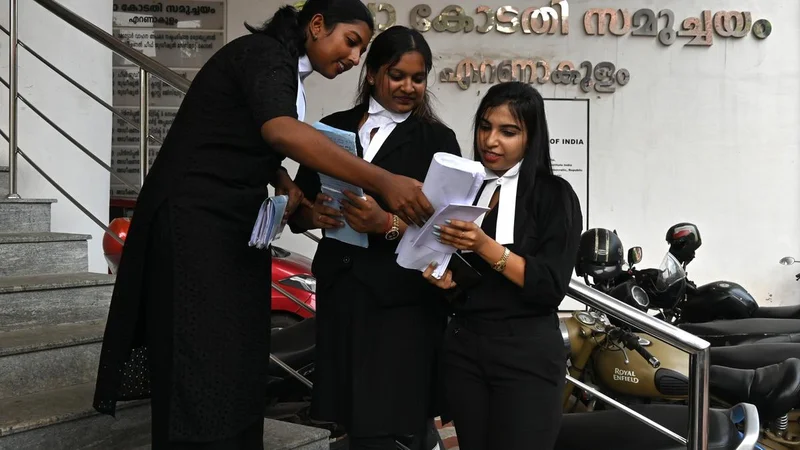
The Bar Council of India (BCI) has directed universities across the country to physically inspect all affiliated and constituent law colleges and submit compliance reports within six weeks. It has also asked universities to identify and discontinue impermissible weekend, evening and shift-based law programmes that, according to the regulator, dilute the mandatory character of a regular law course.
The move marks the latest step in the BCI’s long-running effort to improve the quality of legal education in India.
Why has the BCI intervened now?
In July, the Supreme Court made strong oral observations concerning the quality of institutions imparting legal education and the continuing operation of deficient law colleges.
The BCI also took note of the Andhra Pradesh High Court’s July 29 judgment in All Saints Christian Education Society v. State of Andhra Pradesh, which reaffirmed that universities have a continuing duty to ensure that affiliated law colleges comply with the rules of legal education.
Following these developments, the BCI’s Standing Committee on Legal Education decided that universities should undertake fresh physical inspections of every law college under their jurisdiction.
Why has the quality of legal education become a concern?
Over the past decade, the BCI, the apex statutory regulator of the legal profession and legal education in the country, has repeatedly expressed concern over what it describes as a steady decline in the quality of legal education in India.
It has attributed this to the rapid proliferation of “unchecked and mushrooming growth of sub-standard” law colleges and Centres of Legal Education (CLEs).
The regulator blamed it on the indiscriminate grant of No Objection Certificates (NOCs) by State governments and affiliations by universities, often without adequate scrutiny.
Under the existing framework, a proposed law college must first obtain an NOC from the State government and affiliation from the university concerned. Only then does the BCI conduct its own inspection before granting approval.
The Council has also highlighted an acute shortage of qualified law teachers, saying that 40-50% of faculty positions remain vacant in more than 60% of government law colleges. It has further pointed to inadequate libraries, moot courts and research facilities, along with weak academic oversight, as factors contributing to the decline in educational standards.
How has the BCI tried to address the problem?
In 2016, the BCI urged State governments and universities to stop approving new law colleges. Three years later, it imposed a three-year moratorium on new Centres of Legal Education, citing falling academic standards. The moratorium was subsequently set aside by the Punjab and Haryana High Court.
In August last year, the Council again introduced a three-year moratorium on new Centres of Legal Education.
However, in March this year, BCI withdrew the August 2025 moratorium and shifted its approach to an inspection-based framework. Instead of relying on a blanket moratorium, it has adopted an inspection-based framework under which proposals for new law colleges, additional courses or increased intake are assessed through statutory inspections.
The BCI maintains that with around 2,000 Centres of Legal Education already operating in the country, the priority should be improving existing institutions rather than expanding their number.
What changes for law colleges?
The latest circular significantly expands the scope of inspections.
Universities have been directed to physically verify almost every aspect of a law college’s functioning before granting, renewing or continuing affiliation. This includes land ownership, classrooms, libraries, moot court halls, legal aid clinics, sports facilities, statutory approvals, faculty appointments, teacher-student ratios, and attendance records.
Inspection teams must examine original documents, take geo-tagged photographs and prepare evidence-based reports. They will also verify whether institutions have shifted campuses without approval, admitted students beyond the sanctioned intake, started unapproved courses or sections, or furnished misleading information regarding infrastructure or faculty.
Why are shift-based classes under scrutiny?
A key focus of the latest circular is colleges conducting law programmes through morning, evening, weekend, compressed or overlapping schedules.
The Andhra Pradesh High Court found that the institution before it was running multiple law programmes in different shifts despite lacking adequate infrastructure. It held that such arrangements were not recognised under the regulatory framework.
The BCI has now directed universities to identify institutions using shift-based arrangements to compensate for shortages of classrooms, faculty or other facilities. It has reiterated that a regular law course must follow the prescribed daily and weekly teaching schedule and warned that arrangements replacing regular instruction with weekend or evening classes, or facilitating proxy attendance, should be discontinued.
What happens if deficiencies are found?
Where material deficiencies are detected, universities have been directed to issue show-cause notices and pass reasoned orders after considering the institution’s response. The BCI has cautioned against repeatedly granting conditional affiliation to colleges with fundamental shortcomings.
The circular also states that no admissions should be permitted unless an institution has both valid university affiliation and current BCI approval for the relevant course and academic session.
What happens next?
Universities have six weeks to complete inspections and submit consolidated compliance reports to the BCI. The reports must identify fully compliant institutions, colleges with curable or serious deficiencies, those operating without valid approvals, and institutions conducting impermissible shift-based or weekend classes.
Institutions that fail to comply with the prescribed standards risk regulatory action.
Published - August 07, 2026 05:30 pm IST