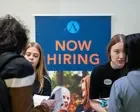
US employers unexpectedly lost 23,000 jobs in July and job gains for the previous two months were revised down sharply, as the summer slump in job growth continued amid ongoing conflict in the Middle East.
The unemployment rate, however, held steady at 4.1%. Economists had projected an unchanged unemployment rate and 83,000 new jobs for the month.
In June, the US added 57,000 jobs, about half of what economists had predicted, with most of the growth concentrated in healthcare and social assistance. The Bureau of Labor Statistics (BLS) also revised its job figures for the previous two months down by a total of 74,000 jobs. The unemployment rate had also dropped to 4.2% in June, down from 4.3% in May, driven by 720,000 people leaving the workforce.
Other data had pointed toward a slowdown in July. Private employers added 44,000 jobs in July, according to payroll firm ADP, a significant drop from the 98,000 jobs added in June recorded by the firm.
Job openings decreased by 178,000 to 7.4m in June, according to the latest Job Openings and Labor Turnover Survey. Job openings in healthcare and social assistance, key areas of job growth, declined by 147,000 in June, the largest decline since July 2025.
Economists have long said the US labor market is in a “low-hire, low-fire” state, and recent data from outplacement firm Challenger, Gray and Christmas found that layoffs in July plunged compared to last year. US-based employers announced about 33,500 job cuts in July, the lowest month in two years.
Though consumer spending has remained resilient, increasing by 0.3% in June 2026, the personal savings rate for Americans in June 2026 hit a four-year low at 2.7%, the lowest rate since June 2022, according to the US Bureau of Economic Analysis.
“With immigration having largely been stopped – and possibly now a net negative – the labor force is growing very slowly,” wrote Dean Baker, economist and cofounder of the Center for Economic and Policy Research, in a post on what to expect from the July jobs report. “However, slower wage growth, even in the face of rising inflation, indicates it is not a very good labor market for most workers. That story does not seem likely to change any time soon.”
Economists are closely watching the labor market and inflation as officials at the US Federal Reserve have become divided on whether to raise interest rates or leave them unchanged. Though the Fed held rates steady last month, officials indicated that they expect at least one rate hike before the end of the year to combat price increases. The annualized inflation rate in June was 3.5%–0.8% higher than a year prior.