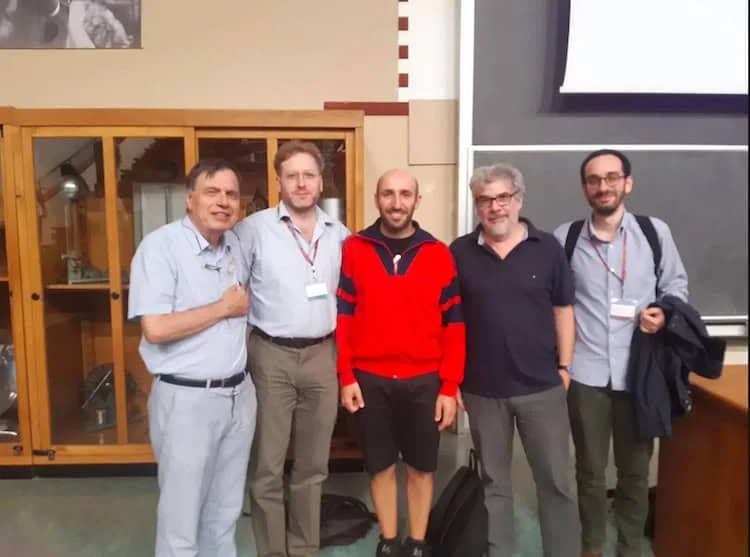
Two theoretical physicists – including a Nobel laureate – have solved a mathematical problem that flummoxed them for 10 years with help from Claude, the large language model (LLM) developed by the US-based firm Anthropic. In addition to its importance for fundamental physics, the result is significant because it offers further evidence that artificial intelligence (AI) is reshaping the nature of research in some fields.
The problem that kept Francesco Zamponi and Giorgio Parisi awake at night originates in the field of complex systems and relates to a phenomenon known as jamming. “Jamming describes a sudden transition at which a fluid system becomes completely rigid, yet remains disordered,” explains Zamponi, a physicist at the Sapienza Università di Roma, Italy.
To visualize this, Zamponi suggests imagining a box filled with spheres (such as tennis balls) that are floating in zero gravity, free from friction or weight. When there are only a few spheres in the box, they have plenty of room to move, bouncing off each other and the box like a classical gas. However, if you add more spheres or inflate the existing ones, space becomes increasingly scarce, and a sphere that tries to move soon impinges on its neighbours. Eventually, a critical density is reached, and every sphere is securely held by those around it, causing the entire system to “lock up” into a state where no more movement is possible.
If the spheres freeze into a regular, geometric pattern, they form a crystal-like structure that resembles carefully stacked oranges at the market. If they are compressed or added quickly, though, a crystal cannot form. Instead, they freeze into a completely disordered packing state, like a traffic jam.
Generalizing the problem
Moving beyond physical spheres into more abstract territory, Zamponi notes that jamming is an example of a highly general mathematical problem known as constraint satisfaction. “In this framework, the spatial positions of the spheres act as the variables, or degrees of freedom, while the strict rule that no two spheres can overlap serves as the constraint,” he explains. As more variables are incorporated, Zamponi adds, satisfying all the rules simultaneously becomes increasingly difficult.
Because of this precise mathematical mapping, jamming concepts are widely applied in neuroscience and artificial intelligence. In a machine learning model or a biological brain, for example, the synaptic weights represent the degrees of freedom, while the data classifications or memories that must be learned serve as the constraints.
“Just like physical spheres, an artificial neural network undergoes a jamming transition,” Zamponi observes. “In the ‘liquid’ phase, the network easily configures its weights to satisfy all constraints, allowing it to classify data perfectly. But when tasked with too much data, it hits a wall, corresponding to the ‘solid’ phase. It can then no longer satisfy all the conditions, and it begins to make errors.”
A surprising relation
In 2014, Parisi, who received half of the 2021 Nobel Prize in Physics for “the discovery of the interplay of disorder and fluctuations in physical systems from atomic to planetary scales”, and Zamponi spotted a surprising relation in the theory of jamming. Working with colleagues in the US and France, they found that in numerical calculations, two mathematical parameters, denoted a and b and related to the scaling of the distribution of contact forces and inter-sphere gaps as the system reaches the jamming point, mysteriously add up to 1. These parameters are very important for characterizing the physical structure of the packing, but try as the researchers might, they could not obtain a formal mathematical proof that a + b = 1.
AI’s black box problem: discovering physics we don’t understand
Asking generative AI for help was Parisi’s idea. The problem was well-suited for machine assistance because it was well-defined, with a clear conjecture and a known numerical answer but no analytical proof. He and Zamponi chose Claude because it boasts more advanced coding and mathematical reasoning capabilities than other models of its kind.
Even so, they didn’t ask it for the proof immediately. “We first prompted Claude to replicate the numerical calculations our group had developed a decade ago,” Zamponi explains. “Once it had successfully reproduced those exact results, we took the natural next step and asked it: ‛If a + b = 1, can you prove why?’”
The model produced an initial conceptual path that was essentially correct, but that contained minor mathematical errors and required several iterative refinements and verifications. Still, Zamponi says, the “core intuition” belonged to the AI: “We had spent years looking for a complicated solution – like deeply hidden structural symmetry – but Claude showed us that the solution was far simpler; it was right there in front of us, but we had just missed it.
“The new proof connects our infinite-dimensional theory, which is more abstract but mathematically rigorous, with a framework developed at the same time by our colleague Matthieu Wyart and his team at the École Polytechnique Fédérale de Lausanne (EPFL),” Zamponi continues. “Wyart’s theory is built on more concrete physical notions, but it relies nevertheless on some assumptions.” The new result, he tells Physics World, confirms that both starting points lead to the same physical laws.
“More important than the industrial revolution or the birth of the Internet”
Zamponi believes that the advent of generative AI could be on par with, or even more important than, the industrial revolution or the birth of the Internet. As a “telescope for the mind”, he says it could become indispensable for research, allowing scientists to test ideas at unprecedented speeds. It could also lower specialization barriers and facilitate interdisciplinary work by unlocking complex literatures that would otherwise take too long to master.
On the downside, though, Zamponi is concerned that LLMs also encourage the production of poor-quality, pseudo-scientific research, straining the peer-review system. “We desperately need to figure out how to filter and review this influx,” he says. “We also need to design novel pedagogical frameworks to responsibly integrate tools like Claude into undergraduate and graduate research courses.
AI-led solutions of Erdős problems spark debate over the future of mathematics
“To use these tools responsibly, we believe transparency is key. This is why we chose to publish our full conversation with Claude alongside our paper. If an AI sparks a genuinely new idea, we believe that its ‘thought processes’ should be public record.”
Jamming and random sequential absorption
Zamponi is now applying the approach detailed in the new work, which is published in Journal of Statistical Mechanics: Theory and Experiment, to a problem involving the random sequential absorption (RSA) of hard hyperspheres. This classic protocol for generating random packings involves introducing spheres one by one at completely random positions. “It is a vital tool for understanding the geometry of void spaces and packing efficiency, which directly relates to finding optimal error-correcting codes and navigating the mathematical ‘curse of dimensionality’,” Zamponi says.
While both RSA and jamming transitions describe how systems of hard spheres lock up, they represent two fundamentally different physical processes, he explains. In traditional jamming, particles are mobile and fluid and they continuously rearrange and relax until the entire system undergoes a collective, sudden transition into a rigid, solid-like state. RSA, on the other hand, is a strictly out-of-equilibrium, irreversible process where particles never move once placed. RSA therefore reaches a “saturation” limit rather than a true collective jamming transition.