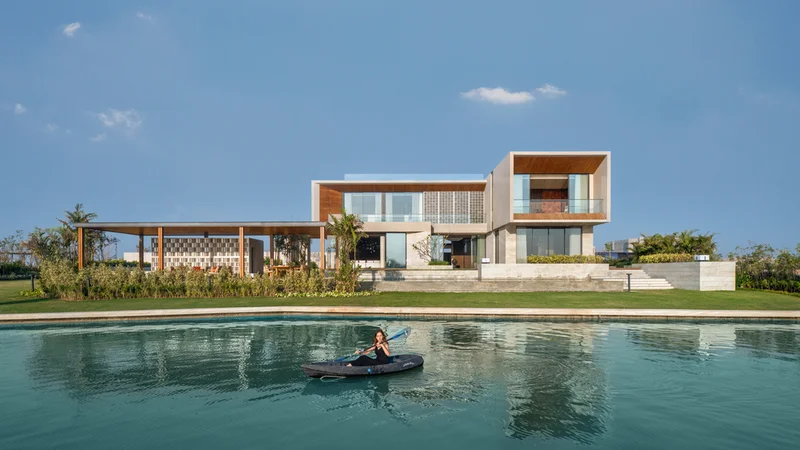
Tumbleweeds roll across the road, stark against the heat haze on the horizon, as we leave Ahmedabad city limits. In the suburbs, the landscape is a dry, dusty brown, which makes our destination all the more difficult to visualise: a massive 72,600 square yard man-made lake nestled in the heart of By the Waters, an upcoming ultra-exclusive 100-acre residential estate by Suryam Developers.
Yes, a lake. In the middle of parched scrubland. The surprise lessens when we learn Witteveen+Bos has engineered the hydrology for this project. The Dutch know a thing or two about working with water in unlikely places — after all, they literally wrangled their country from the sea.
Just 35 km from Ahmedabad, the lake, or Blue Heart as it is called, is being planned as the idyllic backdrop for 99 bespoke waterfront villas (made in collaboration with SCDA Architects from Singapore) at Suryam’s new residential estate. “The inspiration was a refusal to accept that luxury in India must mean verticality and density,” says G.M. Patel, founder and chairman of Suryam Group. “What we kept returning to was a simpler question: what does stillness feel like? And water is the most ancient answer to that question.”
“The system is designed as a closed loop, drawing on a combination of groundwater, rainwater harvesting, groundwater recharge, and seasonal monsoon capture. Gujarat’s erratic rainfall pattern was central to the brief we gave our water engineers — the system had to be resilient across both deficit and surplus years.”G.M. PatelFounder and chairman, Suryam Group
Early doubts about the feasibility of the project evaporated when Witteveen+Bos came on board. “What they introduced was the concept of the water body as a closed-loop biological system rather than a static body requiring constant chemical intervention,” says Patel. “That shift in thinking changed everything about how the lake was designed, from its depth profile to its circulation, to the way the surrounding landscape feeds and filters it.”
Blue Heart in Ahmedabad
Man-made lakes are often a fraught topic. While they can offer significant benefits such as water storage, flood control, and habitat creation, they can also have an adverse environmental impact if improperly done, resulting in anything from increased methane emissions to harmful algae bloom and, ironically, even habitat destruction.
India has a long history of man-made lakes. Across the country, erstwhile maharajas and nizams constructed them as royal symbols and sources of irrigation. Examples include Jaisamand and Pichola in Udaipur, Osman Sagar in Hyderabad, Hirakud in Odisha, and Bhojtal in Madhya Pradesh, the oldest man-made lake in India. Many, however, have been in the news for all the wrong reasons. Bellandur Lake in Karnataka, for instance, has been notorious for contaminating groundwater and surrounding vegetation (as around 500 million litres of untreated sewage is dumped in it daily). Similarly, Bhojtal is facing severe ecological decline because of shrinking catchment areas, rapid urbanisation and untreated sewage. Real-time monitoring and other initiatives are now trying to regenerate its wetland ecology.
“Eutrophication, or excess nutrient loading — primarily nitrogen and phosphorus — is the main failure mode of constructed lakes in warm climates. It drives algae proliferation, which depletes dissolved oxygen and suppresses biodiversity,” explains Dhaval Makhmalwala, master plan and landscape architect, who worked on the project with the team from Witteveen+Bos. “Most constructed lakes in India arrive at that condition within a decade. The reason is almost always the same: the external nutrient load was never controlled, the depth profile allowed thermal stratification [division of a body of water into distinct temperature layers], and there was no biological community designed to consume nutrients before they could accumulate.”
This is where Blue Heart hopes to be different. According to Makhmalwala, their counter-strategy addresses all three red flags. “The closed-loop design eliminates wastewater ingress, the depth profile prevents stratification [which enables phosphorus loading], and continuous water movement by an automated inlet system denies algal blooms the stagnant conditions they require. The native macrophyte fringe [aquatic plants such as reeds and cattails] along the bank provides a biological nutrient sink that, over time, will outperform any chemical treatment regime.”
A work in progress
When we finally reach By the Waters, it’s evening. Pale pinks and yellows ripple over the lake’s still surface, and a cool breeze skims over its surface, bringing some much-needed relief from the day’s residual heat.
It’s clear the lake is a work in progress. The riparian vegetation (plant life along the lake’s banks) is still establishing itself, and the water hasn’t achieved the clear blue that the designers promise it will be in the months to come. But many of the future highlights are already coming up: a 1.5-km lakeside promenade, 2-km kayak trail, over water pavilions, and multiple garden environments — “all curated to ensure that the water is lived with, not merely looked at”, as Patel puts it.
As work kicks into high gear, and the self-sustaining biological ecosystem comes to life, Makhmalwala shares more about the project. Edited excerpts:
How is the lake being built?
We began with a full system analysis to understand the hydrogeology of the site, soil permeability profiles, seasonal groundwater fluctuation patterns, and a detailed evapotranspiration model for this microclimate. In my experience, most constructed water bodies fail because the engineering responds to a generalised idea of a lake rather than to the specific conditions of the site.
The basin geometry that came out of that analysis is functional, not decorative. The depth gradients, bank profiles, inlet positions serve a hydraulic or biological purpose. A lake that moves, lives. Thus the closed-loop water sourcing logic. And what we are commissioning over the next 18 months is the automated intelligence that governs that movement: a real-time sensor network feeding into a management system that regulates inflow through multiple peripheral inlet points.
What baseline ecological survey was conducted?
The pre-construction ecological baseline characterisation covered vegetation, ground-level biodiversity indicators, soil taxonomy, and existing hydrology. The proximity to Thol Lake was something we took seriously. Thol is a Ramsar-designated wetland of ecological significance, and any new permanent waterbody in its vicinity will interact with that system. Our buffer zone assessment has informed both our water sourcing decisions and the native riparian planting palette for the estate’s margins. The formal biodiversity baseline monitoring programme is being established over the next 12 months as the landscape matures.
Critics argue that man-made lakes in water-stressed regions consume a resource communities desperately need.
We take this seriously. The Blue Heart is a closed-loop system and not a point of continuous extraction from a shared aquifer. The groundwater that replenishes the lake is cycled through the estate’s landscape irrigation requirements, and back into the soil through passive recharge. The hydraulic gradient created by a permanent standing body of surface water actively promotes infiltration back into the surrounding aquifer. Over time, a well-managed water body can improve local groundwater conditions rather than deplete them. This is measurable, and we will be measuring it through piezometric monitoring [that determines groundwater levels and pore pressure] as the system reaches operational maturity.
What ecological benefits does this water body offer?
The ecological dividend operates across several registers: urban heat island mitigation, passive groundwater recharge, biodiversity habitat creation, carbon sequestration through riparian vegetation, and microclimatic humidity regulation. The measurement programme for each of these is being designed now and will be formally operational over the next 12 to 18 months.
Our interest here goes beyond the ecological metrics themselves. It has been well demonstrated that constructed water bodies can be significant sources of greenhouse gas emissions if their biological conditions are not well managed. A healthy lake is a low-emission lake. We will be monitoring that as part of the ecological programme.
“We are currently in active collaboration with environmental science and hydrology specialists to undertake a comprehensive post-construction ecological baseline study. This will encompass biodiversity indexing, riparian corridor assessment, hydrological impact modelling, and long-term water quality benchmarking. We see this not as a one-time exercise but as the foundation of an ongoing environmental monitoring protocol.”G.M. PatelFounder and chairman, Suryam Group
Man-made lakes in India often become stagnant and polluted.
A water body that depends on continuous active human intervention to stay healthy will eventually fail when that intervention lapses. We have tried to build a system where ecological health is the path of least resistance rather than a continuous management effort. The closed-loop biology, automated flow management, biological fringe, all reduce the dependence on human vigilance to maintain the lake’s condition. A sensor network provides early warning when something is drifting.
Have you observed any ecological changes?
Observed data is limited; the lake is not at operational steady state. What we have is modelled projections and early observational signals. The modelling projected localised humidity increase, measurable surface temperature reduction, and the establishment of a riparian corridor that did not exist in this landscape before. What we find encouraging at this early stage is the waterbird activity already observed around the basin margins. Birds are reliable ecological indicators. When they arrive, it means the system is beginning to function. We will formalise the biodiversity monitoring over the coming year.
Published - August 07, 2026 06:50 pm IST