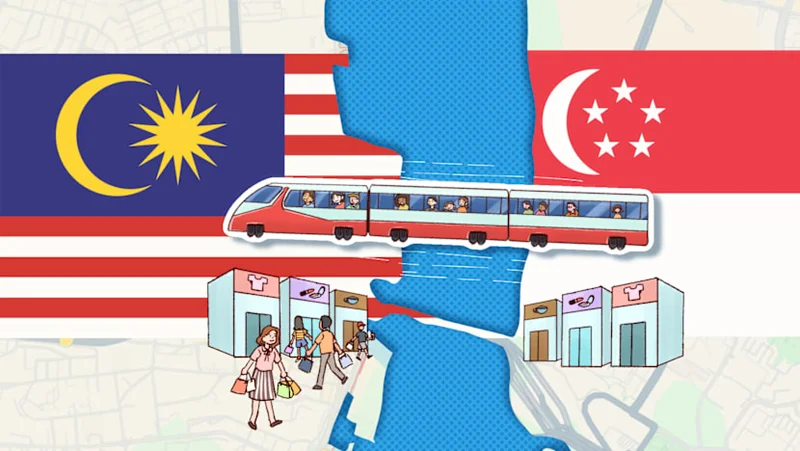
With Johor Bahru set to be just a 5-minute train ride away, Singapore merchants need to raise their game
The impact could ripple beyond shops and restaurants, but analysts say that it also offers Singapore businesses a chance to reinvent themselves through better service, stronger brands and new business models.
Every week or two, Mrs Ruth Lee makes a half-hour drive to Johor Bahru in Malaysia to enjoy a hearty breakfast and stock up on groceries, saving between 30 and 50 per cent of what she would spend in Singapore.
"I usually drive, but the traffic jams can make the journey difficult, so I have to plan carefully," the 55-year-old financial adviser said.
Before setting off for JB Sentral or before returning home, she has to check the traffic conditions to decide which route she should take. Since she shares a car with her husband, these trips also require her to coordinate schedules with him.
The Johor Bahru-Singapore Rapid Transit System (RTS) Link, which is slated to open in January 2027, could help her avoid such hassles.
"With the RTS, it will be much easier," she said. "I can go more often for groceries, a meal, a massage or even to get my nails done and be much more spontaneous about my trips."
While shoppers such as Mrs Lee are eagerly awaiting the opening of the RTS Link, merchants all around Singapore are feeling apprehensive about its potential impact on their businesses.
At 888 Plaza in Woodlands – a stone's throw away from Johor Bahru – Ms Kacey Lin's salon has seen a decline in business over the years as rising costs in Singapore have driven price-sensitive customers to competitors in Malaysia.
The 50-year-old owner of Dawn Beauty, which offers nail services as well as facials and massages, said: "There're already quite a lot of customers going to Malaysia. When the RTS Link opens, we can't predict how many more of these customers will flock to Malaysia.
"We'll definitely be affected – just unsure to what extent."
Her worries were echoed by small businesses across the island.
Mr Wong Toh Onn, 70, who works at a minimart in Bukit Batok East, said that business has dropped by about 20 per cent in the last two years.
His customers were upfront with him and admitted that, with the cost of living rising, they were heading to Johor Bahru more often for groceries to capitalise on the favourable exchange rate there.
"What can we really do? We sell groceries, all we can do is try to keep prices as low as we can."
However, Mr Wong and other retailers told CNA TODAY that it is getting harder for them to keep prices down, with rent, manpower and the cost of supplies already going up.
"When the train opens, we're doomed," Mr Wong predicted.
A study jointly commissioned by the Singapore Business Federation (SBF), the Restaurant Association of Singapore and the Singapore Retailers Association, which was published in July, helped quantify such concerns.
Singapore residents are projected to spend an extra S$1.05 billion (US$820 million) a year in Johor Bahru once the RTS Link opens.
Johor Bahru visitors will also spend more here, but that incremental spending is a smaller projected amount of S$756 million yearly.
This means that Singapore will see a S$290 million net increase in outbound spending each year, equivalent to 0.4 per cent of Singapore's total retail and food-and-beverage (F&B) sales in 2025.
TIP OF THE ICEBERG
The study also found that certain businesses are expected to be hit harder than others, depending on the nature of their business and location.
Businesses dealing with groceries and food products are projected to see the largest net incremental outbound spending, followed by drug stores, F&B establishments and providers of beauty services.
Most regions of Singapore are expected to experience a net outflow in spending, except for Central Singapore, which could see roughly S$25 million in net increased spending mostly in higher-end retail, entertainment, hotels and dining.
Though the S$290 million net increase in outbound spending may represent a relatively small 0.4 per cent of Singapore's retail receipts last year, experts said that the percentage might just be the tip of the iceberg.
Mr Ang Yuit, president of the Association of Small and Medium Enterprises (ASME), said that there would be knock-on effects if shops in Singapore close, for example.
Of the roughly 24,500 retail enterprises here, 98 per cent of them are micro and small businesses.** **
"In our business ecosystem, there are suppliers, logistics providers ... all hiring workers with families, all tied in with the heartland (retailers)" Mr Ang added.
"If you have a series of them closing down, then you'll have a bit of a situation."
Analysts also pointed out that in the long term, if small and micro businesses in the suburbs shut, the retail scene will be left with just big chains and global brands and nothing uniquely Singaporean.
However, businesses and industry observers told CNA TODAY that the opening of the RTS Link in itself is not the problem.
Instead, the new cross-border link lays bare and exacerbates existing challenges that merchants have been facing: rising overheads that eat into profit margins, stacked against a market in close proximity with a structural price advantage due to the exchange rate.
The recent study put forward 11 policy recommendations across three broad categories to tackle businesses' concerns: stimulate domestic spending, boost tourist spending, and support business adaptation.
Some of the recommendations in the form of temporary cost- and price-related assistance, such as expanding the Community Development Council (CDC) voucher scheme, as well as providing targeted manpower levy relief and wage support, will act as important "band aids", analysts said.
This is especially so given that rising operating costs and manpower constraints are limiting some businesses' ability to invest in customer service, service quality and differentiated retail concepts.
Yet, such support on its own will be insufficient and unsustainable for the long term, they added.
Professor Lawrence Loh, director of the Centre for Governance and Sustainability at the National University of Singapore (NUS) Business School, said: "I think we cannot 'voucher' our way out of the structural issue.
"There's a different cost structure, different operating conditions that go beyond just simple price differences. It is more deep-rooted than that."
Associate Professor Lee Kuan-Huei from Singapore Institute of Technology (SIT) said that since the RTS Link will be a permanent feature, it will be necessary to establish policies to deal with the long-term impact, and not initiatives to just cushion temporary shocks.
The director of programmes for the business, communication and design cluster at SIT added that policies and assistance should be tied to transformation, productivity improvement and new business models.
Given that the RTS Link has been in the works for years – with construction in Singapore that began in January 2021 – the government has been cognisant of the effects that it will have on Singapore businesses.
A task force was set up in March 2025 to look at how firms can tap new opportunities arising from this transport link.
During the latest parliamentary session earlier this week, four members of parliament have raised questions about the impact of the RTS Link on domestic businesses following release of the study.
In his written responses, Mr Gan Kim Yong, Deputy Prime Minister and Minister for Trade and Industry (Trade), said the government recognises that Singapore businesses are operating in "an increasingly competitive environment" and that the task force will share its findings and recommendations in further detail later this year.
CLUTCHING ON TO THE SINGAPORE DOLLAR
Fully aware that they cannot compete on price, several businesses told CNA TODAY that they are looking to capitalise on their unique selling points to appeal to consumers in Singapore.
Some are banking on the quality of their services and products so that customers are more willing to pay a premium.
Ms Lin, the spa owner, said that some of her customers who had tried beauty services in Johor Bahru have noticed the difference in quality.
"They say our manicures are cleaner, our nail sets are more durable, and the actual colours match the reference pictures better," she added.
"If we want to be optimistic about the situation, I would say (I'll compete by) continuing to improve our services."
There’re already quite a lot of customers going to Malaysia. When the RTS Link opens, we can’t predict how many more of these customers will flock to Malaysia.
Dr Terence Fan from Singapore Management University (SMU) pointed out that to leverage quality, stores cannot just focus on their service standards.
The assistant professor of strategy and entrepreneurship noted how similar goods – even of the same brand – sold in different markets may be manufactured by different factories and may have slightly different ingredient formulations.
Such products include baby formula milk and skincare products.
"Businesses here should be cognisant of such differences and highlight them to their consumers to further set themselves apart from competitors in Johor Bahru," he said.
Convenience and relatively immediate availability due to physical proximity are other inherent advantages that many businesses here have.
One business, Perky Lashes, has taken this a step further by providing home visits for its lash and nail services since April.
Its founder Jasmin Tay, 41, said: "It's usually after working hours that we have many mothers, who prefer doing their beauty services at home, so they can be with their kids."
She estimated that about half of her clients have tried its home-visit service or have made arrangements to do so, and all those who have tried it have given positive feedback on the service.
With just four branches in Singapore, Ms Tay has expanded her clientele without having to rent more spaces.
Other merchants are reviewing their product offerings and business models, focusing on those that have narrower price differentials with offerings across the Causeway.
Mr Samuel Pei, 45, started this process at Hanbang Skin Solution, which is a facial spa brand under parent company KC Group, where he is the co-founder.
He and his fellow founders decided on this strategy after noticing that other brands in his group that provide quick and "small-ticket" services, such as barber brands KCuts and Clippers Barber, have been less affected by competition up north.
The price difference is so small that a vast majority of Singaporeans do not find it worthwhile to travel to Malaysia for a simple haircut, Mr Pei said.
"We are compacting the menu, focusing on stripping off the top-pricing menu items to focus more on the value-for-money play, and using convenience as a unique selling point," he said of what they are doing with their other brands.
"The price will still be higher (than Johor Bahru) but not two or three times, so for convenience's sake, customers can do it here locally."
Similarly, F&B entrepreneur Francis Ng has had to adjust his business model after noticing his full-service restaurants such as House of Seafood in Punggol and Home of Seafood in Joo Chiat were experiencing a steady decline in revenue as Singaporeans ate out less.
In the last year, he branched out into the curry puff business.
"I converted my chilli crab dish to curry puffs. Rather than splurging S$100 on one plate of chilli crab, people are more willing to spend S$2 for one chilli crab curry puff and still get to taste the dish," the 54-year-old said.
"It's profitable, that's why it can scale up so fast ... and I can use the profits to make up for the losses at my seafood restaurants."
Analysts said that it is also pertinent for retailers to examine their backend operations.
Optimising their processes, such as using automation to save manpower costs in the long term, can go a long way towards bringing down costs and potentially widening their profit margins, making them more competitive and resilient ultimately.
Mr Ng, the F&B entrepreneur, has been experimenting with his menu offerings at one of his restaurants, House of White Bee Hoon at Tampines, to see how he can best streamline his kitchen operations.
The signature white bee hoon dish relies heavily on chefs, who cook each plate individually.
Recently, he decided to introduce "beef kut teh", a halal variation of the traditional bak kut teh (pork bone soup) dish, where a chef can cook a big pot in advance.
"Just one or two workers can handle everything," he said, adding that sales volume has since doubled at the restaurant.
Mr Christopher Lim, chief executive of beauty and healthcare chain British Essential, said that his company has been working closely with suppliers to remain price-competitive where possible, and investing in operational efficiency "so we can continue offering good value despite rising costs".
This is on top of other efforts such as expanding its exclusive product range.
Similarly, major supermarket chains said that among their strategies to tackle evolving developments, which include the RTS Link, are investments in retail technology and offering quality product mix while delivering convenience to consumers.
Mr Vipul Chawla, group chief executive officer of FairPrice Group said in response to CNA TODAY's query: "Over the years, consistent investments in value programmes, staff productivity, retail technology and automation have put us in a good position to tackle evolving developments."
In announcing Sheng Siong Group's first half of 2026's financial results, its CEO Lim Hock Chee said that the supermarket chain is ready to adapt its "pricing, promotions and product mix necessary to remain competitive" in light of the RTS Link opening.
Assoc Prof Lee of SIT said that among all the neighbourhoods, businesses situated in the northern region of Singapore will face the toughest challenge due to the RTS Woodlands North station being located there.
The study jointly commissioned by the business associations reported that pre-RTS, the region already experiences stronger outbound spending than other regions.
Therefore, it is all the more important that retailers there compete based on value offerings rather than prices, he added.
Agreeing, Ms Lee Gek Keow from Nanyang Polytechnic said that businesses and mall operators can band together to create a "stronger destination appeal" for Woodlands.
"For example, curated dining clusters, weekend events, community festivals, thematic markets and integrated loyalty programmes could help increase footfall and dwell time."
The senior lecturer at the polytechnic's School of Business Management also said that if done successfully, this can position Woodlands as a "natural stopping point for both Singaporeans and visitors travelling between the two cities".
Prof Loh from NUS suggested that Woodlands – being at the "mouth of the huge hinterland" – can be turned into an advantage, if infrastructure to host events can be built there with well-curated businesses around it, further adding to the vibrancy of the area.
In March this year, the Ministry of Trade and Industry announced an upcoming Woodlands Gateway district planned around the RTS Link station.
This mixed-use district will offer commercial and lifestyle amenities and include a transport hub. The district will span an area equivalent to about 50 football fields, with its first phase expected to be completed around 2030.
Assoc Prof Lee of SIT said that among all the neighbourhoods, businesses situated in the northern region of Singapore will face the toughest challenge due to the RTS Woodlands North station being located there.
The study jointly commissioned by the business associations reported that pre-RTS, the region already experiences stronger outbound spending than other regions.
Therefore, it is all the more important that retailers there compete based on value offerings rather than prices, he added.
Agreeing, Ms Lee Gek Keow from Nanyang Polytechnic said that businesses and mall operators can band together to create a "stronger destination appeal" for Woodlands.
"For example, curated dining clusters, weekend events, community festivals, thematic markets and integrated loyalty programmes could help increase footfall and dwell time."
The senior lecturer at the polytechnic's School of Business Management also said that if done successfully, this can position Woodlands as a "natural stopping point for both Singaporeans and visitors travelling between the two cities".
Prof Loh from NUS suggested that Woodlands – being at the "mouth of the huge hinterland" – can be turned into an advantage, if infrastructure to host events can be built there with well-curated businesses around it, further adding to the vibrancy of the area.
In March this year, the Ministry of Trade and Industry announced an upcoming Woodlands Gateway district planned around the RTS Link station.
This mixed-use district will offer commercial and lifestyle amenities and include a transport hub. The district will span an area equivalent to about 50 football fields, with its first phase expected to be completed around 2030.
BANKING ON VISITOR SPENDING
Even though Singapore residents are expected to spend more in Johor Bahru, the SBF-commissioned report also forecasts that people in Johor Bahru will spend more often in Singapore.
Dr Fan from SMU pointed out that the report specifically surveyed residents in Singapore and Johor Bahru, but it did not take into account the Electric Train Service (ETS) to Kuala Lumpur that opened at the end of 2025.
"Not only people in Johor Bahru may be interested to come over to Singapore, but people from a few more towns further north, because it's easier," he said.
However, how these tourists spend remains to be seen, he added.
Separately, the survey found that when it came to Johor Bahru residents, Central Singapore – which includes Orchard Road and Marina Bay – will "capture the lion's share" of their inbound spending, due to the concentration of premium shopping as well as major concerts and experiential event infrastructure there.
The report thus calls for support to decentralise event infrastructure to areas beyond the central region.
Analysts said that this suggestion is likely to be only partially feasible, especially in the immediate term.
"The advantage of Central Singapore has been built over the years with the concentration of premium retail, hotels, events and attractions that are connected to each other, which the majority of tourists will visit when in Singapore either for leisure or business," Asst Prof Lee from SIT said.
"It is going to be hard to replicate to other parts of the island."
Ms Lee from Nanyang Polytechnic said: "A more practical approach is for different districts to develop distinctive lifestyle, dining, cultural or community-based offerings.
"As consumers increasingly seek experiences alongside shopping and dining, there may be opportunities for suburban precincts to strengthen their appeal through unique local propositions rather than direct competition with the city centre."
The analysts gave examples of two neighbourhoods that have found ways to cement a distinct identities and appeal to visitors.
One is Joo Chiat, with its focus on Peranakan heritage and its innovative use of alleys and murals to entice visitors to wander around the area.
The other is Kampong Glam, with its focus on Malay-Muslim heritage and the lively slate of events that are held there.
Prof Loh from NUS, who suggested creating a vibrant lifestyle destination at Woodlands, said that such a site in the north would make it attractive for Johor Bahru visitors to make impromptu visits to Singapore.
"Johor Bahru visitors won't have to travel all the way to the city centre (for the leisure activity). And at night, they can just hop on the rail and go back right away, instead of taking a ride-hailing service all the way from Clarke Quay and such," he added.
Looking at the bigger picture, efforts must be made to grow uniquely Singaporean brands that are not available in Johor Bahru, as well as Singaporean brands that are globally recognised – such that visitors are naturally enticed to spend.
Dr Fan from SMU said: "If it's the same global brand, they might as well buy in Johor Bahru. Chances are, it might even be cheaper."
Mr Ng, the F&B entrepreneur, said that he has expanded his curry puff business into Indonesia and the Philippines, and is in the process of entering China and India.
Asked why Johor Bahru is not on his radar, given its proximity, he said that besides gunning for much bigger markets in the four countries, it is also about product differentiation.
"If I want to sell curry puffs in Malaysia, it also has curry puffs," Mr Ng reasoned. "But if I go to other markets first and it becomes a global brand, then there's a strong differentiation and Malaysians may be more keen to buy."
This is a similar principle to why tourists may want to try brands such as Old Chang Kee or Tiger Balm in Singapore given their strong brand equity.
In the meantime, other businesses are making sure that whichever side of the Causeway consumers choose to spend their money, it will ultimately be at their shops.
Healthcare and beauty care chain Watsons Singapore said that it has been preparing for "increasingly mobile consumers" by investing in its loyalty ecosystem, which allows members to access local promotions when they are travelling.
Other businesses told CNA TODAY that they are seriously considering expanding into Johor Bahru, but are adopting a wait-and-see approach for now.
ASME said that it set up a professional services centre in Johor Bahru in early 2025 to help Singapore businesses that need guidance in navigating the business landscape there.
Ultimately, business experts said that the efforts and investments proposed to better capture Johor Bahru visitor spending will also help businesses capture a slice of the growing international visitor spending pie.
After all, Singapore is hoping to grow tourism receipts from S$32.8 billion in 2025 to between S$47 billion and S$50 billion by 2040.
"If implemented successfully, they could also help attract spending from regional and international visitors," Ms Lee from Nanyang Polytechnic said.
Mr Ng the F&B boss said that the RTS Link is indeed a major development with a potentially significant impact on his business, but such big changes are par for the course for any entrepreneur.
"It's not easy, but businesses must always be willing to continue changing their business model according to the market to survive."