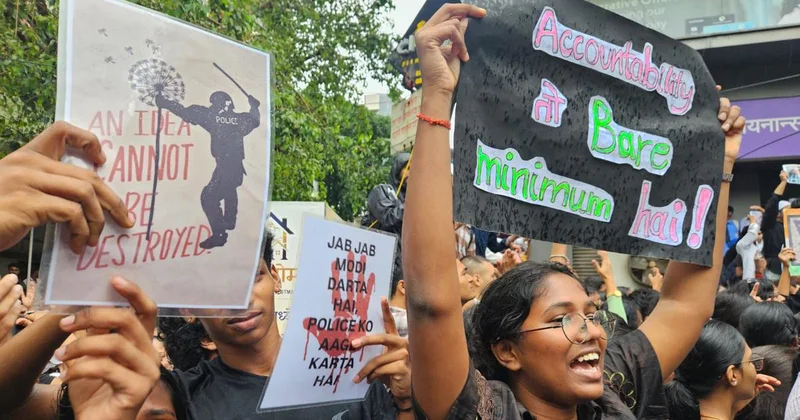
On July 20, hours after students marching to Parliament were beaten up by the police in Delhi, Mumbai student Preeti Kamble headed to Shivaji Park in the heart of the island city.
Kamble, who recently passed her Class 12 exams and is preparing to join college, wanted to demonstrate her solidarity with other students. “A close friend of mine is preparing for the NEET exam,” she said, referring to the national-level medical entrance test.
The Cockroach Janta Party-led protest in Delhi is demanding that Union Education Minister Dharmendra Pradhan resign for mishandling the national NEET-UG exam for seats in medical colleges.
Kamble explained: “Her parents have put their entire savings into her education. I decided to show up at the protest site so I could do my bit to ensure she does not face what other NEET students did.”
But Kamble was detained by the police even before she could reach the protest site or shout any slogans.
She was taken to the Kalachowkie police station, in the south-eastern part of the city. “They took my name, phone number and address and let me go,” Kamble said.
But the police action did not end there. The next day, Kamble got a call from her local police station in Amboli in northern Mumbai to come and collect a notice issued against her under sections 37 and 135 of the Maharashtra Police Act that relate to disobeying prohibitory orders and section 189 of the Bharatiya Nyaya Sanhita that relates to unlawful assembly.
She visited Amboli police station on Tuesday and waited for two-and-a-half hours before the police allowed her to leave.
On Wednesday, three police officials showed up at her door. “Only one of them was dressed in uniform,” Kamble said. “They insisted that I again go to the police station with them.”
She said the police would have used physical force had her mother not stepped in.
Kamble is not alone. Several young protestors have alleged that the Mumbai Police have been using intimidatory tactics to prevent them from attending protests in support of the youth agitation in Delhi that has rattled the Narendra Modi government.
According to a statement by the Mumbai police on Wednesday, 1,400 people have been taken into custody in the city for taking part in various protests since July 16.
Hundreds were detained and then let go. Many of those then were pressured not to take part in subsequent protests, they told Scroll. Some got police notices on WhatsApp, listing sections of the Bharatiya Nyaya Sanhita.Some received calls to visit their local police stations. Some were asked to share their live GPS location with the police.
And some, such as Kamble, had police constables knocking on their door.
On Wednesday, as the city braced for protests in support of the Cockroach Janata Party campaign, Mumbai police began visiting the homes of protestors they had mapped over the last two days to detain them.
Scroll called Mumbai Police spokesperson Raj Tilak Roshan several times to ask about the rationale behind the action. He did not respond.
Senior police inspector at Shivaji Park station, Pramod Pawar, told Scroll that the protestors were detained because they assembled unlawfully.
The police at the protest in Chembur. Credit: Tabassum Barnagarwala.
‘Stay at home’
After the protest started in Delhi, writer Rohan Shelar went to the Jantar Mantar site several times. On July 19, when he was visiting his family in Mumbai, he decided to join a silent march in Dadar. He was detained and taken to the Bhoiwada police station.
“The police pulled my hair, grabbed my clothes,” he claimed. He was released the next morning.
Since Tuesday, Shelar alleged, he has been receiving calls from the police asking him to share his live GPS location. “I received calls from the RCF police station in Chembur,” he said. “Today, three police officials were stationed outside my house to keep an eye on me.”
RCF police senior inspector Dattatray Patil refused to comment on Shelar’s claims.
In Andheri West, protestors alleged that they had been harassed by Versova senior police inspector Deepshikha Waare.
Nandini Gautam, a student, said she was detained by the police on July 20 outside Dadar station. “I had not even joined a protest,” she told Scroll. “But I was extremely cooperative. I gave all my details. They detained us for four hours that day.”
On July 21, she was summoned to the Shivaji Park police station, where she gave her statement.
On Wednesday, Gautam claimed that a senior inspector from the Versova police station phoned her and asked her to stay at home. “Later she called again and asked me to send her my live location,” Gautam said. “I shared it even though I am not obligated to do so. The police officer eventually began to threaten me by saying that they know my address and can pick me up anytime.”
When Scroll contacted Versova station’s senior PI Deepshikha Waare, who had texted and phoned Gautam, Waare first asked for the protestor’s name. She refused to comment on the calls and texts.
A senior Mumbai official, who spoke on the condition of anonymity, told Scroll that while “protest is a right, it is subject to not hampering other people’s rights”.
The official added: “If there is a prohibitory order issued, then the protestors can’t step out. Of course, we will ask them to share their live location or ask them to stay at home.”
The protests in Mumbai on July 16, July 20 and July 21 had not received permission from the police, the official said.
Notices on WhatsApp
Another protestor, Annapurna Soni, 36, recounted a similar pattern of detention and intimidation.
Soni said that on July 20, the police detained her as she stepped out of her car at Shivaji Park and took her to the Mahim police station.
“Male cops pushed me around,” she claimed. “I kept asking the reason for detention since till that point I had not done anything.”
Soni was released after four hours that day. At 2.30 am on July 21, she received a notice on WhatsApp telling her to visit the Shivaji Park police station.
Soni was served a notice under sections of the Maharashtra Police Act that relate to disobeying prohibitory orders and sections of the Bharatiya Nyaya Sanhita that relate to unlawful assembly and rioting.
Similar notices were served to other protestors on WhatsApp.
“I complied with everything they asked me to do,” Soni said. “They asked me to appear again on July 23.”
A notice serviced over WhatsApp by the Mumbai police. Credit: Special Arrangement.
OnWednesday, Soni received a phone call from a police official from Oshiwara, which she recorded. Scroll has heard the recording.
“Hum logo ko uppar se order aaye hai,” said the police official. We have got orders from higher-ups. “We have to present you to the senior police inspector. You need to come back.”
Soni told the officer that she had already visited the police station twice and given all her information.
Soni said repeated calls by the police were “a way of trying to scare us”.
“The government thinks they can suppress us in this way,” she told Scroll. “But I will again join a protest. This will not scare us.”
Like Soni, an actress from Andheri West was detained by the police on Wednesday at 10.30 am, two days after she had been taken into custody at the Shivaji Park protest and held at the Sion police station.
“On Wednesday, three cops showed up at her home with no warrant or summons,” said advocate Aditya Mehta. They took her to the police station again. The actress waited at the police station till evening.
Mehta said that typically, it is the police station under whose jurisdiction a protest has been held that detains participants and investigates any violations of the law.
But with this agitation, protestors are being taken to various other stations, Mehta said. After this, the stations under whose jurisdictions the protestors’ homes fall are contacting or picking them up later.
“This is unlike routine protocol,” Mehta said.
Advocate Samya Korde told Scroll that several protestors to whom she is providing legal aid called her in a panic on Wednesday because the police were demanding that they share their GPS locations at all times.
“This is to monitor their movement and discourage them from joining the protest,” Korde said.
Lara Jesani, a human rights lawyer with People's Union for Civil Liberties, said that the latest methods adopted by the Mumbai Police “are clearly intimidation tactics to scare young students”.
“Police cannot detain people without allowing access to lawyers or pick them up from their homes without a warrant,” she said. “We have never seen the police act so fast. They are reaching protestors’ doorsteps within a day.”
Jesani told Scroll that the police are trying to scare citizens so that they do not go to protest sites. “We have circulated a list of advocates who are helping detained protestors in these cases,” she said.
A protest at Shivaji Park on Tuesday. Credit: Tabassum Barnagarwala.
‘We won’t be scared’
Despite the pressure, students have been defying the police. Anushka Kashibasi, a clinical psychology student, said she has joined the protest to demand a better education system. “There has to be accountability,” she said. “The government is answerable,”
Kashibasi said that the police detentions will not deter her. On July 21, she was detained briefly by Shivaji Park police.They took her name, address, phone number and Aadhaar details. As soon as she was released that evening, she returned to the protest site.
On Wednesday, the Peasants and Workers Party held a press conference to demand that the police stop harassing students and drop all charges against them.
Activist Aamir Qazi claimed that the police had assaulted him on July 16 near Azad Maidan when he was on his way to attend a protest.
“The way the police are tackling the situation is shocking,” he said. “They do not care about citizen rights. They are only looking at ways to suppress our protest.”
On Wednesday, at least 51 people were detained at the RCF police station after attending a protest at Chembur’s Ambedkar Chowk. Of them, most were students. Eight were minors, confirmed senior police inspector Dattatray Patil.
John Bright, one of the students, told Scroll that the police did not allow him to meet his lawyer waiting outside.
Outside the police station, advocate Bhagyesha Kurane declared that the police action “is nothing short of kidnapping”.
Among the protestors was Uzair Ansari, a 17-year-old, who wanted to offer support to students. His elder brother Faraaz told Scroll that they were both detained for three hours before being released.
Sanchi Bhowar, another protestor in Chembur, said she was attending her first protest.
“I am in Class 11. I am preparing for NEET. And I have no trust in the education system,” she said. “That is why I am here.”
Bhowar added: “We are only demanding a better system. Why are the police acting against us?”