Mexico Buys Its Biggest Sargassum Ship as the Riviera Maya Hits 96,000 Tonnes
Mexico · Travel
Key Facts
- The ship.A new sargassum vessel with roughly double the at-sea capacity of the navy’s ARM Natans is being fitted out and arrives in Quintana Roo in about two months.
- Who runs it.The navy, Semar, which has led the sargassum operation for seven years with around 500 sailors.
- The design.Drawn up by Dakatso, a Playa del Carmen firm, with 15 conveyor belts able to lift up to 600 tonnes in an eight-hour shift and bag the weed straight into a dump truck.
- The money.President Sheinbaum’s strategy commits more than 2,000 million pesos (about US$115 million). The first phase alone is 768.7 million pesos (about US$44 million).
- The season.96,151 tonnes collected by 30 July, already more than all of 2025. Another 90,538 tonnes were floating offshore on 2 August.
- The wait.Hoteliers say the full system will not be working until the summer of 2027.
Mexico’s new sargassum ship doubles the navy’s at-sea collection capacity and arrives in about two months — into the worst season the Riviera Maya has recorded.
Mexico has bought its largest sargassum ship yet, and it will not arrive soon enough. The vessel is being fitted out now and reaches Quintana Roo in about two months, into a season that has already produced more seaweed than any year on record.
What the new sargassum ship can do
Toni Chaves, who heads the Riviera Maya Hotel Association, told the trade outlet Reportur on Friday that the federal government has bought a vessel with about twice the collection capacity of the ARM Natans, the ocean-going sargassum ship commissioned in 2020. The Natans handles 250 tonnes; the new one is built for roughly 600 tonnes in an eight-hour shift.
The design came out of Playa del Carmen. Dagoberto Ruiz, who runs the firm Dakatso, says it carries fifteen conveyor belts, software that logs the volume collected, and a stern system that bags the biomass and drops it straight into a waiting truck. The Natans has to be unloaded by hand.
One point of care. Semar announced a vessel called the Sargasum on 30 July, saying it would lift daily collection from 627 to 1,227 tonnes. The capacity figures line up with what Chaves described, but no official source has confirmed that the two are the same ship, and the cost of the individual vessel has not been published.
The plan around it
Sheinbaum set out the wider strategy at her morning press conference on 30 July. It concentrates equipment on five stretches of coast — Cancún, Puerto Morelos, Playa del Carmen, Tulum and Mahahual — covering 40 to 50 kilometres of beach.
Navy Secretary Admiral Raymundo Pedro Morales Ángeles gave the breakdown. The first phase costs 768.7 million pesos, about US$44 million, and buys two tugs, six coastal sargaceras, 1.5 kilometres of dynamic barriers and 50 kilometres of coastal containment barrier. That should take collection to 1,870 tonnes a day. The second phase targets 4,000. Rear Admiral Topiltzin Flores Jaramillo coordinates the operation.
The existing fleet is eleven coastal sargaceras, the Natans, one amphibious vessel, eighteen smaller craft and just over 16 kilometres of barrier. Also on order: two more ocean-going ships, six semi-oceanic craft, six tugs, an early-warning system and a new dock at Puerto Juárez.
Why it is needed
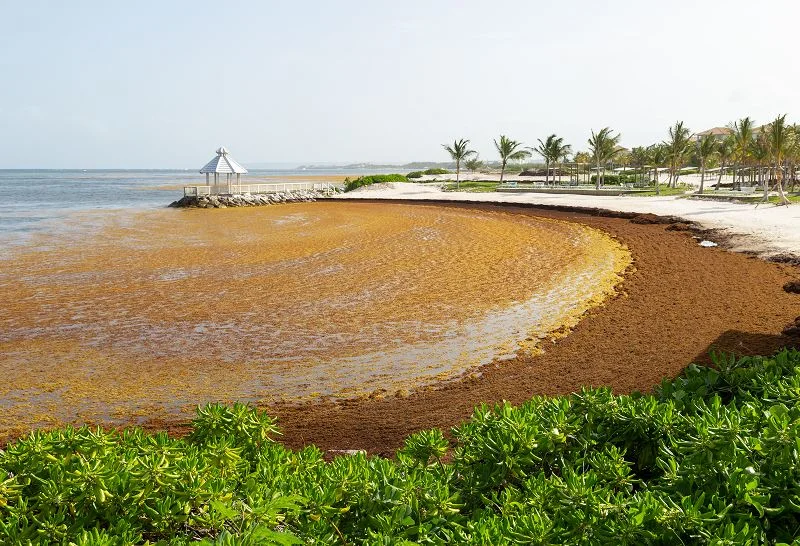
This is the worst season on record and it is not close. Semar had collected 96,151 tonnes by 30 July, against 92,782 tonnes in the whole of 2025. Environment Secretary Alicia Bárcena calls the 2026 volume four times last year’s and 27 times the historical average. State authorities expect around 119,000 tonnes by the end of the year.
The load is not spread evenly. Playa del Carmen has taken 33,511 tonnes, more than a third of the state total. Tulum is the worst-affected destination in the country and its season began in January rather than April. Eleven beaches were at the “excessive” alert level in late July.
The economics have followed. Local business groups put Quintana Roo sales down 30 percent in the first half of the year.
What it means if you are there or thinking of going
The honest arithmetic is not encouraging in the short term. The new ship adds roughly 600 tonnes of daily capacity against arrivals that Bárcena has described in the thousands of tonnes a day, and the government’s own timeline puts a fully integrated system in the summer of 2027. That is two more seasons.
What that means in practice is divergence. Beaches with private hotel barriers — the Cancún hotel zone, Puerto Morelos, Isla Mujeres, the west coast of Cozumel — will keep looking very different from unbarriered stretches at Tulum and Mahahual. If you are booking for this season or next, ask the hotel specifically whether it has its own barrier and its own crew, not whether the beach is clean.
If you own or rent out beachfront property, the same divergence is showing up in occupancy and yields. This is general information, not investment or travel advice.
Frequently Asked Questions
How big is Mexico’s new sargassum ship?
It is built to collect about 600 tonnes in an eight-hour shift, roughly double the 250-tonne capacity of the navy’s ARM Natans. It arrives in Quintana Roo in about two months.
Who operates it?
The navy, Semar, which has run Mexico’s sargassum operation for seven years with around 500 sailors.
How bad is the 2026 season?
The worst on record. 96,151 tonnes had been collected by 30 July, more than the whole of 2025, with another 90,538 tonnes floating offshore in early August.
Which beaches are worst affected?
Playa del Carmen has taken more than a third of the state total, and Tulum is the worst-affected destination in the country. Eleven beaches were at the “excessive” level in late July.
When will the new system be fully working?
Hoteliers say not until the summer of 2027, which means two more high-sargassum seasons.
Sources: Semar; Presidencia de México; Reportur; Infobae; El Financiero; Noticaribe.
This article was produced by The Rio Times’ automated newsroom system. How we use AI · Report an error