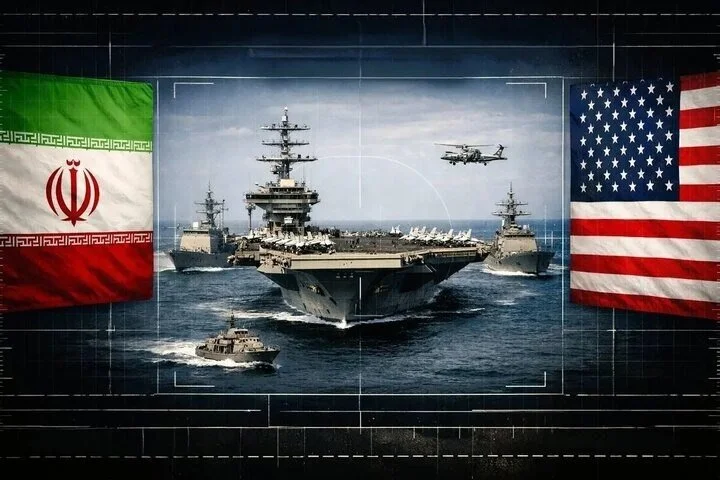
Iranian military, officials stress firm stance as tension with US persist
TEHRAN — Over the past 48 hours, a series of statements from senior Iranian military commanders and government officials have underscored the Islamic Republic's heightened state of military readiness and its firm stance against continued US pressure, as tensions between Tehran and Washington show no signs of abating.
Mohsen Rezaei, a member of Iran's Expediency Discernment Council, issued an explicit warning via his official X account regarding the consequences of continued US hostile policies in the Persian Gulf. "If the blockade continues, American vessels and forces will face serious risks and casualties," Rezaei wrote. Emphasizing that Washington must "change its behavior," he added: "We will not tolerate this." Concluding his remarks, Rezaei dismissed any possibility of an alternative maritime route, stating unequivocally: "We will never permit the opening of a second corridor in the Strait of Hormuz."
The warnings from the political establishment were swiftly reinforced by statements from Iran's military leadership. Brigadier General Pilot Masoud Jafari, the deputy coordinator of the Iranian Army Air Force, revealed that the military had continuously monitored US military bases in the region over the past years and had meticulously planned for various operational scenarios. Speaking to domestic media, General Jafari noted that on the first day of any confrontation, the enemy did not imagine that Iran's Air Force would possess the courage to carry out air operations—and that this very factor contributed to the successful execution of the mission. "Our pilots accepted this mission with full awareness of the risks, the extremely high stakes, and the available intelligence," he stated. "In fact, they made possible what seemed impossible." Regarding the status of the pilots involved in recent operations, General Jafari said that except for martyred Pilot Majid Kazemi—whose remains were returned to the country sometime later—no precise information is yet available about the other three pilots.
Brigadier General Majid Ebn-e-Reza, Iran's Acting Defense Minister, asserted that the Iranian Armed Forces are fully prepared to respond to any threat, emphasizing that their capabilities are underpinned by the country's domestic defense industry. In a message posted on his social media account on Thursday, General Ebn-e-Reza declared: "Every day, the signs of the enemy's erosion of power become more evident; however, our Armed Forces, relying on the country's defense industry, are fully equipped to respond to any threat." He further warned that countries seeking to purchase security and military superiority from abroad "will soon realize that Iran's indigenous technology is superior to any system in the region."
Brigadier General Mohammad Akraminia, the Iranian Army spokesperson, reaffirmed that the Army remains in full operational readiness despite two wars imposed by enemies. According to a statement published by the Army on Thursday, General Akraminia said that damaged systems have been modernized, new equipment has entered service, and efforts to strengthen combat capability are continuing without interruption. He emphasized that preserving combat readiness is not limited to acquiring equipment, adding that recent improvements have been based on a combination of measures, including rebuilding and upgrading existing systems, introducing new equipment, expanding domestic capabilities, and reinforcing personnel morale. "A significant part of combat capability, particularly under current conditions, depends on the modernization and restoration of damaged or worn-out systems," General Akraminia stated. "The Army is pursuing reconstruction and upgrading programs through its own engineering and technical expertise." He described this process as "not merely a technical operation, but part of the country's broader defense strategy to preserve deterrence and increase rapid-response capability." The spokesperson noted that the introduction of new equipment has enabled the Army to reorganize its weapons and military systems in line with current operational needs. He identified air defense as one of the country's highest defense priorities, saying that in the face of complex regional conditions and diverse threats, it plays a decisive role in protecting the nation's airspace and safeguarding vital infrastructure. General Akraminia also emphasized the importance of personnel morale and discipline, saying the Army's forces possess "jihadi spirit and a very high determination" to carry out their missions. He added that part of the defense development effort is carried out within the Army and part through cooperation with the defense industry and other specialized national institutions—a process that reduces external dependence and allows faster modernization.
In a message on Thursday, Brigadier General Bahman Behmard, Chief Commander of the Islamic Republic of Iran Air Force, pledged that the force will remain fully committed to defending the Iranian nation against any aggression by its "sworn enemies" while following the Leader of the Islamic Revolution.