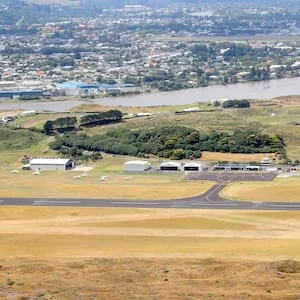
Gasnet said the site would be “good for around 4MW [megawatts]” and that a connection to the Powerco network should not be a problem.
Gasnet is a council-controlled organisation (CCO) that operates a natural gas network and metering business.
At a CCO and economic development committee meeting on Tuesday, Gasnet chief executive Michael Ram said the electricity generated would offset council usage.
He said iwi had been approached about the project, “to make sure there are no issues”.
“We know there are a couple of sensitive pieces of land bordering that piece of land.
“I’m not seeing any barriers at the moment, but we‘re waiting to talk to the parties.”
Ram said a business case would be brought back to the council.
The Gasnet report said there should be no problem with solar panel glint and glare for aviation.
Panels would be in a similar location to those at Gisborne Airport, it said.
In 2023, a 5.2-megawatt solar farm, Te Ihi o te Ra, became operational in Gisborne, with around 8000 bi-facial solar panels covering 6.1ha.
Whanganui Mayor Andrew Tripe. Photo / NZME
Whanganui Mayor Andrew Tripe told the Chronicle electricity was one of the council’s biggest costs, and household bills had risen significantly in recent years.
He said he had encouraged Gasnet to explore solar options, and work had so far been funded from the company’s budget.
“I think the concept has some real legs,” he said.
“If the business case delivers, then it’s something we can expand upon.
“We need to think more broadly about energy security for Whanganui.”
At the meeting, Deputy Mayor Michael Law said he was “super excited” about the project.
In 2023, Law proposed Solarnet, a council-run company that would install solar panels on people’s roofs in exchange for a rates rebate, but the initiative did not make the council’s 2024-34 long-term plan.
“I hope the numbers make sense and I look forward to hearing how many gigawatt hours we can actually produce,” he told committee members.
“In my estimations, it could be [enough electricity] for 750 households.
“I’m looking forward to seeing it, proving it, and showcasing to the rest of Whanganui how much utilisation we could have of solar, and be profitable as well.”
Speaking to the Chronicle, Tripe said the council would continue to do the basics, but it had to think about the future as well.
“Building capability, technology and energy will always be there, they’re never going to go away.
“We need to face into that space.”
Mike Tweed is a multimedia journalist at the Whanganui Chronicle. Since starting in March 2020, he has dabbled in everything from sport to music. At present his focus is local government, primarily Whanganui District Council.