When the Supreme Court tells a president that his executive order conflicts with more than a century of constitutional interpretation, the ordinary response is to stop.
But Donald Trump doesn’t fancy himself ordinary in any way.
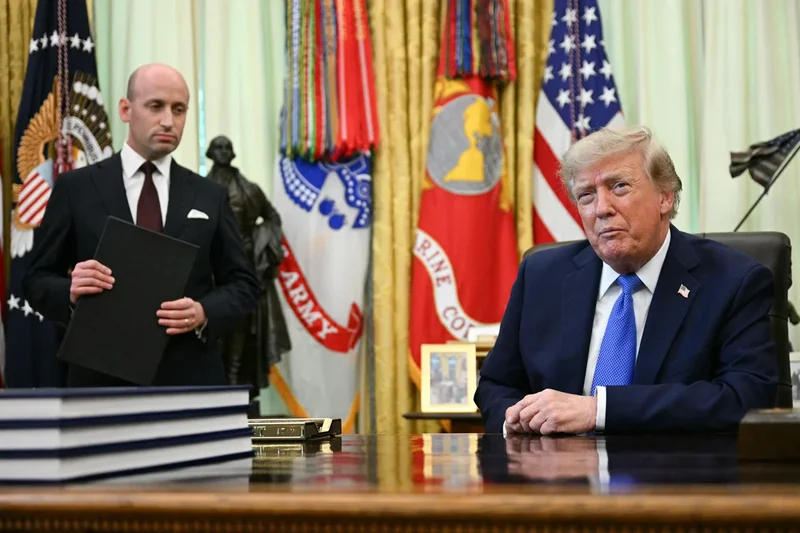
In a hastily arranged Thursday Oval Office appearance, the president announced he was — for a second time — attempting to restrict birthright citizenship by executive fiat while repeating his complaint that a 6-3 Supreme Court decision striking down his previous attempt to do so had been “very unfair.”
“We had a very unfortunate decision in the Supreme Court concerning birthright. It was close, but a very, very unfortunate decision. So we're making adjustments because it's very unfair,” he said.
White House Deputy Chief of Staff Stephen Miller then told reporters that the new orders would use Trump’s “authority as commander-in-chief” to “expand the definitions of people who are ineligible for birthright citizenship.”
“That includes, for example, alien enemies of the United States, members of foreign terrorist organizations, and large categories of people who lobby and act on behalf of foreign governments. And so, with taking this action, it ensures that large numbers of people who wrongly would be getting birthright citizenship will no longer be eligible for those benefits,” said Miller, who added that Trump was also issuing an order to prohibit what he called “birth tourism.”
On the surface, these latest actions represent a dramatically narrower carve-out than the one Trump claimed for himself in the executive order he signed within hours of his second inauguration, which withheld citizenship from any child born in the U.S. unless at least one parent was already a citizen or permanent resident.
That rule was broad enough to cover the roughly 150,000 babies a year born to undocumented or temporary-visa parents, according to the plaintiffs who sued to block it — and broad enough that multiple federal appeals courts called it unconstitutional well before the justices got their turn.
But at no point did Trump or the White House mention that the new orders are a fraction of the size of the one the courts killed. Instead, a fact sheet distributed to reporters late Thursday declared that the administration "continues to guard against" citizenship fraud "after the Supreme Court's decision.
Then it pivots into a section headlined "Putting Americans First" that reads less like legal reasoning than a campaign flyer: three million deportations, 88 denaturalization cases filed against people it says obtained citizenship fraudulently, 1.4 million people cut from public benefits, visa processing paused for "75 high-risk countries," and a drive to purge alleged noncitizens from state voter rolls.
None of that reads like an administration confident enough in its legal position to let the ruling speak for itself. It reads like a White House that needs a citizenship-and-borders headline heading into a midterm election year, and would rather announce two narrower orders under a "continuing to protect" banner than let a Supreme Court defeat sit there for voters to notice unadorned.
That's because immigration remains one of the only lanes where this White House still likes its odds. The tariffs got struck down by the same court. The war in Iran polls badly. Even parts of his own base have grumbled about the price tag on his Washington makeover.
But birth tourism is the kind of narrow, easy-to-caricature target — foreign nationals allegedly gaming a visa to secure a passport for their newborn — that plays well on cable news regardless of how few people it actually affects, which may explain why a policy retreat got relaunched this week as a two-order offensive rather than absorbed quietly.
But ironically, Trump’s latest citizenship gambit appears to be a play lifted from the playbook of his successor-turned-predecessor, former president Joe Biden.
When the Supreme Court struck down Biden’s roughly $400 billion student loan forgiveness plan in June 2023, his administration didn't drop the subject either.
It pivoted to new executive actions to create what was called the SAVE income-driven repayment plan, then to a second attempt at mass cancellation through Higher Education Act administrative rulemaking — both promptly sued by Republican-led states, both left tangled in injunctions through much of 2024 that stranded millions of borrowers in limbo over debt they'd been told was already on its way to forgiveness.
Biden's team never described the SAVE plan as a workaround for a policy the justices had just killed. But that is functionally what it was, in much the same way Trump's new orders are functionally a retreat dressed up as round two.
Both presidents arrived at the same discovery: voters rarely parse the fine print of an injunction or a 14th Amendment exception, and a fight that still looks like it's being fought can do more for a political coalition than a policy that quietly complies with an unambiguous court decision.
Whether either strategy delivers anything more than headlines remains to be seen. What's already clear is that both the man who wanted to end birthright citizenship and the man who wanted to cancel student debt found it easier to keep signing new paper than admit to their most fervent supporters that neither plan was legal in the first place.