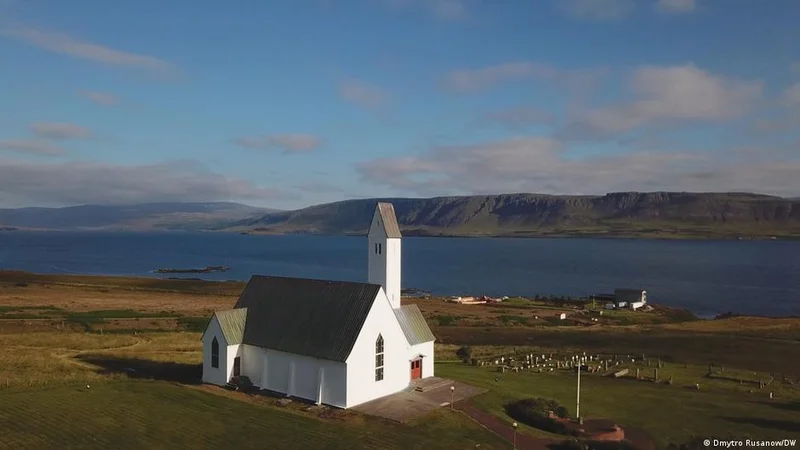
The white church stands alone in the Icelandic countryside. Wind sweeps across the Hvalfjord. Kristjan Ingolfsson, a retired bishop, lives here beside Hallgrimskirkja church in Saubaer, surrounded by silence and vast open landscapes.
But far from this quiet corner of western Iceland, the debate over Europe is heating up. At the end of August, voters will decide whether to reopen accession talks with the European Union. The referendum is not about joining the EU immediately, but about restarting negotiations that were suspended more than a decade ago.
"[Icelandic] people are a bit different to the mainland folks, who always have to think about borders. We have no border, just the sea all around," Kristjan Ingolfsson says.
"That gives a specific feeling of freedom. And I believe that's also part of the whole discussion, that people want to be free."
Whether campaigning for or against closer ties with Brussels, many Icelanders frame the debate around the same ideas: freedom, independence, and sovereignty.
**The 'Yes' campaign **
At the headquarters of the pro-European group in the capital, Reykjavik, supporters are celebrating the official launch of the campaign. The small office is packed, with volunteers spilling onto the pavement in the afternoon sun. Young people mingle with pensioners. A DJ provides music while beer and soft drinks are kept chilled in ice buckets.
At the center of it all is Snaeros Sindradottir, executive director of the 'Yes' campaign. The 34-year-old mother normally runs an art gallery, but that work is now on hold. Instead, she spends her days campaigning for a closer relationship with Europe.
The referendum is taking place at a time of growing geopolitical uncertainty. US President Donald Trump's threats toward neighboring Greenland have become part of Iceland's debate over Europe, says Snaeros Sindradottir.
"And it's not a very comforting fact that Trump has mispronounced Greenland as Iceland on several occasions."
Iceland, with its population of about 400,000, has no standing army. Protection is provided through NATO, of which Iceland is a founding member. The country also has a bilateral defense agreement with Washington. During the Cold War, the US maintained an important military base near Reykjavik, although its permanent troop presence ended in 2006.
"I think security would definitely be increased if we enter the EU," says Snaeros Sindradottir.
"Given the situation in the United States, it would be wiser to lean [on] our true allies and friends in Europe."
Iceland is already closely tied to Europe. The country belongs to the European Economic Area (EEA), allowing free movement of goods, services, capital and people between Iceland and most EU countries, even though the island nation is not an EU member. It is also part of the passport-free Schengen zone.
Pawel Bartoszek, chairman of parliament's foreign affairs committee, points to Iceland's small and relatively volatile currency.
"It has cost us much higher inflation and interest rates compared to continental Europe," he says.
Bartoszek argues that joining the euro in the future could lower borrowing costs for households and businesses. Mortgage rates of 8 to 9% are common in Iceland, while borrowers elsewhere in Europe often pay roughly half as much.
**The 'No' campaign **
In downtown Reykjavik, campaigners from the anti-EU movement are making the opposite case. They have set up a small table where they hand out leaflets and "No" campaign badges. Haraldur Olafsson, a physics professor, currently spends up to 12 hours a day campaigning against membership.
"We are basically here to explain to the people that being members of the European Union is a huge step away from democracy."
"We are giving power to someone else who will make rules that we cannot control," he adds.
For years, Haraldur Olafsson has campaigned against joining the EU. He is the president of the Heimssyn organization, which belongs to the 'No' camp.
The 'No' campaign's stand is quiet today. Tourists crowd the square opposite parliament, every now and then Olafsson is approached by acquaintances. This is Iceland. People know each other here.
"I do not know anybody in Iceland who fears either the Russians or the Americans," Haraldur Olafsson says.
"Really, I don't think these international matters matter a lot when it comes to local politics. The only threat comes from the European Union. The European Union is the only big power in the world that wants to govern Iceland, that wants to set the laws in Iceland and wants to pass judgment."
Supporters of EU membership reject this argument, saying that as an EU member Iceland would participate in decision-making rather than simply follow rules set elsewhere.
**Rich fishing industry **
Iceland's thriving fishing industry is one of the foundations of the country's prosperity. That is why the debate over possible EU membership has become highly emotional, with both sides arguing over whether the European Union would gain control over Iceland's valuable marine resources.
"The European Union has nothing to say about the natural resources in Iceland — the sea, the fish," Haraldur Olafsson says.
"The European Union doesn't have the final word on energy, which is a very important natural resource for Iceland."
"The economy of Iceland is very different from the economy of Europe. The main disadvantage is that the EU would take over the administration of [our] natural resources," he argues.
Haraldur Olafsson heads down to Reykjavik's harbor. Here he meets former fisherman Agust Österby, who is standing on his wooden boat, fixing an old window frame. Österby first went to sea with his father when he was six years old. Today, he restores wooden boats.
Icelanders, he says, are stubborn and independent by nature.
"It is somehow in our genes to deal with [things] ourselves — to deal with life, the sea and the weather."
He adds: "We will never give our freedom to the European Union. We know exactly how to do things in Iceland. We don't need help from abroad."
The former fisherman says he does not think Icelanders feel threatened by anyone — not even Donald Trump.
**Referendum to break the deadlock **
The belief that Iceland can simply keep a low profile and avoid international pressure is something political scientist Audunn Arnorsson disagrees with. He fears the strategy "might backfire."
If Iceland were ever to face pressure similar to that experienced by Greenland from its "big brother in the West," having the possibility of EU accession could prove valuable, including access to the bloc's common customs protection.
Iceland had already begun accession negotiations once before, in 2010, following the banking and economic crisis. They were later suspended after a change in government and never resumed. Audunn Arnorsson argues that holding a referendum became the only way to break the political deadlock over whether Iceland should reopen negotiations.
**Debate dividing Iceland **
Members of Iceland's parliament are also divided over whether the country should resume accession talks with the European Union. The debate cuts across traditional party lines.
Gudrun Hafsteinsdottir, leader of the opposition Independence Party, believes that a small nation like Iceland may have a bigger voice outside the European Union than inside.
"In the European Parliament, we would have approximately six seats out of 726. We are afraid that we will just disappear in this mass that the European Union is."
Smaller EU member states such as Malta, Luxembourg and Cyprus also hold the minimum allocation of six seats in the European Parliament.
For Gudrun Hafsteinsdottir, joining the EU is not the solution for strengthening Iceland's security.
"Our strength lies in NATO and our bilateral agreement with the United States of America. And we have not had any discussion from [the] American side that they want to change that agreement that we have had here in Iceland for decades."
But something else concerns the opposition leader deeply: the divisions the debate has created within families and friendships.
"We are building a wound that won't heal [for] years. We can't survive in this harsh country if we don't have solidarity between us, so that we can fight Mother Nature."
Opinion polls predict a tight race, with support for and opposition to closer EU integration running neck and neck. Both camps are now fighting for the same group: the many undecided voters who are likely to determine the result on August 29.
A 'yes' vote would not mean EU membership. It would only open accession talks — with a second referendum required before Iceland could ultimately join the bloc.
But former bishop Kristjan Ingolfsson is confident: "No matter how it turns out — we will remain one people and [it will] not build walls between us."