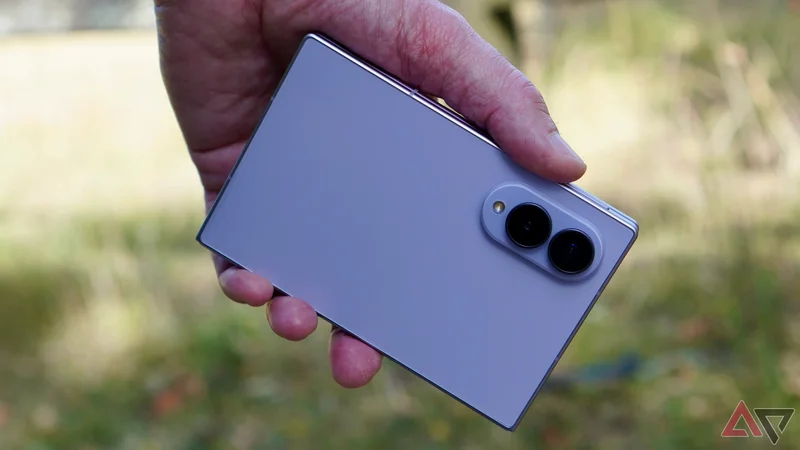
Quite simply, I’ve never made true, proper use of a foldable phone as often as I have with the Samsung Galaxy Z Fold 8.
It’s not just because of the new, wider design; it’s a host of other things too, which I’ll go into more detail about as we move through the review. But, spoiler alert, I’ve really enjoyed living with the Z Fold 8, and don’t want to stop using it.
Samsung Galaxy Z Fold 8
-
**SoC** - Qualcomm Snapdragon 8 Elite Gen 5 for Galaxy
-
**Display dimensions** - 7.6-inch open / 5.5-inch closed
-
**Battery** - 4,800mAh
-
**Rear camera** - 50MP main / 50MP wide
The Samsung Galaxy Z Fold 8 may seem like just a different shaped folding phone, but it transforms the way you use it. The excellent hinge encourages you to open the phone and enjoy the big screen, which is ideal for video and reading.
Pros & Cons
- Genuinely usable open and closed
- Wonderfully balanced hinge mechanism
- Minimal crease
- Useful anti-reflective coating on inner screen
-
Lightweight
-
Average camera
- Galaxy AI features are still niche
- No Qi2 built-in
Price, specs, and availability
The Samsung Galaxy Z Fold 8 is available from Samsung’s online store, most major carriers, and other retailers, including Amazon and Best Buy from August 7.
The 12GB/256GB model costs $1,900, the 12GB/512GB model is $2,100, and the top 16GB/1TB model is $2,500.
There are three main colors: Lavender, Cream, and Graphite, or the Samsung exclusive Pistachio color available if you buy through the online store.
What else should you consider? The $2,100 Galaxy Z Fold 8 Ultra is the real successor to the Galaxy Z Fold 7, at least in terms of the shape and style. The Oppo Find N6 remains our favorite big-screen foldable, if you can buy one, along with the $1,800 Google Pixel 10 Pro Fold, and the $1,900 Motorola Razr Fold.
However, the Galaxy Z Fold 8 is unique due to its size and dimensions, with no clear competitor at this time.
Specifications
-
**SoC** - Qualcomm Snapdragon 8 Elite Gen 5 for Galaxy
-
**Display type** - Dynamic AMOLED 2x 120Hz
-
**Display dimensions** - 7.6-inch open / 5.5-inch closed
-
**Display resolution** - 2448 x 1848 open / 1972 x 1248 closed
-
**RAM** - 12GB / 16GB
-
**Storage** - 256GB / 512GB / 1TB
-
**Battery** - 4,800mAh
-
**Charge speed** - 45W Super Fast Charging 2.0 wired / wireless
-
**Operating System** - Android 17 / One UI 9
-
**Front camera** - 10MP main / 10MP cover
-
**Rear camera** - 50MP main / 50MP wide
-
**Wi-Fi connectivity** - Wi-Fi 7
-
**Bluetooth** - Bluetooth 6.0
-
**Dimensions** - 124 x 161 x 4.5mm open / 124 x 82 x 9.7mm closed
-
**Weight** - 201 grams
-
**IP Rating** - IP48
-
**Colors** - Lavender / Graphite / Cream / Pistachio (online exclusive)
-
**Stylus** - N
-
**Material** - Armor Aluminum
Samsung Galaxy Z Fold 8 design
Spot-on dimensions
Not only is the Galaxy Z Fold 8 the middle foldable in Samsung’s 2026 range, but it operates like it, and this is the most important distinction to understand.
The Z Flip 8 is made to be used open, and the Z Fold 8 Ultra is really designed to be used open too, mostly due to the tall, thin cover screen’s restrictions. The Galaxy Z Fold 8 feels like it’s made to be used open and closed.
This versatility is encouraged by the superb hinge. It’s perfectly weighted, completely silent, has a great snap when it opens or closes, and doesn’t require any effort to use at all. You want to open the phone, and because of the fantastic-looking inner screen, you’re going to do so very often.
Samsung’s clever Flex Titanium screen technology, which adds a titanium film under the display for uniform flatness, almost removes the crease. After 10 days of use the crease hasn't altered, despite the many times I’ve folded and unfolded the phone.
The phone’s light 201 gram weight makes it so portable, and I barely notice it after slipping it into my pocket or bag.
Folded, it’s 9.7mm thick, and 4.5mm thick when open. The closed dimensions are important, as the Z Fold 8 is about 1mm thicker than the Apple iPhone 17 Pro Max, so if you are happy carrying that around, you’ll be fine with the Z Fold 8.
It feels sturdy and durable, and while the IP48 dust and water resistance rating isn’t up there with the Honor Magic V6, it’s adequate provided you’re careful.
The phone’s compact nature makes it easier to keep hold of, and despite the smooth rear panel, I haven’t accidentally juggled the phone when opening it either.
One thing to note, my review phone did not come with a screen protector over the cover screen, and while I have treated it the same as I do other phones, it has picked up an ugly scratch I can actually feel with my finger.
You may want to factor in a screen protector if the retail versions don’t come with one.
The size, weight, and operation of the Galaxy Z Fold 8 is so balanced and expertly tuned, it feels like the first foldable you’ll be equally happy to use whether it’s open or closed. Why? Let me explain.
Life with the Samsung Galaxy Z Fold 8
I haven't wanted to put it down
The dimensions and vital statistics of the Galaxy Z Fold 8 only tell part of the story, as does the 16:10 aspect ratio, 5.5-inch cover screen, and 4:3 aspect ratio, 7.6-inch open screen.
It’s what all these numbers mean when you go to use the phone that transforms the Z Fold 8 from passport-sized foldable to the most versatile, enjoyable, and fun phone I’ve used in ages.
The cover screen runs all the apps I regularly use, with the only change being a requirement to scroll a bit more often. It fits in my palm comfortably, so the keyboard is natural to use, and it’s really bright too. I’ve used it in direct sunlight a lot recently, and it’s noticeably brighter than the Motorola Razr Fold’s cover screen.
The real joy comes when you use an app that wants to be enjoyed on a bigger screen, such as YouTube, Instagram, TikTok, reading long-form pieces in Chrome, or books in the Kindle app. Snapping the Z Fold 8 open feels so natural, and there’s an immediate positive return, as it looks so sharp, colorful, and bright.
However, it’s the natural size and the way it feels so good to hold that encourages you to use it like this. It never feels like you’re accepting a compromise, such as ungainly weight or top-heaviness, leaving you to simply enjoy the phone’s big screen. It means you enjoy it more often, and that increases value.
One slightly unusual decision comes with the placement of the speakers. They're set on the top and bottom of the phone in open landscape orientation, and on the left and right in portrait. It means you may not hear a marked stereo separation in some situations. I mostly use the phone for dialogue-heavy videos, or portrait orientation for Shorts and Reels, and it hasn't bothered me.
Everyone I’ve shown the phone to has marveled at how it feels in their hand when closed, then I’ve seen genuine smiles when they’ve opened it up. Most other foldables get an in-between reaction. There’s a bit of a compromise somewhere, and they recognize it instantly.
I don’t get that with the Galaxy Z Fold 8. I’ve watched more video on the open screen, love the way books appear on it, and have found I reach for the Z Fold 8 more often over my tablet and my iPhone 17 Pro Max.
It’s hard to properly describe. It’s not about the apps, the smaller black bars around video, the lightness, the anti-reflective coating on the inner screen, or the beautifully engineered hinge. It’s the entire package that works, and until you give it a try, I don’t think you’ll fully get it. But when you do try the Z Fold 8 out, I think you’ll be smitten, whether you’re an existing foldable fan or not.
Samsung Galaxy Z Fold 8 camera
Not the Z Fold 8's strong point
The Galaxy Z Fold 8 has two 50-megapixel cameras on the back, covering main and wide-angle photos, along with a 2x optical quality zoom mode that crops the main camera’s 50MP photos down.
I know what you’re thinking. This is where the Galaxy Z Fold 8 falls on its face, right? Who will be happy with just two cameras and no telephoto on such an expensive phone?
Photos are very 'Samsung'. Primary colors pop off the screen, you’ll notice a lack of detail when you crop photos down, and there isn’t much consistency between the main and wide-angle camera.
The 2x optical quality zoom isn’t bad at all, and even when you examine the photos closely, the level of detail is almost the same as the main camera’s photos.
Elsewhere, you can try out the My FanCam mode, which is made for concert use where you want to ensure your favorite singer stays at the center of your video. It's fun, really niche, and not much use without a capable telephoto zoom, unless you're just videoing your friends.
This isn’t a flagship camera phone. You’ll want to buy it for other reasons, but even though it’s far from a high point, the camera isn’t a crushing disappointment. It’s just that the performance is in line with the Z Flip range, and not the S Ultra range.
Samsung Galaxy Z Fold 8 software and performance
Powerful stuff, but forget the AI
The Galaxy Z Fold 8 has the Qualcomm Snapdragon 8 Elite Gen 5 for Galaxy processor, and it comes with either 12GB or 16GB of RAM, depending on whether you opt for 256GB, 512GB, or 1TB of storage space.
Android 17 with Samsung’s One UI 9 installed, and I can’t say there are many obvious differences between them and Android 16/One UI 8 on the Galaxy S26 Ultra. This isn’t a negative, because Samsung’s interface is well-designed, fast, and powerful.
Multi-tasking is one of its strengths, and it’s so logical and simple to open apps in split-screen mode with the phone open. Using two side-by-side works best, but it can support another app and a floating window, too.
Samsung’s Flex Titanium hinge has seen the Flex Mode feature removed, as it can’t support itself at a 90-degree angle. I haven’t missed it, as the phone either wobbles around on the camera or risks screen damage, but some may bemoan its absence.
Running the 3DMark app’s stress test, the phone gets warm to the touch, but no hotter than most other top phones, and it never overheated. Playing Asphalt 9: Legends makes great use of the open screen, and I haven’t noticed any adverse heat buildup.
One thing to note is how the Z Fold 8’s size helps with typing. I don’t use the standard Samsung keyboard, which I find less intuitive than Google’s Gboard.
|
|
|
|
|
|
| 6104 | 40% | 8% |
|
| 5255 | 70% | 7% |
The compact closed phone makes swipe typing fast and accurate, but when open I find holding the phone in portrait orientation the best way to use the split keyboard. Typing on the closed Z Fold 8 is very close to typing on a non-folding phone.
Samsung’s software update policy promises seven years of major OS and security updates. This softens the blow of the Galaxy Z Fold 8’s price, as you could realistically keep the phone until 2033 and still have up-to-date software.
|
|
|
|
|
|
| 3528 | 9411 | 19706 |
|
| 2280 | 6483 | 11916 |
Finally, we come to Galaxy AI. All the same features I've seen before, and never found a reason to use, are back. Now Brief is a glorified weather app that also shows data from a Samsung wearable, along with some suggested YouTube videos and news stories. I left it on the home screen for the review, but had to force myself to open it, as it's almost entirely useless.
There's also Now Nudge, which apparently monitors what you're doing and suggests an app or feature you want to use next. I've seen it demonstrated and it looks useful. It hasn't proved useful in my personal life yet, which sums up all mobile AI features perfectly.
Samsung Galaxy Z Fold 8 battery and charging
Silicon-carbon arrives
It’s a 4,800mAh silicon-carbon battery powering the Galaxy Z Fold 8, and Samsung worked hard to perfect the battery tech before integrating it into its phones.
Charging has been upgraded to accept 45W wired and 20W wireless speeds. It does not have Qi2 wireless charging without putting it in a compatible case.
The fast charging feature is very helpful, as 30 minutes adds about 65% to the battery, which has been more than enough for a single day’s use for me. A full charge using an Anker charger took 75 minutes. You don’t get a charger in the box.
The battery lasts about 5 hours of screen time under my average use without gaming. This is slightly shorter than the Razr Fold, which has a 6,000mAh battery, and similar to what I achieved with the Honor Magic V6’s 6,660mAh battery.
Should you buy the Samsung Galaxy Z Fold 8?
Yes, you should buy the Samsung Galaxy Z Fold 8. For me, this is the big surprise of 2026, and it has become the phone I’ve enjoyed discovering the most.
I didn’t expect a size change, especially one going ‘down’ compared to the Z Fold 7, to have such a positive effect. Instead, it made me want to use the phone more, both open and closed, and I’ve felt the Z Fold 8 has made me enjoy a folding phone more than ever before.
Because of this, I think even folding phone holdouts may find plenty to enjoy here. Unfortunately, camera fans won’t. It’s fine for casual snaps and social media, and the 2x zoom is surprisingly decent, but don’t set your expectations too high.
Compact, cool-looking, high-performance, versatile, with decent battery life, excellent software and a surprisingly capable camera, the Galaxy Z Fold 8 is a real winner.
Samsung Galaxy Z Fold 8
-
**SoC** - Qualcomm Snapdragon 8 Elite Gen 5 for Galaxy
-
**Display dimensions** - 7.6-inch open / 5.5-inch closed
-
**Battery** - 4,800mAh
-
**IP Rating** - IP48
The Samsung Galaxy Z Fold 8's wider, more compact size is transformative enough that it has the potential to convince even folding phone holdouts to give the design a try. The light weight, well-engineered hinge, and great software help balanced out the average camera.