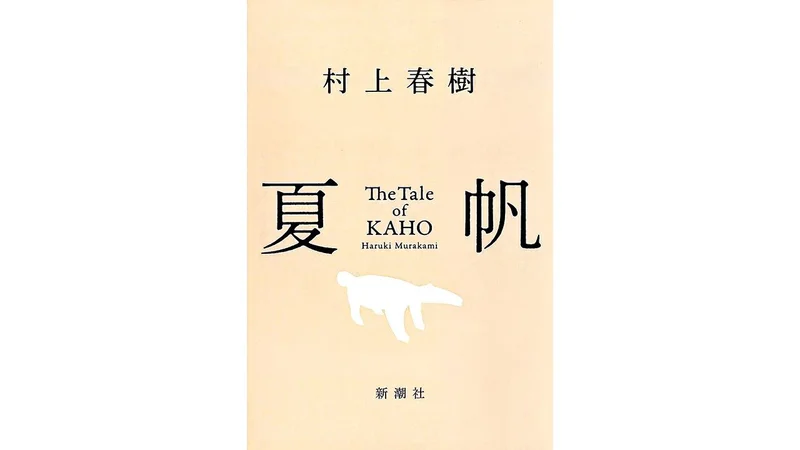
Murakami Haruki Takes On Anteaters and Mother-Daughter Relationships in “The Tale of Kaho”
Books Society FamilyThe Tale of Kaho. Originally serialized in the literary journal
Shinchō, the 650-page work, his first in three years, follows the titular female protagonist through a series of plot twists that can only be described as “Murakamiesque.”
Like an Anteater Cleaning Out an Anthill
“To tell you the truth, this is the first time I’ve ever dated a woman as ugly as you.”
The main character of the story is Kaho, a 26-year-old woman who writes and illustrates children’s books. At the start of The Tale of Kaho, she is on a first date with an older man to whom she has been introduced by an editor friend. They are waiting for dessert when the man suddenly blurts out his remark. Kaho is so taken aback that she struggles to take in what he has said and cannot understand what he could possibly mean by his cruel remark.
It occurs to her that:
This man was reading every thought that scampered through her mind. He didn’t miss a beat. Like an anteater licking an anthill clean with the tip of that long, thin tongue.
Who is this man and what does he want?
“Listen—you must move to Musashi-Sakai. And you must do it now. That is where you need to be.”
Time and again, a “jet-black anteater with a magnificent fluffy tail” appears before Kaho and delivers this message, urging her to move to Musashi-Sakai. Kaho duly leaves her old-fashioned shitamachi neighborhood in Adachi, close to the border with Saitama Prefecture, and moves to this unglamorous place out toward the west of Tokyo. But why Musashi-Sakai, of all places?
The story opens with a mystery, and from there Kaho’s adventures begin. For regular readers, this will mark a welcome return to a familiar Murakami world. As in his previous works, the author introduces a succession of bizarre characters with quirky names—an anteater husband and wife, a ferocious jaguar, the sharp-eared owner of a local knife-sharpening shop, the termite queen, a guardian angel on a motorcycle, and a cat named Scarlett Johansson—situating them in chapters with names underscoring their roles, and oddness, in the tale: “Kaho and the Motorcycle Man,” “The Anteater of Musashi-Sakai.” Their appearance will no doubt delight Murakami’s fans. What roles will these characters be given, and how will they entertain us as the story unfolds?
A Passageway from the Amazon to the Tokyo Suburbs
As the story unfolds, the unreal world of anteaters and termite queens intersects with Kaho’s everyday reality. Some readers may feel a sense of déjà vu at this point, but the novel also marks new ground: it is the first of Murakami’s books to feature a woman as the sole protagonist (in 1Q84, the female character Aomame shared this role with Tengo, an earnest young man), and it addresses the relationship between a mother and daughter as one of its central themes.
Although Kaho and her mother have never been openly at odds, there has always been a certain tension in the air. Murakami’s story delicately captures the awkwardness between them.
Here’s another taste of the plot. After their children are devoured by the ferocious jaguar, the anteater couple leave their home in the Amazonian jungle and escape through a secret passageway to Tokyo, where they take up residence under the floor of Kaho’s house and become her guardians.
Their staple food is termites, but the termites in Japan are disappointingly different in taste and texture from the ones they are used to. In answer to an entreaty from her anteater friends, Kaho visits an inconspicuous shop in the local arcade that advertises itself as an old-fashioned knife-sharpening business. Inside, however, a mysterious man with flashing eyes and sharp-pointed ears deals in a range of smuggled goods, including bottled termites. Kaho becomes caught up in a series of bizarre events that threaten to tear her from her everyday reality.
Summarized in this way, the plot may sound like a children’s story. But this is no ordinary fable: It also contains plenty of the unsettling edge that makes Murakami’s works so unique. Suffice it to say that the act of killing becomes a dramatic element in the struggle to regain everyday reality, and that Kaho suffers deeply as a result.
Goodies and Baddies
As a writer and illustrator of children’s books, Kaho begins to shape a story for a new picture-book based on her experiences. In it, a 10-year-old girl goes on a picnic with her family but becomes lost in the woods and is stranded in another world, wandering alone in search of the secret exit that will bring her home. The progress of this story-within-the-story starts to synchronize in strange ways with the situation in which Kaho herself is embroiled, as the plot becomes increasingly complex and layered.
Kaho struggles to come to terms with the events happening around her. Her picture-books, she believes, “are stories for parents to read to their small children. I don’t want to fill them up with negative subjects.” But she is also troubled by the fact that “in children’s books, there are goodies and baddies, and every character is either on one side or the other . . . But in real society, the dividing line between good and evil isn’t so clear. . . . Reality and unreality, dreaming and wakefulness—what side do I belong on now?”
A History of Kaho’s Inner Life
In an interview with the Asahi Shimbun to mark the publication of his new novel, Murakami admitted: “It’s true that I often write about unreal things, but it’s not my intention to write fantasy. The conflicts, the interplay between the real and the unreal—these are the things I want to write about.”
Perhaps the most compelling part of the novel comes in its second half, as the plot explores the relationship between mother and daughter. Returning to her parents’ home after a long absence, Kaho notices that a change has come over her mother. She has been possessed by the “termite queen,” one of the evil characters in the story. If nothing is done, her mother’s personality will be destroyed and she will no longer be the person she was. How will Kaho respond?
Despite the violence and the surreal elements, the presiding feeling that remains after reading the novel is a warming and comforting one. In the same interview, Murakami expressed a hope that readers would see the story as “a kind of history of the inner life of this woman, Kaho.” As she grows from a child into an adult woman, the circumstances surrounding her change.
After everything has been resolved, Kaho’s mother tells her with a gentle sigh: “That’s the way it has to be. Everyone disappears eventually.” Some things are inevitably lost as we grow older. Other things are gained in their place. Perhaps in the end, this novel of parallel worlds and unstable reality is really a story about loss, reconciliation, and rebirth.
Kaho (The Tale of Kaho)
By Murakami Haruki
Published by Shinchōsha in July 2026
ISBN: 978-4-10-353440-2
(Originally published in Japanese. Banner photo © Shinchōsha.)