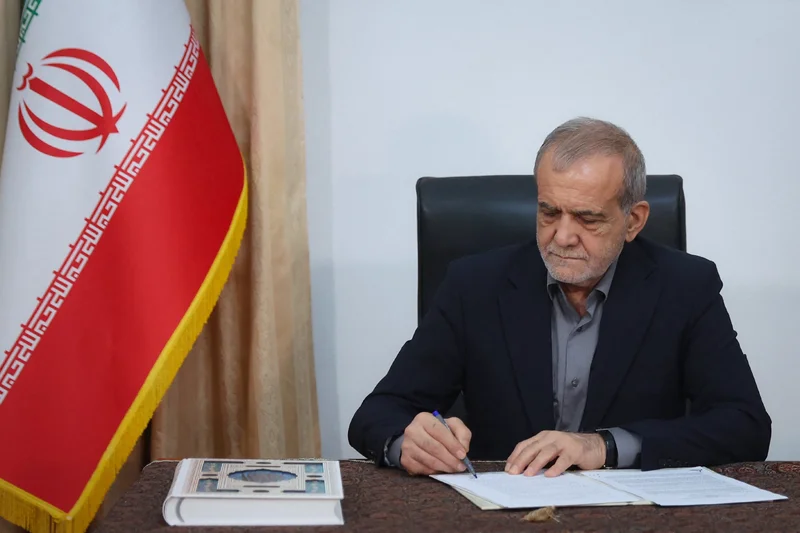
Iranian President Masoud Pezeshkian pushed back Friday against mounting criticism of Tehran's June memorandum with Washington, accusing its domestic opponents of adopting Israel's narrative and rejecting speculation that he could step down.
According to his office, the president defended the agreement that called for ending war on all fronts, opening the Strait of Hormuz and holding further negotiations on the Iranian nuclear program, saying those who describe it as a failure are repeating Israel’s narrative.
"We will firmly defend what we have written as a memorandum of understanding,” he said Thursday in an address to the nation. "Those who want to label it a failure are being unfair, and this is exactly what Israel wants. Knowingly or unknowingly, they are conveying Israel’s message.”
Pezeshkian said Iran had not compromised in any provision of the memorandum, challenging critics to identify a single clause in which Tehran had "backed down.”
"Why should we constantly say we must fight? That is exactly what Israel wants. Israel wants the war to continue,” he said.
He said Iran would fight if forced into submission but questioned why it should pursue a course that served Israel’s interests when it could secure its rights through negotiations.
Responding to criticism that Washington might not honor the agreement, Pezeshkian said Iran’s implementation would remain reciprocal.
"As long as they fulfill their commitments, we will fulfill ours. Wherever they fail to do so, we will have no obligation to continue,” he said.
The president also said Iran had succeeded in forcing the US to lift what he described as its blockade.
He said Iran’s principal concession under the memorandum concerned the Strait of Hormuz, explaining that Tehran agreed to allow ships to transit the strategic waterway under Iranian regulations, a framework that was accepted by the U.S.
Pezeshkian also dismissed criticism from domestic opponents, saying they failed to recognize the achievements secured through the agreement.
"Either they do not know the leader, or they lack logic and reason. What did we give to the United States? We achieved many accomplishments,” he said.
He said critics "stand on the sidelines” offering opinions on the economy, politics and sociology, only to criticize the government’s decisions if problems arise later.
"It is enough for a person’s ignorance that they do not know the extent of their own power,” he added.
Pezeshkian said the U.S. sought to strip Iran of its military and defensive capabilities during the negotiations, something Tehran refused to accept.
"We will not surrender to force,” he said, adding that Iran sought neither aggression against other countries nor territorial expansion but would never accept giving up its means of self-defense.
He contrasted Iran’s regional policy with what he described as Israel’s pursuit of a "Greater Israel,” saying Tehran sought peaceful coexistence with neighboring countries rather than expansion.
The president also disclosed that the memorandum had initially been expected to be signed in Geneva by Parliament Speaker Mohammad Bagher Qalibaf and U.S .Vice President JD Vance. He said the plan was later changed so that he and U.S. President Donald Trump would sign the document, giving it greater political weight and making it more difficult for either side to back away from the agreement.
Responding to recent speculation over his possible resignation, Pezeshkian said: "If I want to resign, I will announce it officially.”
Regional tensions escalated on Feb. 28, when Israel and the U.S. launched coordinated attacks on Iran targeting military, nuclear and energy infrastructure. Tehran responded with missile and drone attacks against Israeli and U.S. targets across the region.
On June 18, Iran and the U.S. signed a memorandum of understanding through Pakistani and Qatari mediation, ending active hostilities and launching negotiations toward a final agreement. The talks later stalled over disputes related to maritime security and freedom of navigation through the Strait of Hormuz, a critical export route for Gulf oil and gas.