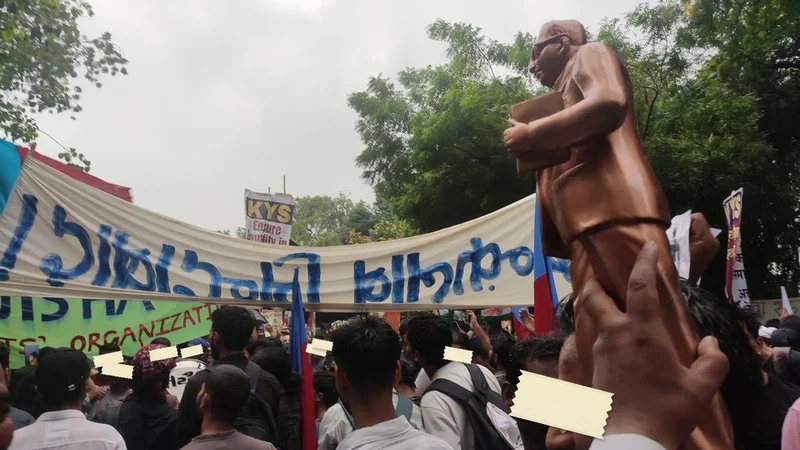
Who owns the memory of dissent? A photograph. The photograph becomes a symbolic entity of resistance against the state’s tone-deafness. The documentation of these photographs becomes an archival, treasuring a nation’s collective memory in a socio-political period. These photographs largely allude to the nation’s sentiment against the state’s policies.
Think of the iconic “Tank Man” picture captured by American photojournalist ‘Jeff Widener’, about a Chinese man, who stood in front of a tank during pro-democracy demonstration in Tiananmen Square in Beijing. They just remain indelible, and it’s possibly because it wears the symbol of resistance against injustice.
The chilling images of Rapid Action Force’s (RAF) assault on unarmed protesters on July 20, 2026, became a recent reminder of state’s crackdown on dissent. The march was enroute Parliament, demanding Education Minister Dharmendra Pradhan’s resignation, for NEET-UG paper leak. The photographs capturing alarming use of pellet guns, tear gas, and spike-studded batons on civilians drew significant criticism, invoking immediate restraint.
Amidst the vicious crackdown on protesters, two remotely working women at the All India Professional’s Congress, Pallavi Nayak and Varna Sri Raman, espoused the idea of archiving the dissent. The idea was a simple one: to setup a crowdsourced visual archive of the posters, placards, and photography of India’s ongoing student’s protests.
“The peaceful nature of the protest, corroborated by an organically huge participation of women, compelled us to set up an visual archive platform”, Pallavi Nayak says. Thus, the website ‘Democracy by Design’ was formed by the team of two people within a few hours. Varna, drawing on her technology background, developed the website’s robust backend infrastructure, while Pallavi leveraged over two decades of experience as a communication professional to shape its design, usability, and overall user experience. The visual library was later bolstered with a series of sharply curated essays, outlining social-political context of a protest placard or photograph.
On a war footing, the duo then finalised the editorial guidelines to prevent the platform from being misused by fringe elements. Largely, these guidelines touched upon the criteria to upload original photographs, securing the privacy of protesters, and stop the curatorial essays from being misinterpreted from rousing adjectives.
In a freewheeling chat with The Hindu, Pallavi Nayak and Varna Sri Raman shed their thoughts on the need for documentation of public protests, the subjective biases in covering protests, and verification process of user uploaded photographs. Essentially, what seeded the motivation behind the creation of ‘Democracy by Design’.
Before we begin, could you briefly introduce yourselves and your backgrounds?
Varna: I am a development economist and I have been one for about 20 years now. While my background is rooted in research and policy, I have always enjoyed building things, and this project allowed me to combine those interests. I have run my own firm, and I am, of course, a Manmohan Singh Fellow with the Indian National Congress. I am also a mother, I have two kids, and I have a dog.
Pallavi: My career, spanning over 25 years, as a branding and advertising strategist has been associated with multiple agencies. For the past six years, I have worked with the Congress Party, and I currently lead organisational engagement strategy at the All India Professional’s Congress (AIPC). In my present stint, I head the National Head of Arts and Culture within AIPC. ‘Democracy by Design’ emerged as an independent forum under that banner.
What sparked the idea behind ‘Democracy by Design’? When did you realise the idea to document these protests?
Pallavi: The idea spurted from an instinctive decision keeping in mind the organic nature of mass mobilisation. We did not depend on the permission 10-20 people in the upper echelons of the party. One conscious effort we undertook while launching the platform was to ensure the safety of protesters. As the movement gained traction, what left us spellbound was their authenticity. The biggest reason for me was the participation of women in the protest. Hence, I called up Varna and said, “Hey, I have this thing,” because I’ve seen so many posters and, particularly because I am interested in art, I said, “Let’s just do visuals.” There is a lot of other archiving to be done regarding the genuine violence that happened to students, but we said we would stick to art and just visuals to start with. In two hours, the website was ready. She took over the technical things, and that’s how this entire thing started. It is very instinctive, born from the fear that all of this will get lost and people should remember how beautifully and effectively it was done. We should keep a memory of it.
Varna: The thing that piqued my interest to archive this protest is the underlying tone of joy and beauty in this protest. Though we cannot set aside the brutal crackdown on protesters in Jantar Mantar, but the overwhelming number of art, humor, and sarcasm in form of memes, videos, and placards in unique. The idea to archive the protests stemmed from a simple thought on what will happen to the protest placards, cardboard, and arts once it gets over. Therefore, we archived these memories of protest, where one can visit two-three decades later to take a glimpse of it. Hence, we archived the protest memories where one could come two-three decades later.
You mentioned the website came within two hours? How was that possible?
Varna: It really was just the two of us. Since I come from a technology background, I am adept with handling backend infrastructure. While, another person helps us in curating the essays for the captured photographs. So, we just cobbled it together in about two to two-and-a-half hours. The name, of course, is Pallavi’s brainchild. We put the backend together, bought the domain, and put forth intensive efforts on the security and safety features for the whole website. To maintain the website’s sturdiness, we undertake daily maintenance. Majority in the tech ecosystem are unaware that it is essential to put an hour everyday to fix the bugs. We began with a basic version, but with gradual improvements we are running a robust version now.
How does the verification and curation process work?
Pallavi: The archive is entirely crowdsourced. Anyone can submit photographs through the website. We ourselves also upload material using the same submission form as everyone else.
What does rightful dissent mean to you? How do you prevent bias?
Pallavi: The fundamental aspect of the visual archival platform is crowdsourced in nature. We are not manufacturing a narrative; we remain solely focussed to preserve what people choose to contribute. Therefore, the editorial intervention has less scope. However, we remain steadfast in remaining averse towards content that incites violence. If any person from the RSS, or any other ideological background, wants to upload a non-violent poster expressing criticism of the government, we would welcome that too.
Varna: Our editorial intervention is constricted to ensuring the safety of contributors and adhering to basic moderation standards. One of the placards on the website reads, ‘Koi bhi sarkar ho, jawabdehi honi chahiye’ (’Whichever government is in power, there should be accountability’). We are not filtering out content because it is critical of the Congress. The respective material is only excluded if it violates our editorial guidelines. Though, any act of selection is a result of subjectivity, and we admit that archiving is never entirely free from politics. However, our intention is not to construct a political narrative.
What is the verification process before it becomes part of the archive?
Varna: The first step involves human curation. This essentially means every submission is reviewed by a person prior to getting published. Besides, the technical system performs thorough checks. We scrutinise the metadata such as EXIF timestamps, run through double check whether any image has been altered or originated from social media. Also, we check if any image has lapses in the file’s digital footprint. Finally, we cross-reference with publicly available sources to establish veracity.
If you could change one thing about how India documents public dissent, what would it be?
Varna: I will give a one non-serious answer and one serious answer. The non-serious answer is that I really wish that archives and archiving become more ‘fun’. The serious answer is that I hope people approach ‘archiving images’ with safety in mind, especially in case of an ongoing protest. A lot needs to be done in terms of public documentation—even in newspapers or on social media—involves a cavalier approach, risking the safety of protesters.
Pallavi: The key to communication begins with a meaningful product. Without it, the communication can only be manufactured through resources and relentless messaging. Today, we tend to preserve only what enters the mainstream, while countless local struggles, acts of dissent, and community initiatives remain undocumented. Unless we broaden what we choose to remember, much of our democratic history risks being lost.
Published - August 08, 2026 07:08 am IST