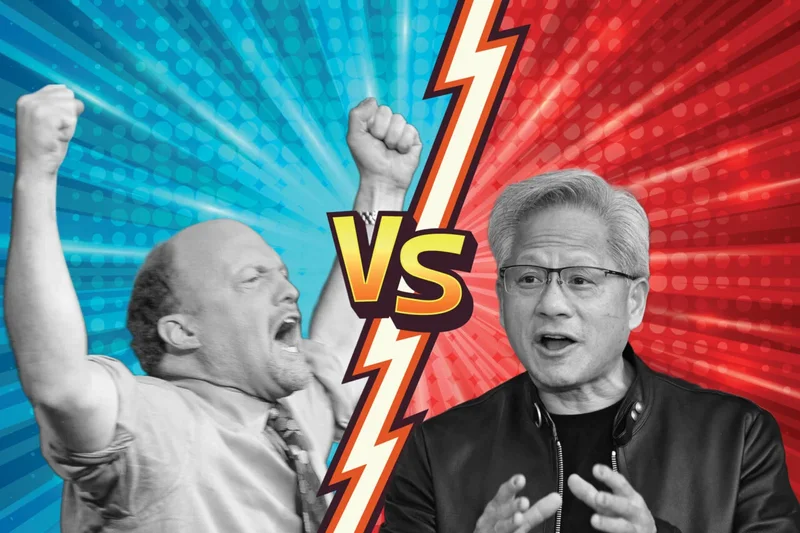
The release of a powerful open-source AI model from China has once again split the tech industry into two camps: the evangelists who believe good tech should be accessible and the protectionist hawks who believe anything foreign is a threat.
It must simply kill Jim Cramer, host of CNBC’s Mad Money and a guy who has never once been deterred by being both loud and wrong, to find himself on the opposite side of Nvidia CEO Jensen Huang, given how much he loves to tell people to smash the buy button on the chipmaker. But Cramer is a China hardliner, refusing to believe anything coming from the country could be anything but compromised. Huang, meanwhile, thinks access to good, cheap AI models is a net positive regardless of where they come from.
In an interview with Axios, Huang said plainly that the Chinese models like the recently released Kimi K3 are “excellent” and that “open-source models that are excellent should be used.” That’s a pretty simple equation to follow: If model equals good, use the good model. He also dismissed the idea that good models from China are somehow a threat to American labs like OpenAI and Anthropic. “There’s no scenario where China runs U.S. companies off the road,” he told the publication. “Zero possibility.”
You’d be hard-pressed to get Cramer to believe that. Ol’ Jim drew a line in the sand on X, stating explicitly, “We must NOT let our companies use these Chinese models to save a few bucks. OpenAI and Anthropic are correct. This is vital national security,” he said. “I respect the Chinese people greatly but these companies are run by the PLA [People’s Liberation Army] for heaven’s sakes.”
That last claim seems to be baseless. Moonshot AI, the maker of the Kimi AI model, does have state-linked investors, but there’s no real evidence of direct military ties. Rival lab DeepSeek has been accused of lending its capabilities to the Chinese military, and members of the US Congress have pushed for it to be designated as a Chinese military companyâbut you’d be pressed to figure out what is different about what DeepSeek is doing for the Chinese government than what the Trump administration has pushed Anthropic and other American AI labs to do for the Pentagon.
Huang doesn’t seem impressed by people like Cramer ringing the alarm bells. He told Axios that it’s a “misconception” that Chinese models provide a “backdoor” to the nation’s government, and said that companies that want to use an open-source model like Kimi can control access when they deploy it. He also stated the obvious: that the open-source nature of the models makes them much easier to check for security vulnerabilities.
Nvidia’s top exec also called out the fact that Cramer’s pals in the finance world keep lighting their hair on fire for no reason. “The market misunderstood the impact of DeepSeek the first time,” he told Axios, and they’ve “misunderstood the impact of Kimi again this time.” Huang’s case is basically that cheaper models are good for business all around, increasing demand for data centers and computing power while also being less burdensome on all those chips that get deployed. “Free AI should be great for chips. Free AI should be great for data centers,” he said.
Of course, there’s a strange thing that happens with the “free enterprise” folks like Cramer when an outside player threatens to eat into the American share of the pie. Suddenly the market actually does need regulating, and companies perceived as “threats” need to be locked out. If Cramer has his way, Kimi will be the BYD of AIâcheap, good, and inaccessible to Americans.