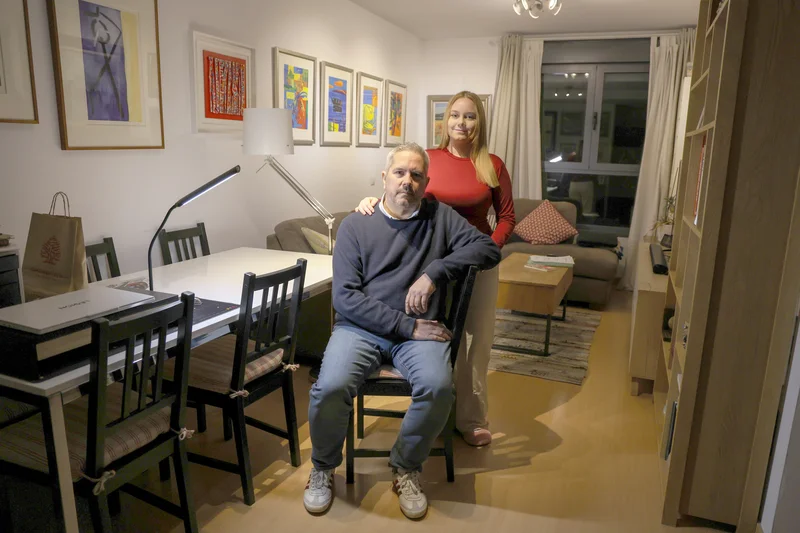
Ramón Bultó is worried about the future — or rather, about his future as a renter at the age of 57. “Of course, the situation worries me,” he says. “I might extend my working life by a few years to increase my pension, but even so, it’s likely that I’ll have to move to a small town, far from my daughters, friends and the city where I was born and raised.”
He lives in an apartment in the Buenavista neighborhood of Getafe — a commuter city about 10 miles south of Madrid — with his eldest daughter, Gabriela, a 21-year-old student. Bultó works in the IT department for a multinational company. He pays €751 a month in rent, or the equivalent of $890. This is because, three years ago — with the support of the Madrid Tenants’ Union — he refused to sign a new €1,100 ($1,2900) contract with Fidere, a vulture fund.
Iván Aranda, 46, rents in the Arganzuela district of Madrid. He’s separated and has two children. He works in renewable energy consulting and acknowledges his good fortune, although he doesn’t hide his uncertainty and unease.
“I have a good job now, but it would be difficult to maintain my current level of spending if I didn’t have it next year,” he says. “I worry about what will happen when I retire — handing over that amount of money every month without it becoming an asset I own, and after 20 years not having a place to call my own. If there were a rental ecosystem with enough supply and reasonable prices, everything would be much calmer.”
Aranda pays €1,300 a month ($1,540) — a low price for the area, where they’re asking for up to €1,700 ($1,990) — because the landlord is a friend. And the location isn’t a whim: he rented near where his ex-partner lives, “so that managing the logistics with the children is more or less convenient,” he explains.
Many others are facing similar situations. Renting is no longer just for young people: increasingly, older people are being forced into this market, due to the impossibility of buying a home. They want to escape the uncertainty and high cost of renting.
Countries like Spain — historically a nation of homeowners, where having a residence has been the best retirement plan — are facing this new challenge. And they don’t seem prepared for what’s coming. In the European country, many members of the aging population are living in rented housing. The baby boom generation — born between the late-1950s and mid-1970s — has been the first to collide with this harsh reality.
“A ticking time bomb.” That’s how Josep Oliver, an emeritus professor of applied economics at the Autonomous University of Barcelona, describes the situation. He warns that the government and public policies must urgently address the needs of this group, which is approaching — or has already reached — retirement age. Time is running out.
“Access to homeownership is becoming increasingly difficult, mainly because people can’t save up for a down payment, due to the high rents we pay,” Ramón Bultó explains. “This [market] is going to explode,” he adds.
While most renters in Spain are still between the ages of 30 and 40, CaixaBank Research notes that the share of tenants aged 45 to 65 has increased in recent years, even before the pandemic. And data from Spain’s National Statistics Institute (INE) confirms that this group continues to grow each year. In 2024, the latest figure available, 14.9% of households headed by someone aged 45 to 65 were renting — more than double the share in 2004 (6.5%). Among households headed by someone aged 65 or over, the figure reached 5.2% in 2024, compared with 3.2% two decades earlier.
This increase reflects a structural shift in the market, where it’s not just young people looking to rent. Instead, it affects a wider age range. Professor Oliver breaks it down: “By age group, in Spain, 32% of all rental households are headed by someone aged 50 or over.” In terms of affordability (rent as a percentage of family income), they pay around 25% of their income. “The financial burden is lower, because they generally have higher incomes,” CaixaBank Research notes.
That picture changes, however, when you zoom in on household income levels. “We see a concentration of renting among the poorest households,” Oliver explains. More than 37% of all rental contracts are concentrated in the lowest‑income third of households, and they devote 44% of their income to paying rent — far above the 30% considered the maximum acceptable burden. Once other basic expenses such as utilities are added, these households are left with less than half of their salary.
“In this context of an aging population, there’s a group — those 50 and over — that’s not part of the public debate, which focuses solely on young people. But in reality, those [under the age of 30] only represent 8% [of the rental market],” Oliver elaborates.
Elena Martínez, a sociologist and head of Research and Evaluation at the nonprofit Asociación Provivienda (“Pro-housing Association”) agrees with this assessment. “There’s a socially accepted image that housing is a problem that affects young people, but we have to keep in mind that, within the other age groups, the reality is very heterogeneous. And we find very worrying situations.”
There are several reasons why more people are having to rent. On the one hand, it’s the natural market for middle-aged immigrants. On the other, prices keep rising and access to financing is becoming increasingly difficult. “After successive [financial] crises, a portion of the population that’s between 50- and 60-years-old lacks the necessary capital to afford a down payment on a mortgage,” says Ana Solozábal, vice president of the Madrid Association of Real Estate Companies (AMADEI).
Divorces and separations
Furthermore, “there are increasingly more separations in nuclear families, where people go from needing one home to needing two in their mid-life. There are also more single-person households, with less savings capacity,” Elena Martínez points out.
For this group, renting is a forced decision: “They can’t find or afford to buy a home,” says José María Alfaro, president of the Federation of Real Estate Associations (FAI). “There’s a process of financial loss among middle-aged people.”
This is the case of Iván Aranda. He has firsthand experience with two burdens imposed by the market: price and supply. “Out of 30 interactions with listings on portals, I didn’t manage to see a single apartment.” And, of course, he can’t buy a similar apartment to his current one, which is a three-bedroom flat. He doesn’t believe the problem is renting per se, but rather doing so in the current context of limited supply and unreasonable prices. “I’m trying to come up with a plan, but honestly, I can’t think of one. I’m more inclined to cross my fingers and hope that things stay the same; I’m aware of how lucky I am to have this apartment.”
Ramón agrees: “If the authorities protected tenants, renting wouldn’t be a bad thing. My parents lived their whole lives with an indefinite, rent-controlled lease.”
Pedro Martínez is 65 years old. Due to various after-effects of COVID-19, he receives unemployment benefits, along with Spain’s guaranteed minimum income (IMV), totaling around €650 ($770) per month. He has always rented, in different cities, since he used to work as a cook. With the support of Provivienda, he was able to access a subsidized apartment managed by the Granada Provincial Council’s public housing company.
Growing older in rented accommodations is a dangerous combination in today’s market. “In many cases, this leads to housing precarity for tenants,” Martínez explains.
And the older they get, the worse it is: 22.7% of households headed by people over 65 are experiencing housing insecurity. “Among people over 65, the rent‑to‑income burden is higher, much like it is for young people,” notes CaixaBank Research.
According to Martínez, “renting has become a factor of economic vulnerability at every stage of life — and certainly in old age.“ The decline in homeownership isn’t limited to younger cohorts. Rather, it’s progressively extending to other age groups.
According to analyses by CaixaBank Research, at the beginning of the 2000s, 66% of young Spaniards owned their homes. Today, that proportion has fallen to 31.8%.
“In some cases, homeownership is being delayed further and further into the life cycle. In others, a growing number of households spend their entire residential life renting,” Martínez concludes.