A convicted killer who is accused of murdering two friends sent a text message saying he was 'bloodthirsty' and feeling hostile around the time he allegedly carried out the killings, a court heard today.
James Desborough, 40, who was a fan of the television serial killer 'Dexter', is accused of murdering acquaintances Daniel Coleman and Claudio Aquilino near his remote woodland cabin before chopping up their bodies, then cremating and burying them nearby.
Desborough today admitted in court that he had used Mr Coleman's bank card to buy himself a 'large beef roast' after dismembering his friend's body.
He has confessed he 'lost all grip on reality' and tried to hide their bodies - insisting he only found them dead on his land and that he didn't kill them.
Jurors have been told the former construction firm boss already has one conviction for murder after he was found guilty of killing his prison cellmate Steven Kempster while he was awaiting trial over the deaths of Mr Coleman and Mr Aquilino.
Winchester Crown Court heard he strangled Mr Kempster, 65, because he was annoyed by his loud snoring while on remand at HMP Exeter in September.
Today jurors were shown a text message in which Desborough tells an acquaintance that he is 'absolutely bloodthirsty real hostile fuming spitting feathers'.
The accused claimed that this was due to the state his cabin and the surrounding wood had been left in by the people staying there - which included Mr Aquilino, 57, and Mr Coleman, 43.
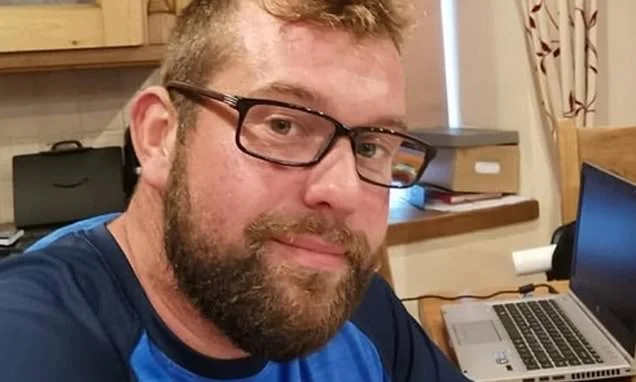
James Desborough (pictured) is accused of murdering Claudio Aquilino and Daniel Coleman
The remains of Daniel Coleman, 43, were discovered in remote woodland near Sticker, Cornwall
The 'dismembered' body of Claudio Aquilino, 57, was also found in the woods
The text was dated on May 30, 2025 - the date Mr Aquilino became a missing person.
However, when Desborough was challenged on whether the text was evidence that he could become 'violent' and 'threaten' people, he claimed he did not even know what the word bloodthirsty meant.
He told the court: 'I don't know what it means to be fair. I was very unhappy about rubbish and human waste being left everywhere.
'I don't understand how that's a threat.'
A week earlier on May 21, Desborough told Mr Coleman he was 'a f****** retard' over text and warned him 'don't take me for a mug, boy'.
Jurors heard the two had fallen out over Mr Coleman's relationship with his wife, Hannah Cresswell, whom Desborough had had an affair with.
Desborough claimed today that Mr Coleman shook his hand when he discovered the affair.
But in this text he described Mr Coleman and Ms Cresswell, 'a pair of f****** toxic wasters', having previously emailed the council that Mr Coleman was 'getting on his f****** tits'.
Police photographs of a pathway in the woodland near Sticker which appeared to have been concealed by cut branches. It is alleged the branches were moved there after the murders
James Desborough, 40, allegedly chopped up the bodies of two of his acquaintances before burying the remains
Desborough is accused of murdering Mr Aquilino on a date between April 17 and July 7 last year and Mr Coleman between June 2 and July 7 last year.
He allegedly chopped up their bodies into 'pieces of flesh' before leaving them in shallow graves by a stream in secluded woodland near Sticker, Cornwall.
The trio met at a shared accommodation block called Sandy Lodge for people with addiction issues in Newquay.
Prosecutor Ahmed Hossain KC said Mr Coleman had lived with his wife at the shelter until March 2025 when they split.
Desborough told the court he did not think Mr Coleman was controlling in his relationship with Ms Cresswell, but in another email to the council claimed he was 'massively concerned about her estranged husband and his controlling behaviour'.
A previous witness in the case, Craig Cudmore, alleged that Desborough once stared at Mr Coleman and said '(It) looks like someone else is getting buried in the woods'.
Today Desborough admitted under cross-examination that this could have happened but he did not remember.
This evidence was presented to challenge Desborough's account that he had a steady friendship with the two deceased men.
It was also alleged by prosecutors today that Desborough had sent texts after the men's deaths to make it seem as though they were still alive.
He also texted a friend that he was going to buy petrol for his chainsaw to make fire wood, which Mr Hossain put to Desborough was an attempt to establish a lie about why he had bought petrol.
The bodies of the two men were burned.
A petrol can was found by Mr Coleman's grave, which Desborough has claimed someone else 'possibly' put there.
This afternoon, Desborough told jurors he bought a 'large beef roast' after dismembering his friend's body and called it 'everyday life'.
Mr Hossain asked the defendant: 'That weekend you used (Mr Coleman's) card to buy yourself a large beef roast, didn't you?
'So you just dismembered his body and you used his money and bank card to buy a large beef roast?'
Mr Hossain then asked Desborough if he knew what the word 'macabre' meant, to which he said 'no'.
The lawyer instead asked: 'It seems unpleasant doesn't it?' and Desborough replied: 'Just everyday life.'
On Tuesday, Desborough said he did not kill the two men and found both of them dead amid 'a series of unfortunate circumstances', then decided to 'destroy' their bodies.
Mr Hossain has previously told the jury that 'dismembered' body parts of both victims were found by police in Paramoor Woods, near Sticker, during searches near Desborough's cabin last summer.
He added: 'Both of these men had lived with Mr Desborough...and these two men were last seen alive in the company of James Desborough.
'After each of them disappeared, their bank accounts were accessed and their money was spent by James Desborough.
'He killed them, he dismembered their bodies, he attempted to burn and bury their remains to conceal what he had done, and then used their money whilst at the same time lying to those around him about where they had gone.'
The trial continues.