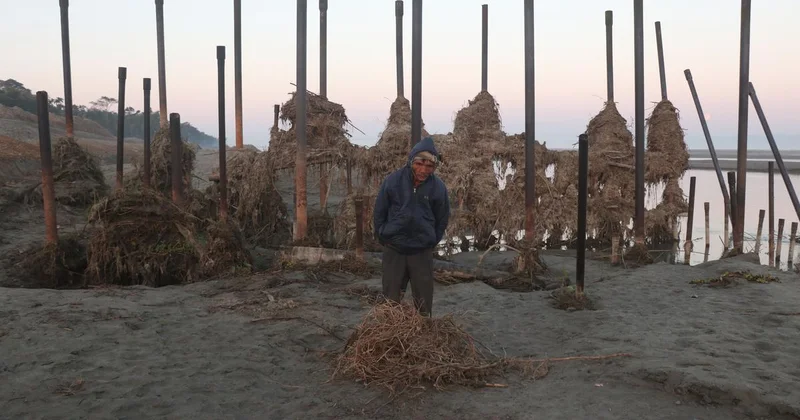
In Upper Assam’s Rahmaria area in Dibrugarh district, the Brahmaputra river is central to people’s lives and imaginations. But since a massive earthquake in the region in 1950, Rahmaria has witnessed widespread river erosion, claiming several forests, paddy fields, villages, and shifting lands in its wake.
There was also rampant militarisation in the early 1990s under the influence of the United Liberation Front of Assam, creating an atmosphere of unsettling silence in Rahmaria. This is the backdrop against which visual artist and photographer Pallov Saikia sets most of his work.
Pallov, 36, works as an Assistant Professor at the Department of Fine Arts and Music, Rajiv Gandhi University in Arunachal Pradesh. He is also co-founder of the Assam-based Anga Art Collective, which has emerged as an important voice from the region.
Excerpts from an interview with the artist.
**When I see your work, it feels very rooted in where you grew up, and where you come from. Could you talk about your growing up years, and the factors that influenced your work? **
I grew up in Garpara village in Rahmaria mouza, located in Assam’s Dibrugarh district. Our village was situated on the banks of the Brahmaputra river.
One of the main things I remember is the backdrop of constant river erosion. So much so, that the river has now consumed more than 30 villages along its course, including my village.
When I was growing up, the erosion in our area was at its peak. The farmlands, the houses, the infrastructure, everything was swept away. There was a huge migration of people out of the area. Most of the families, including mine, were eventually forced to migrate out of Garpara.
The people of Rahmaria were also protesting at the time. They were demanding that the government construct an embankment to prevent erosion in the region. They even stopped Oil India Ltd, from extracting crude oil from Rahmaria as leverage against the government to fulfill their demands. The protest led to the closure of the crude oil site for a long time.
**What was the erosion like and when did it start? **
There was an earthquake in 1950, in Assam. After that the whole topography of the region changed. My father recalls a lot of stories from his childhood. He was very young when the earthquake took place. After the earthquake, there was a flood, and eventually that led to erosion.
My father recalls that when he was growing up, the Brahmaputra river was far away. He had to first cross the Dibru river to reach it, and it would take him at least three to four hours to reach the river. But now, the Brahmaputra is close by, since it has merged with the Dibru river, and is right next to our home.
At the same time, there is something very magical about the riverine landscape. Even now, when I go back to Rahmaria, I can make out that “Oh, there was a village in this area.” Or, “Oh, there was a bamboo forest there.” Now nothing exists anymore.
**When you went to art college in Guwahati, what was the syllabus inside the classroom like? **
It was very academic and colonial. We would do things like still lifes, model studies etc. I submitted my internals, but I was not very interested in these activities. I found the classes to be very dislocated from my background.
For example, I was coming from a rural background and I brought with me my own history, material practices, sensitivities etc. But the syllabus was not showing me a way on how I could engage with my background.
It was very common for art teachers to ask if we would define a work as an “illustration” or a “painting”, whether it would be classified as “art” or “craft”. We often had these kinds of conversations. But when I look back at them now, they feel meaningless to me.
For me now, it’s all about where someone’s practice is coming from, and the urgencies around it. Not about whether something is a painting or an illustration, whether it’s art or craft. We were into such traps when we were in art school.
But I made a group of friends in art college. Which is why I feel very fortunate about studying there. On top of that, since I studied in Guwahati Art College, I feel I did not have the institutional baggage that several other schools in the country carry, and that I could start from anywhere.
**What you have pointed out feels like a pain point for several young artists. I’m sure you must have felt quite confused and frustrated at the time, because you were not able to relate to what was being taught in the classroom. Did you have any guiding light to help you through this period? **
Yes, actually. There was Naskar da. He used to sell art books in Guwahati. We bought books from him in installments, and started reading together. These books were about art history and contemporary art practices. I remember reading a book called Making of Contemporary Art by Linda Weintraub, another one called Concise History of Modern Art by Herbert Read and Ways of Seeing by John Berger, and so on.
Naskar da played a very important role for us during our art school years. He exposed us to the art world through books. And even though he is not in Guwahati anymore, and has moved to Kolkata, we still have a very strong connection with him.
At the same time, we also rented a four room house in Ganesh Nagar, near our college, and converted it into an art studio. This happened quite organically, when I was in my fourth year. Our college was not open 24 hours a day. We asked the college authorities to keep the studio open at night, because we wanted to work for longer, but they refused. That’s when we realised that we needed a separate space where we could work even at night. This was in 2010.
For us as a group, the foundation of working together was already there. At this point we also wanted a space where we could critically discuss art, but the college was not fulfilling our desire to learn more or cultivate our interests. So the studio helped with that. We used the space to organise talks with various artists and writers like Nilmani Phookan, Harekrishna Deka, to name a few from the city. We also developed a strong connection with the community around us. Today many of us continue to work together under the banner of Anga Art Collective.
**Now you are a professor yourself. How do you approach teaching differently from your college years? **
I always want to know what background and life of my students are coming from. I want to understand their location, their urgencies, and the psyche of their place. And accordingly I want to have discussions with them.
The art they make needs to come from their urgencies. All I try to do is to understand their backgrounds, and nudge them to engage with it. In this process, I also learn a lot from them.
**Can you talk a little about your current practice? How did you arrive at it? And what are some of the questions driving your work? **
When I was doing my dissertation during my masters at SN School, University of Hyderabad, I was looking for photographs of Rahmaria. But I was unable to find anything. I was looking for photographs of theatre, but didn’t find much of that either. That is one of the reasons that I do a lot of documentation, and follow people from my village.
I was very clear that I wanted to go back home after getting my degree. I did not dream of going to Delhi or Baroda, like many other artists do. At that time, I bought a camera, and started going to Rahmaria again and again. And I started interviewing the people who still live there.
**Who did you interview, and what kind of stories did you uncover? **
I interviewed many people from different age groups.
Let me share a few anecdotes about it. One of the people I interviewed was my father’s friend. His name is Khagen Saikia. He told me that he had spent most of his life in the river, almost 60 years of his life, that is. He used to travel to a place called Ramsingh through the river with his small boat to bring vegetables and chicken, etc., to sell in the weekly market, and that he would carry essential things like kerosene to the families who stayed in Ramsingh, which was inhabited by a few families. He travelled alone, even in the monsoon when the water level was very high.
Since he spent most of his life in the river, he developed a soulful connection with it. And eventually became an expert of boating. He could tell just by looking at the river how deep the water was. Even during monsoons when the water level rises very high, he wasn’t worried about any unexpected calamities. His only concern was about the goods he was carrying, because he knew that if something were to happen to him, he was already well equipped to save his own life in such circumstances. I interviewed him on different occasions and used to stay at his place and had many wholesome conversations with him.
Then, there is an uncle whose name is Biswa Gogoi. He was telling me the story of a tiger. They had gone to the river island to collect firewood. One night the tiger came near their camp, and slept there. And they had to keep quiet, until the tiger left. Apparently, the tiger was snoring [laughs]. The way he was telling me the story was also very interesting. He was adding a lot of drama to it. The words he used, the way he expressed it. It was something very interesting, I thought.
So, I go to the village. I observe things. I observe the landscape, the seasonal changes. I have long conversations with people. And I take photographs. My process of practice is very slow. You can say, it is the opposite of today’s time, which is very fast.
And when I think about my practice, I feel like it goes beyond documentation. Because I am not merely documenting various activities or cultural practices.
**That’s really interesting. And I agree with you. When I look at your work, it feels like it does more than just document a place and its people. What do you think you are trying to do? **
Yes, my work goes beyond documentation. It is about observing various possibilities, through which the disappearing knowledge systems of my village can be retranslated, and reactivated. I am critically engaging with these systems. And I believe that this can give an alternative way of thinking, and practising art.
**What are some of these disappearing knowledge systems? **
So many things. For example, when I was growing up, there was a strong sense of community. Now, it still exists in parts, but it is slowly disappearing with time.
Then, there were people who sang Bihu songs. Now there are very few such people. These songs were very popular in the village. These songs are very much connected to the landscape. You can see a lot of elements of the river reflected in these songs. They are also very philosophical. They talk about the misery and the happiness of the people.
And the other interesting thing about these songs is that they talk not just about humans, but about non-human things as well. They talk about birds, different species, about the river situation, about the various changes taking place in the landscape.
That’s why I follow a Bihu singer from my village. His name is Sonel Gohain. We can call him a living archive of Bihu songs. I often take photographs of him, and have had long conversations with him.
**How do you think these knowledge systems can be re-inculcated into our lives? Or even in your work? **
In my photographic practice, for example, there is the element of imagination. It’s about how I imagine. And this imagination is not my imagination alone. It is the imagination of my people. For example, how do they imagine a folk character? Or a ghost?
I have been exploring various images of folk characters and ghosts in my village. And people in my village often believe in such characters…someone might see something mythical by the river, for example.
So, I explore these images in my work. This is also a kind of preservation. An attempt to reactivate such imagery. I want to bring that imagination; the collective imagination of the people of Rahmaria into my practice. Along with that, I explore the various changes of the river. I follow the people and the landscape and wait for certain moments and photograph them.
**While you talk about disappearing knowledge systems, it is also clear that the narrative of development, comprising shiny bridges, world-class infrastructure, and large-scale industry, is here to stay. How do you see your work, and the knowledge systems of your community in this context? **
There has always been a dominant narrative of development. Ironically, this narrative is often tied to resource extraction and environmental degradation. The place I come from has been treated as a site of extraction since the colonial period, and that logic continues today.
A recent example is the June 2025 Handbook on Geological Potential of Northeast India, which highlights the potential presence of rare earth materials in the North-Eastern region. While such discoveries are often celebrated as opportunities for development, they also raise important questions about who benefits, what is extracted, and what ecological and cultural costs these projects may bring.
In this context, I believe it is essential for a collective voice. As I mentioned earlier, the erosion of the sense of community has become one of the most pressing concerns of our time. Practising together as a collective allows us to carry forward the local knowledge systems, articulate the realities of the spaces we come from, and offer alternative ways of imagining development that are rooted in care for people, culture, and the environment, rather than extraction alone. It also creates the conditions for nurturing a grounded art ecosystem in this region.
There is a strong anti-Miya sentiment in Assam right now. How do you see such sentiments against perceived outsiders in relation to ideas of development and climate change in your state under the current political regime?
I don’t support any kind of communal politics. So far, we haven’t had the opportunity to work closely with the Miya community. However, I, as an art practitioner, as well as our collective, would love to collaborate with practitioners from the community. I think the practice of Miya poetry on social media a few years back has brought to the fore important young voices from the community.
Reflecting the multilingual channels of communication in the social world, the Miya poetry discourse was able to create a dialogic platform for a moment. Today, a project like Itamugur Community Media is continuing significant work in shedding light on the interconnected nature of exclusionary politics, developementalist paradigm and extractive policies. The social and cultural life of the community is also expressed in many of its presentations.
**And finally, if I were to ask, why do you do this? Why do you practice art? What would happen if you stopped? **
The thing about the practice is that I have to practice, otherwise I don’t feel good. I simply need to practice. I am very clear about that. Being a visual art practitioner, I feel I have a certain obligation to practice art.
Whenever I come home, I go to Rahmaria. I go to my friends’ houses, talk to them, spend time with them, and spend time in the landscape. For me spending time is more important than producing something quickly.
Purvi Rajpuria is a writer and illustrator from Kolkata. This conversation was first conducted as part of her podcast series, Documenting Culture.
We welcome your comments at letters@scroll.in.