A book reviewer or a film reviewer often falls into the trap of judging a work by pre-set notions of what it ought to be, fixating on exclusions rather than what it contains. This is something any serious critic should be mindful of. Yet I must confess that some of my reservations about Shoma Chatterji’s The Male Gaze Redefined are along those lines.
Subtitled ‘Through Mother India and Other Classics of Indian Cinema’, this book examines the works of nine major male directors in terms of the attitudes to women revealed in their films, spanning several decades. To elucidate her points about ways of looking and depicting, Chatterji also discusses, and occasionally argues with, Western film theory by Laura Mulvey and others.
Limited scope
This is an unquestionably worthy project, and Chatterji, like any writer, is free to choose her area of study and to stay within its limits. In actual practice, though, things get tricky, because this is a freshly published book — not a reprint or a revised edition — which makes many broad-based statements about Indian cinema, and doesn’t define itself as dealing only with distant history. That being the case, one can raise an eyebrow at the datedness of some of its content.
For instance: at the end of a generally insightful chapter touching on idealised goddess representations of women, as well as the supressing of the voices of fresh-and-blood female characters, comes an observation about trends changing for the better. “The final note comes from two young directors,” writes Chatterji, “[whose films] speak of women, and for women, in a language we all understand but are afraid to speak.”
Who are these “young directors”? One is Mahesh Manjrekar, now aged 67, and the other is Rituparno Ghosh, who passed away 13 years ago.
In fairness, the chapter containing this assertion does specify a timeline of 1935 to 2000 for its study. But in all other respects, The Male Gaze Redefined asks to be assessed as a 2026 publication, and there is a randomness in what it chooses to include or leave out.
In one sub-section about political films, Chatterji refers to recent works such as Indu Sarkar (2017) and Thalaivii (2021). Shyam Benegal’s Zubeidaa (2001) is one of the films selected for close study. But otherwise the 21st century rarely impinges on this canvas. Some passages feel like they were excerpted from papers written decades ago. The Mother India analysis cites a couple of later films that attempted to follow in the tracks of Nargis’s iconic role as Radha, but even here the films mentioned (two Smita Patil-starrers) are from the 1980s.
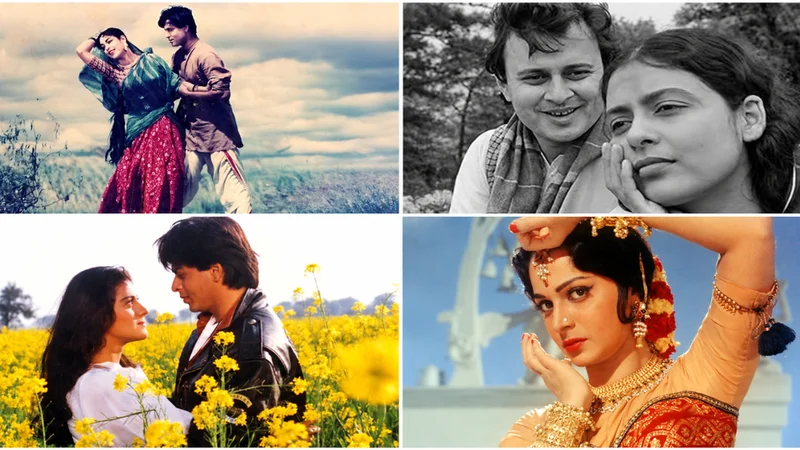
A section titled ‘Silent Submission in Some Contemporary Films’ boldly ventures to the mid-1990s (Dilwale Dulhania Le Jayenge), but no further.
This created a conflict for me as a reader. As someone whose most intense engagement has been with very old films, made decades before I was born, I can relate to and appreciate Chatterji’s study of classics. But even a reader who is invested in deep film history may be perplexed about this book’s unwillingness to engage with more recent developments in feminist (or pseudo-feminist) cinema.
Timelines aside, there are other exclusions. In a work that makes generalisations about “Indian cinema” (and even observes that some Western pedagogy may not be applicable to our filmic culture), the focus is almost exclusively on Hindi and Bengali films – with only a few quick notes at the end about directors such as Adoor Gopalakrishnan, Jabbar Patel, and Girish Kasaravalli.
Further, Chatterji’s main engagement is with a certain type of cinema: the filmmakers discussed are largely auteurs who come from relatively progressive, modern backgrounds (Satyajit Ray, Mrinal Sen) or those who worked in what is called parallel/art or ‘middle cinema’ (Benegal, Gulzar). These are directors who can be seen as essentially sympathetic to and interested in their women characters – even if there are some inevitable blind spots in their work, since they are to varying degrees affected by patriarchal conditioning.
Notwithstanding the inclusion of Vijay Anand’s 1965 film Guide (and observations about his other big-budget work, such as Jewel Thief, 1967, and Teesri Manzil, 1966), there is not much effort here to discuss the many ways in which “male lens” cinema operates within the truly popular or mainstream. Or to engage with more openly or unapologetically “male” directors. A case can be made that a comprehensive analysis of this subject would have to consider the myriad ways in which women have been depicted in commercial films too, especially since these films, more than self-consciously “serious” cinema, are open to many conflicting readings.
Internationally, for instance, there have been many cases of filmmakers who have been widely dismissed as objectifying women, but whose work is subsequently reassessed in other terms. Camille Paglia, always a deeply divisive figure herself in feminist studies, responded with both verve and nuance to allegations that Alfred Hitchcock was a misogynist. Brian De Palma, often derided for sleazy content in his films, has been passionately defended by women critics such as Stephanie Zacharek or Pauline Kael.
Close readings
How best, then, to approach The Male Gaze Redefined? By reading the individual essays on specific films, entirely on their own terms, without bothering much about the larger picture. Seen this way, the book contains some thoughtful analysis and attention to detail, as you would expect from a scholar of Chatterji’s standing.
Writing about Mehboob Khan’s Mother India (1957), she compares it with his earlier treatment of the same story, Aurat (1940), noting that the older film treats the protagonist Radha’s story in more personal terms while the later one, made a decade after Independence, places on her the additional burden of being a symbolic village-mother and nation-mother. Elsewhere, she looks at the treatment of women characters by the Bengali masters Ritwik Ghatak and Ray, with an emphasis on the “cannibalising” of the hard-working Nita in Ghatak’s Meghe Dhaka Tara (1960) by her own family, or Ray’s treatment of the friendship between Arati and her Anglo-Indian colleague Edith, who can be seen as a victim of racism in reverse, in Mahanagar (1963).
As she has done in her earlier work, including The Woman at the Window, Chatterji writes about objects as signifiers and markers: a scarf in Zubeidaa, a lipstick in Mahanagar. She celebrates the revitalising power of Waheeda Rehman’s great snake dance at a pivotal point in Guide (1965), and remarks on the ambivalence that a viewer may feel about the attitudes of the guide Raju, played by Dev Anand. And she raises interesting questions, letting them hang in the air: does Mother India’s heroine, for all her framing as an inspirational figure, really have any agency when it comes to the important things, including the killing of her own errant son? What is the purpose – and what conflicting feelings might it evoke in a viewer – of the brief close-ups of “the naked breast of a nursing woman” in Nabyendu Chatterjee’s Parasuramer Kuthar (1989)?
Inevitably, with a work like this, a reader’s interest will vary based on his familiarity with the films being discussed. Having re-watched Meghe Dhaka Tara, Guide, and Mahanagar recently (all on big screens in excellent prints), I was better equipped to appreciate the segments on those films. On the other hand, not having seen Budhadeb Dasgupta’s Andhi Gali (1984), reading that section was an abstracted process (though Chatterji’s observations made me keen to seek the film out).
A mixed verdict
As for the writing itself, some of it is dry and repetitive. In one passage, listing the different layers of meaning carried by Radha’s kangans (bangles) in Mother India, the author says exactly the same thing in points one and two: “First, they symbolise her uncertain marital status” followed by “Second, she does not know whether she is married, widowed, or a deserted wife; the kangans are a sign of this flux”. There are other examples of such tautology, a problem that has long afflicted much cinema writing in India in both the academic and general spheres.
Regardless of my overall reservations, though, I appreciated Chatterji’s open-endedness and handling of complexity. At one point she suggests that though writer-director Gulzar is sensitive to his women characters, and careful not to subject them to an objectifying gaze even when the narrative offers such opportunities, he also seems conservative about the idea of the working woman or the woman in a position of power. That these contrary impulses exist in all artists, and often create conflicting energies in a film, is something that Chatterji, unlike many other analysts, is attentive to. And that attitude is important when it comes to a subject as contentious and polarising as gender politics in cinema. You can disagree with some of her analyses while also admiring the seriousness that lies behind them.
The reviewer is a freelance writer and journalist based in New Delhi.
The Male Gaze Redefined
Shoma A. Chatterji
Hachette India
₹499
Published - July 31, 2026 07:04 am IST