'I woke up and I had lost the baby': Miscarriages in Gaza spike amid harsh conditions, UN report finds
Eman Abu Fasifsa's miscarriage was one of nearly 4,000 pregnancy losses recorded in Gaza so far this year
In a small, dark room off the side of the morgue in the Nasr Medical Complex in central Gaza, about a dozen tiny white shrouds are arranged on a metal table.
These are the remains of recent miscarriages.
The white cloths are labelled with the term of pregnancy and the date of the miscarriage as well as sometimes a name.
Dr. Ahmed Al-Farra, head of pediatrics at the hospital, told CBC News late last month that the miscarriage situation is alarming.
"The percentage increased nearly three-fold in comparison with the percentage from before the war," he told CBC freelance videographer Mohamed El Saife.
There have been nearly "4,000 pregnancy losses" recorded as miscarriages in the enclave between January and June 2026, a rate that's more than three times higher than in the second half of 2025, according to a statement provided by the United Nations Population Fund (UNFPA).
This number doesn’t include instances where a miscarriage happened outside the hospital.
WATCH | Doctor says living conditions in Gaza lead to miscarriages:
What pregnant women in Gaza endure
UNFPA's statement notes that pregnant women in the strip "endure severe food insecurity, malnutrition, repeated displacement, sustained psychological trauma and overcrowded and unsanitary living conditions."
The organization says interruptions to prenatal care and limited access to essential health-care services like diagnostics, medicine and emergency obstetric procedures "leave complications undetected or untreated."
In its statement, the organization notes that more analysis is needed to better understand the reasons behind the increase in miscarriages. It has commissioned a report to further analyze conditions pregnant women are experiencing on the ground in Gaza. That report is due out in about two months.
- In Gaza City, a funeral for 112 family members takes place 3 years after their deaths
- Israeli strikes kill two in Gaza and destroy warehouses storing medicine
A July report published by the United Nations Office for the Coordination of Humanitarian Affairs (OCHA) says sexual and reproductive health indicators "continue to deteriorate" across Gaza during the first six months of 2026.
"Nearly 74 per cent of pregnancy losses occurred during the first trimester, while 57.1 per cent of pregnant women were anemic," it noted. These numbers "highlight the worsening health and nutritional status of women in Gaza."
Fear, anxiety contributing factors: Doctor
Al-Farra's experiences at the Nasr Medical Complex align with these numbers.
He says there are many factors that contribute to rising miscarriages, including the inhumane living conditions pregnant women face, such as extreme temperatures, the struggle to find food and water and the constant displacement of their families. He says they also contribute to fear and anxiety.
"They’re afraid," he said. "They are suffering a lot."
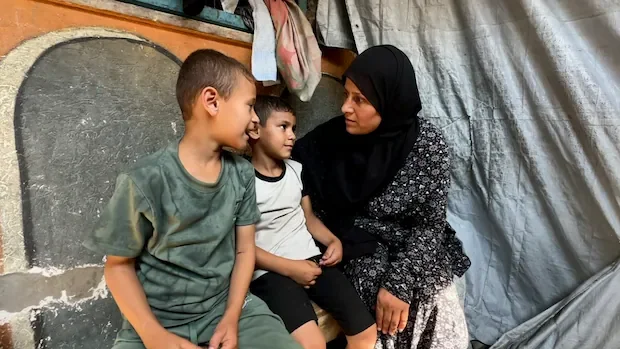
Eman Abu Fasifsa, 38, lives in a makeshift room at a UN-run school in central Gaza with her five children. Her walls are pieces of tarp held up with rope. She recently went through a miscarriage after being pregnant with her sixth child.
"The day of my miscarriage there was a very, very strong explosion," she said. "I was so scared, and that morning I woke up and I had lost the baby."
Abu Fasifsa says she also spent her pregnancy carrying heavy water jugs and had a hard time finding food, which she thinks also contributed to the miscarriage.
Aid needs still not being met
In Gaza, food insecurity has eased, according to a recent OCHA report, which also notes there's a real risk that those gains could be reversed as aid coverage has declined since February 2026, based on the latest Integrated Food Security Phase Classification analysis.
On Thursday, Israel's Co-ordinator of Government Activities in the Territories (COGAT) wrote in a post to X that it has co-ordinated the entry of more than two million tons of food "along with other essential humanitarian aid" into the enclave.
"The constant flow of food has contributed to reduced market prices, as markets across Gaza offer a variety of fresh fruits, vegetables, meat and dairy products," the post said.
But for Abu Fasifsa, finding that food for herself and her children is still a struggle.
"There is no good food, no clean water, no safe place," she said. "We can only save food for one day. The situation is very difficult, really."
And that's true for families throughout Gaza, despite the ceasefire, according to the UNFPA's statement.
"Nearly 90 per cent of the population remains displaced," the statement said. "Humanitarian access and the movement of essential goods remain constrained."
Gaza, it says, "has not moved from emergency response to recovery."
Back at the UN school where she lives, Abu Fasifsa sits to chat with her sons as the sun begins to set.
She says she isn’t considering getting pregnant again because of how difficult her living conditions are at the moment. But she still longs for the baby she lost, as well as the life she had before the war.
"It was my dream to have the child with me today, with my children," she said.
With files from Mohamed El Saife