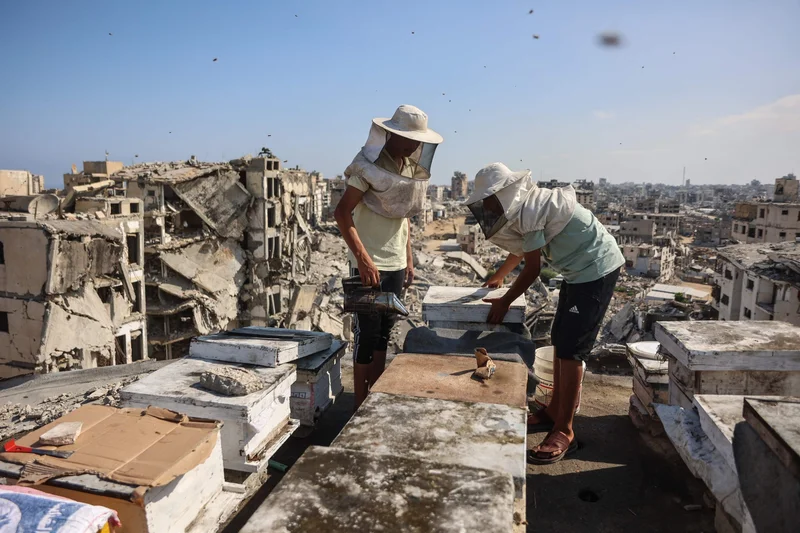
High above Gaza City's war-scarred landscape, Ibrahim al-Dabba tends his hives, preserving a rare source of hope amid the devastation of the Israel-Hamas war.
Wearing protective netted hats and carrying metal bee smokers, al-Dabba and his sons carefully inspect rows of buzzing hives. As they lift each honeycomb frame, hundreds of bees swarm above the shattered neighborhood, creating a striking contrast in a city scarred by war.
The rooftop apiary is an unlikely setting, but for al-Dabba, who heads the Beekeepers Cooperative in the Gaza Strip, it has become a necessity.
He said the war that erupted in October 2023 devastated Gaza's beekeeping industry, destroying much of the territory's long-standing beekeeping tradition.
"We had more than 40,000 beehives and more than 450 beekeepers" before the war, he told Agence France-Presse (AFP) from the rooftop in Gaza City's Tel al-Hawa neighborhood.
"The situation was good, with more than 1,000 families making a living through the beekeeping sector," he added.
"The war came and destroyed the beekeeping sector by more than 95% because most beekeepers were near the border areas," he explained.
Al-Dabba himself lost about 400 hives, which he had kept on agricultural land east of Gaza City.
He had no choice but to relocate his remaining 35 or so hives to the roof of a residential building, but admitted the situation was far from ideal.
"Bees are supposed to be in a safe, suitable agricultural area, but today the bees are suffering just as we are," he said.
Al-Dabba explained that he could not move his bees back to their previous home because it had been destroyed and the land was now under the control of the Israeli military.
"We cannot approach or enter," he said.
"Just as we are displaced in the streets, the bees are also displaced on the rooftops."
The devastating war in Gaza was triggered by Hamas' Oct. 7, 2023, incursion on Israel, which resulted in the deaths of 1,221 people.
Israel's retaliatory military campaign in Gaza has killed more than 73,300 people, according to the territory's Health Ministry, whose figures are considered reliable by the United Nations.
Despite the cease-fire in effect since October, bloodshed has continued in the territory, with the Israeli military continuing to target Palestinians it says are Hamas members.
Israel says it now controls more than 60% of the Gaza Strip, up from about half when the cease-fire took effect.
The humanitarian situation also remains dire, with hundreds of thousands of people living in tents and Israel tightly controlling the entry of goods into the territory.
"We lack essential supplies because importing beekeeping equipment from the other side is not permitted," al-Dabba told AFP, saying he had approached external organizations and ministries in Gaza and the occupied West Bank for help.
Despite the suffering and challenges of relocating his hives to an unfamiliar landscape, al-Dabba said he found "hope after seeing the bees coexist and adapt."
"The bees now come and go and feel settled," he said.
"So we hope that hope, goodness and living in peace and security will come, like in other countries."