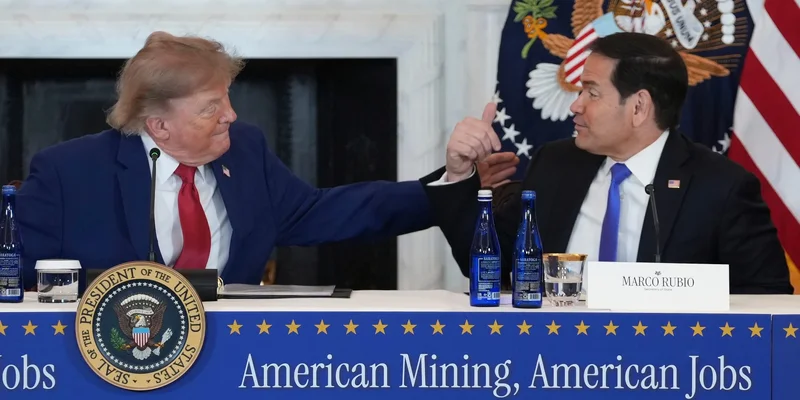
Secretary of State Marco Rubio announced last month a policy banning visas for foreigners accused of links to “far-left terrorism.” The policy cited Donald Trump’s National Security Presidential Memorandum-7 as well as the law Rubio used to try to deport the pro-Palestine activist Mahmoud Khalil.
More than three weeks later, however, it’s not clear how Rubio and the State Department intend to use the policy. Their silence since the announcement has left some advocates wondering if the policy is really just a public-relations push by the Trump administration.
Existing law already allows the State Department to block terrorists from visiting the U.S. But tucked inside the policy is language about “economic sabotage” that advocates worry could empower a broad crackdown against people associated with the Boycott, Divestment, and Sanctions movement and campaigns to divest from fossil fuels.
“The message is to the public at large and particularly to anybody who would disagree with the government’s policies that they should tread carefully, lest they be considered a member or aligned with what the government considers to be a far-left terrorist group,” said Carrie DeCell, a senior staff attorney at the Knight First Amendment Institute.
“I think the vagueness is the point. It’s intended to send a broad chilling effect through the public and discourage dissent.”
Rubio’s Right-Wing Fever Dream
Rubio announced the policy at a July 16 gathering of foreign diplomats where he played up the threat of what he called “far-left terrorism,” which he said had been overlooked after the September 11, 2001, attacks.
“For far too long, however, our counterterrorism doctrine has had a blind spot — a blind spot when it comes to extremist violence from the political left. Even today, the very idea that far-left terrorism could be a serious threat is treated as a right-wing fever dream, or worse, as a dangerous fascist conspiracy,” Rubio said.
In a press release, Rubio said that State Department officials had been instructed to deny visas to “members of Far-Left Terrorist and other aligned groups who have supported or incited acts of terrorism; supported violent criminal activity; participated in economic sabotage; financed, recruited, or provided logistical support for violent or criminal actions committed by Far-Left Terrorist and other aligned groups; and/or facilitated the convergence of Far-Left Terrorist and other aligned networks for the purposes of violent action.”
The State Department has not elaborated further on how it decides whether a foreign national is a member of a “far-left” terror group or “aligned” groups. The department did not answer questions from The Intercept about its definitions for those terms.
The policy raised major concerns, however, for Peter Margulies, a law professor at Roger Williams University.
Nothing in the policy appears to restrict it to foreign nationals residing abroad, Margulies said. He is concerned that the State Department could attempt to apply it to students living in the U.S. or to other people with legal status who are applying for different visas or renewals.
“The worry is that this will be used who are already in this country, for example, foreign students,” he said. “This gives the administration a hammer to go after these people, that I think is problematic under the First Amendment, and also exceeds the authority that Secretary Rubio has.”
Other parts of federal immigration law already give the government wide discretion to block people accused of links to terrorism, making it something of a puzzle why the government would need a new policy to block people accused more specifically of “far-left” terrorism.
Yet one provision of the policy appears to mark a shift from existing policy, Margulies said: a section singling out people accused of “economic sabotage.” That kind of language could be used to target people who have supported Palestinian calls for the boycott of Israel, or environmental activists protesting fossil fuel companies, he said.
“That’s a term broad enough to get a tank through, and so that would really be problematic under the First Amendment, because of course people in this country have a right to criticize corporations as well as government,” he said.
The Vagueness Is the Point
When Rubio announced a new policy last May targeting misinformation researchers for visa denials, the State Department followed up seven months later by announcing that it would block or deport five foreign nationals.
So far the State Department has not announced any visa denials under the latest policy. For an example of the type of people that Rubio considers to be supporters of far-left terrorism, DeCell pointed to a State Department report about Cuba’s influence network issued last month. That report named streamer Hasan Piker, Amazon Labor Union founder Christian Smalls, the National Lawyers Guild, and the Democratic Socialists of America.
Baher Azmy, the legal director at the Center for Constitutional Rights, said it was possible that the new visa restriction policy is simply another part of the multipronged effort to build up the threat of the left ahead of the midterms.
“This is coming at the same time they’re starting this once moribund terrorist court, they’re calling Amy Goodman a far-left enemy of the state,” he said. “It might be a midterm strategy, because it does seem to be coming all at once.”
DeCell’s group recently won an injunction blocking the State Department from implementing its visa restriction policy against misinformation researchers. She expects the State Department to eventually get around to announcing visa denials, as it did with them. “The justifications for their targeting likely would be made on X, if it follows the same path,” she said.
When it does, the latest restrictions could also be vulnerable to legal challenge. While the State Department has broad discretion to deny visas to foreigners, Margulies said, it is not unlimited, particularly for those living in the United States.
“Watch this space. They may have particular people in mind. Then we may see some developments very quickly how they intend to apply this,” he said.
IT’S EVEN WORSE THAN WE THOUGHT.
What we’re seeing right now from Donald Trump is a full-on authoritarian takeover of the U.S. government.
This is not hyperbole.
Court orders are being ignored. MAGA loyalists have been put in charge of the military and federal law enforcement agencies. The Department of Government Efficiency has stripped Congress of its power of the purse. News outlets that challenge Trump have been banished or put under investigation.
Yet far too many are still covering Trump’s assault on democracy like politics as usual, with flattering headlines describing Trump as “unconventional,” “testing the boundaries,” and “aggressively flexing power.”
The Intercept has long covered authoritarian governments, billionaire oligarchs, and backsliding democracies around the world. We understand the challenge we face in Trump and the vital importance of press freedom in defending democracy.
We’re independent of corporate interests. Will you help us?
** IT’S BEEN A DEVASTATING** year for journalism — the worst in modern U.S. history.
We have a president with utter contempt for truth aggressively using the government’s full powers to dismantle the free press. Corporate news outlets have cowered, becoming accessories in Trump’s project to create a post-truth America. Right-wing billionaires have pounced, buying up media organizations and rebuilding the information environment to their liking.
In this most perilous moment for democracy, The Intercept is fighting back. But to do so effectively, we need to grow.
That’s where you come in. Will you help us expand our reporting capacity in time to hit the ground running in 2026?
We’re independent of corporate interests. Will you help us?
** I’M BEN MUESSIG,** The Intercept’s editor-in-chief. It’s been a devastating year for journalism — the worst in modern U.S. history.
We have a president with utter contempt for truth aggressively using the government’s full powers to dismantle the free press. Corporate news outlets have cowered, becoming accessories in Trump’s project to create a post-truth America. Right-wing billionaires have pounced, buying up media organizations and rebuilding the information environment to their liking.
In this most perilous moment for democracy, The Intercept is fighting back. But to do so effectively, we need to grow.
That’s where you come in. Will you help us expand our reporting capacity in time to hit the ground running in 2026?
We’re independent of corporate interests. Will you help us?
Latest Stories
Chilling Dissent
State Department Wants Palantir’s Advice on Free Speech and “Countering Digital Surveillance”
Founded by Trump ally and right-wing billionaire Peter Thiel, Palantir has attacked the press and works in the digital surveillance space.
The War on Immigrants
Congress Might Give ICE the Power to Go After Shoplifters
A bill intended to halt the supposed threat of “organized retail crime” would put ICE in charge of the federal response.
Targeting Iran
The Pentagon Is Posting Cryptic Biblical Messages on Social Media
Defense Department accounts posted the biblical quote “SEND ME.” The Pentagon won’t say if its proselytizing is a message about the Iran war.