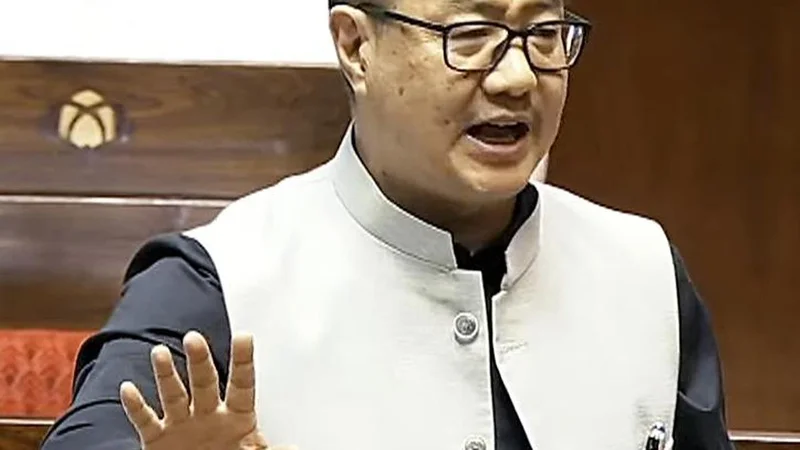
Union Parliamentary Affairs Minister Kiren Rijiju and the Leader of the Opposition in the Lok Sabha, Rahul Gandhi on Saturday (August 8, 2026) sparred over the implementation of the women’s reservation law after a fresh delimitation exercise, with Mr. Gandhi questioning the government’s decision to link the two.
The exchange on the social media platform X began after Mr. Gandhi posted a video speaking of harnessing the “energy” of India’s women and freeing them from patriarchy.
Mr. Rijiju responded by describing it as a “positive message” and said there was a “visible change of heart” in Mr. Gandhi. The Parliamentary Affairs Minister challenged the Congress to support the Women’s Reservation Bill “unconditionally”.
Hitting back, Mr. Gandhi said the Congress had already supported the legislation and asked why its implementation had been held up for three years. “Why has it still not been implemented even after three years, and why do you now want to unnecessarily link it to delimitation?” Mr. Gandhi said in a post on X, adding, “Implement the 2023 law. Without any conditions.”
Responding to Mr. Gandhi, Mr. Rijiju said the Opposition leader knew that the reservation of seats for women in the Lok Sabha and the State Assemblies was provided for under the Constitution (106th Amendment) Act, 2023 or the Nari Shakti Vandan Adhiniyam.
Its provisions, he said, would come into effect only after a delimitation exercise based on Census figures published after the Act’s passage in 2023. Since the figures for the ongoing 2026 Census — including caste enumeration — could take substantial time, implementation could be delayed until at least the 2034 General Election, he said.
Mr. Rijiju argued that if women’s reservation was to be implemented from the 2029 General Election, delimitation would have to be undertaken at the earliest, using the latest available Census figures.
“The implementation methodology has been proposed under the Delimitation Bill, 2026, introduced in the Lok Sabha along with the amendments to the Constitution. However, the Constitution (131st Amendment) Bill, 2026, introduced for the purpose, was defeated in the Lok Sabha,” the Minister said.
In his video, Mr. Gandhi said India could not become a successful country without women being able to express themselves freely. “Our country is stunted and incomplete without the expression of women,” he said, calling for women to be able to question their parents, husbands, and brothers, and to speak without fear.
In a response to the video, Mr. Rijiju said: “Now, I hope the Congress Party will support the Women’s Reservation Bill unconditionally.”
The sharp exchange between Mr. Rijiju and Mr. Gandhi came amid the government’s renewed effort to push through the delimitation package.
In April, the Indian National Developmental Inclusive Alliance (INDIA) bloc voted against the Constitution (131st Amendment) Bill, which sought to increase the strength of the Lok Sabha to 850 seats and reserve 33% of them for women after carrying out a fresh delimitation exercise.
Opposition parties had raised concerns over the implications of a fresh delimitation exercise for the political representation of States that have successfully pursued population control.
Though the government failed to secure the two-thirds majority mark of 360 in the current 540-strong Lok Sabha (there are three vacancies) on April 17, 2026, the ruling National Democratic Alliance (NDA) has added more members to its fold since then.
Since April, the government has already secured the support of 20 rebel Trinamool Congress MPs, who are now part of the Nationalist Citizens Party of India (NCPI), along with six Shiv Sena MPs of the Uddhav Balasaheb Thackeray (UBT) faction, who have switched sides to be part of the Eknath Shinde-led Shiv Sena.
Despite repeated denials from the party, there is also speculation in political circles that the Sharad Pawar-led Nationalist Congress Party (NCP), which has eight MPs, could also reconsider its stance on the delimitation issue in the coming days.
Published - August 08, 2026 05:07 pm IST