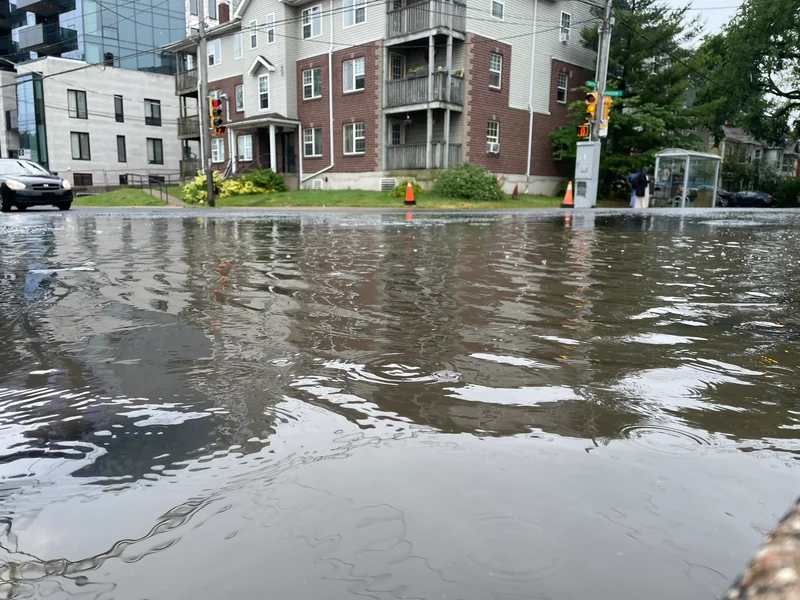
Environment Canada has issued a yellow rainfall warning for parts of Nova Scotia, as the province’s emergency management minister warns residents to take the forecast “seriously.”
Up to 60 mm could fall in southwest Nova Scotia and along the Atlantic coast, with the weather agency warning more could fall during thunderstorms.
The heavy rain is expected to continue in Nova Scotia until Thursday afternoon.
The worst-hit areas are expected to be along the province’s Atlantic coast, and with the heavy rain, low-lying areas are at risk of flooding.
“As we have these warnings out, we’ll be watching them today and adjusting if necessary if we need to add to any of those,” said Ian Hubbard, an Environment and Climate Change Canada meteorologist.
The warning comes on the three-year anniversary of flash floods that claimed the lives of four people in the municipality of West Hants.
Story continues below advertisement
Two six-year-old children, a 52-year-old man and a 14-year-old girl died after they were swept away as waters poured onto a rural highway near Brooklyn, N.S., on the morning of July 22, 2023.
3:23
Nova Scotia flooding: Aerial video shows large portions of urban areas underwater
For Emergency Management Minister Kim Masland, it’s a day that sticks with her.
“I didn’t need anyone to remind me of the anniversary,” said Masland, who was public works minister at the time.
Get breaking National news
Get breaking Canada news delivered to your inbox as it happens so you won't miss a trending story.
“It’s something that stays very much embedded in my mind and how I was feeling that morning.”
The following year, a report prepared by the West Hants emergency management coordinator said the municipality faced several challenges transmitting timely emergency alerts to the public.
The report found poor cellphone service was partly to blame for the delay, as was the fact that not all cellphones were equipped to receive such messages. The report said the alerts can only be received by phones using LTE networks or more advanced systems.
Story continues below advertisement
In July 2024, a child died in a flash flood in the Town of Wolfville while playing at a park.
Masland says since the fatal incidents, both the province and the municipalities have taken steps to improve crisis communication.
“We have created the Nova Scotia Emergency Alert app, and that has been incredible. It allows people that would be in areas that does not have cellular service or Wi-Fi, 3G, they can actually through the LTE … still get those alerts,” she said.
“And it will allow you to get the alerts in other areas, too.”
2:02
Advocates push for better flood alert system in Nova Scotia
Since the incidents, the province has also created the Department of Emergency Management, creating a dedicated minister role that Masland now holds.
More on Weather
More videos
Story continues below advertisement
“To me, it’s about information and getting the information into the hands of trusted sources so that people can be informed of what’s happening in their communities,” said Masland.
Halifax prepares
In Halifax, the municipality is encouraging people to sign up for HFX alert to see all warnings and alerts about inclement weather.
Emad Aziz, Halifax Regional Municipality’s emergency management director, says the department is keeping a particularly close eye on the Sackville and Bedford areas because they were flooded “quite significantly” back in 2023.
“We are more aware of impending weather events, and we’ve improved our communication with our residents,” he added.
“So those are three key areas of planning coordination and communication we’ve approved since the events of July, 2023.”
In terms of preparedness, he advises people to keep an eye on the forecast and check their properties.
“Residents can check the exteriors of their properties to make sure (their) storm drains, their gutters, catch basins, troughs, those kind of things are clear of debris, especially leaves that tend to clump and cause blockages,” he said.
“Inside the house, things like electronic items and electrical cables should be elevated and away from the floor, especially in basement and below-ground areas. There’s a high risk of electrocution, especially when water levels are rising and appliances are plugged in and life sockets and those kinds of things.”
Story continues below advertisement
He adds those with sump pumps should make sure they’re working. Otherwise, residents should have a plan.
“How will you keep the water away from the home, especially around the entrances? So those would be some things to keep the water away from the house,” he said.
2:02
Halifax council moves forward with changes to limit development in high risk flooding areas
© 2026 Global News, a division of Corus Entertainment Inc.