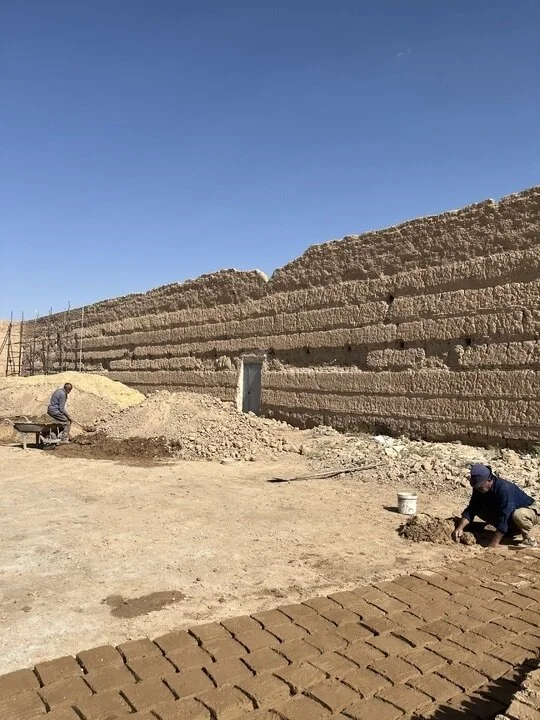
Restoration begins at historic Seb castle in central Iran
TEHRAN - Restoration work has begun on the historic Seb castle in Abarkuh county in Iran’s central Yazd province, a local cultural heritage official said on Saturday, as part of efforts to preserve the region’s traditional adobe architecture.
Abbas Qadirian, head of the Cultural Heritage, Tourism and Handicrafts Office of Abarkuh, said the castle was the largest residential citadel in Abarkuh and dates to the Safavid era (1501–1736).
The 17,000-square-meter complex was added to Iran’s National Heritage List in 2005 under registration No. 13724.
Qadirian said the residential complex features a distinctive grid-like layout, with most of its houses arranged along both sides of its alleys. Its traditional construction incorporates unfired mudbrick, mud mortar, fired brick, stone and wood.
Some of the older houses within the complex feature decorative plasterwork, including floral and arabesque motifs as well as muqarnas, a form of ornamental architectural vaulting.
The current restoration program includes establishing a conservation workshop, producing water-mixed adobe bricks, removing deteriorated materials from surfaces, rebuilding adobe walls with mud mortar, stitching and stabilizing deep cracks, and applying base and finishing layers of kah-gel, a traditional mud-and-straw plaster.
Qadirian underlined that the restoration was particularly important for protecting the castle’s adobe architecture and historic urban layout. Continued conservation and maintenance, he added, could prevent further structural deterioration, preserve the complex’s architectural authenticity and historical identity, and help create conditions for its eventual cultural and tourism use.
Seb castle is considered one of the country’s major adobe residential citadels.
Abarkuh is also known for a roughly 4,000-year-old cypress that has been listed as a national heritage site. The tree has long been associated with the history of the city and was described by Venetian merchant and explorer Marco Polo in his accounts of Iran.
AM