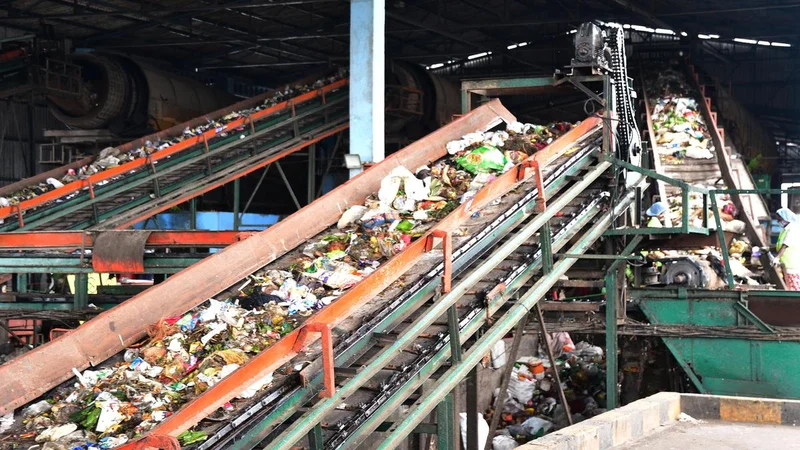
The Central Pollution Control Board (CPCB), in a report submitted to the National Green Tribunal (NGT), has flagged significant gaps in solid waste management in Coimbatore.
The CPCB prepared the report after its inspection of the Vellalore dumpyard and solid waste processing facilities in February. The inspection was carried out on the directions of the NGT in a suo motu case initiated after a fire broke out at the dumpyard in April 2024.
According to the report, Coimbatore city generates around 1,293 tonnes of solid waste a day. This includes about 795 tonnes of wet waste and 455 tonnes of dry waste, while animal waste, street sweepings and sanitary waste account for the remaining quantity.
The Coimbatore Corporation has decentralised facilities such as Micro Composting Centres (MCCs), Material Recovery Facilities (MRFs) and Dry Waste Centres (DWCs), besides integrated processing facilities at the Vellalore site.
Wet waste is processed through windrow composting, vermicomposting and MCCs. The windrow composting plant has a design capacity of 600 tonnes per day (TPD) and an operational/utilisation capacity of 460 TPD. The vermicomposting plant has a design capacity of 100 TPD, of which 47 TPD was being utilised. The MCCs have a combined design capacity of 97.6 TPD, with only 32.2 to 36 TPD being utilised.
For dry waste, the RDF (Refuse-Derived Fuel) and recyclables processing plant has a design capacity of 340 TPD and an operational/utilisation capacity of 274.5 TPD. Dry waste from bulk waste generators is also handled through MRFs/DWCs, which have a combined design capacity of 77 TPD, with 49 to 59 TPD being utilised.
The CPCB noted that the city generates about 455 TPD of dry waste, against a total processing capacity of 417 TPD, while the operational/utilisation capacity was only 333.5 TPD. In the case of wet waste, generation was about 795 TPD, against a designed processing capacity of 747 TPD, while the operational/utilisation capacity was only 593.6 TPD.
Thus, while the gap between waste generation and the designed processing capacity was 38 TPD for dry waste and 48 TPD for wet waste, the gap was much higher when actual utilisation was considered — 121.5 TPD for dry waste and 201.4 TPD for wet waste. The CPCB termed the quantities corresponding to these gaps as “unaccountable.”
The report also observed that several decentralised processing facilities were either non-operational or under-utilised. At the time of inspection, 10 MCCs and 16 MRFs/DWCs were found to be in operation.
The CPCB report was placed before the NGT at the hearing on August 5. The case has been posted for further hearing on September 2, 2026.
Published - August 08, 2026 06:53 pm IST